
Professor Ann Kumar Southeast Asian Civilisation Archive
The Ethical Policy and the Limits of Colonial Reform
Moral debt, welfare reform and the contradictions of Dutch rule in the early twentieth-century Netherlands Indies.
This focused teaching page draws from the second half of Professor Kumar’s Lecture II. It examines the Ethical Policy: the Dutch attempt, around 1900, to recast colonial rule as a moral and developmental project. The policy promised welfare, education, decentralisation and administrative reform. Yet Professor Kumar’s account makes clear that these reforms remained constrained by private enterprise, racial hierarchy, limited political participation and the deeper realities of colonial control.
Key Idea
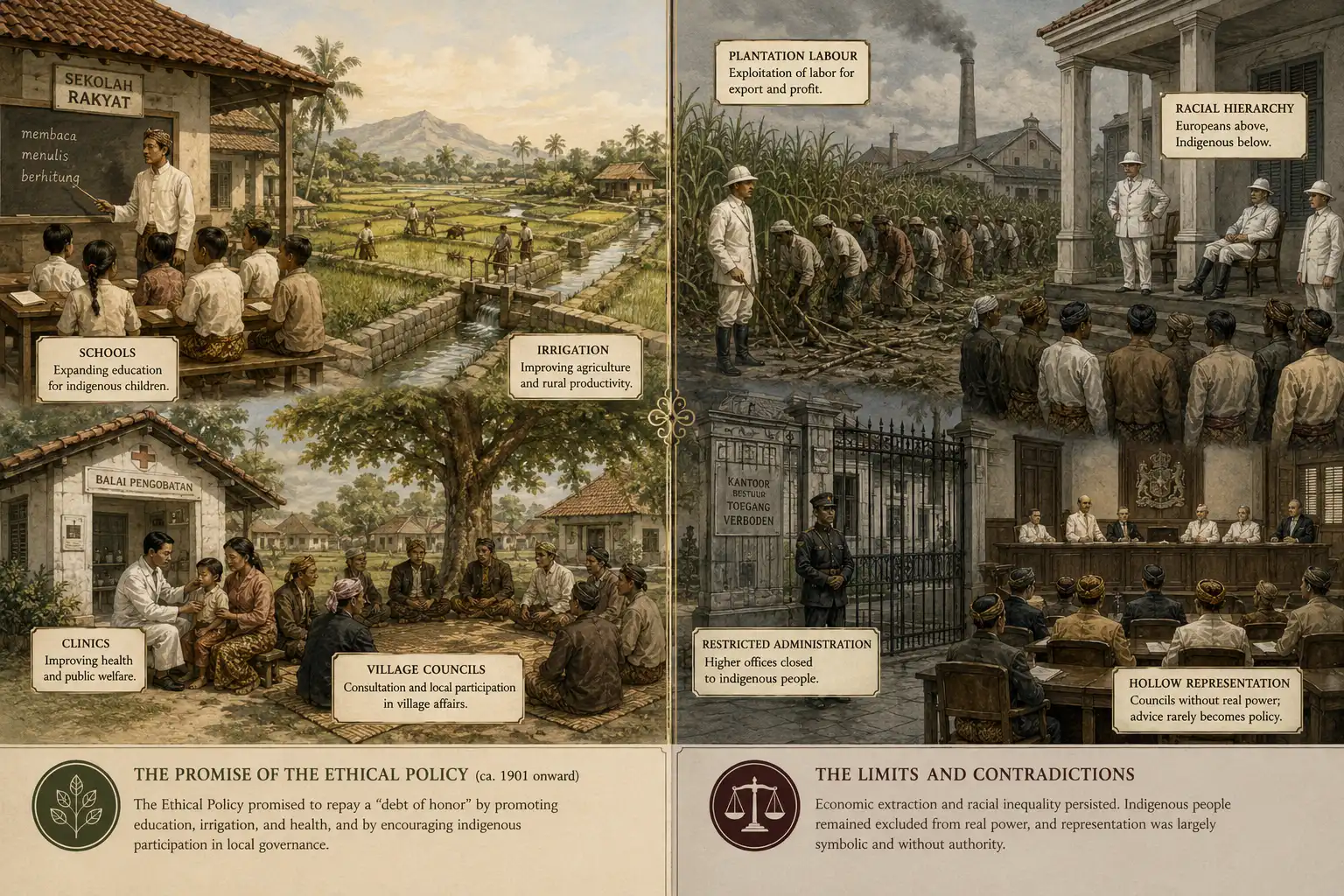
The Ethical Policy was a genuine rethinking of Dutch colonial responsibility, but it remained trapped inside colonial assumptions. It promised welfare, education and political training, yet avoided the structural reforms needed to give Indonesians real power. Its contradiction was simple: it taught modern political ideas while refusing colonial subjects the substance of political equality.
A New Moral Language for Colonial Rule
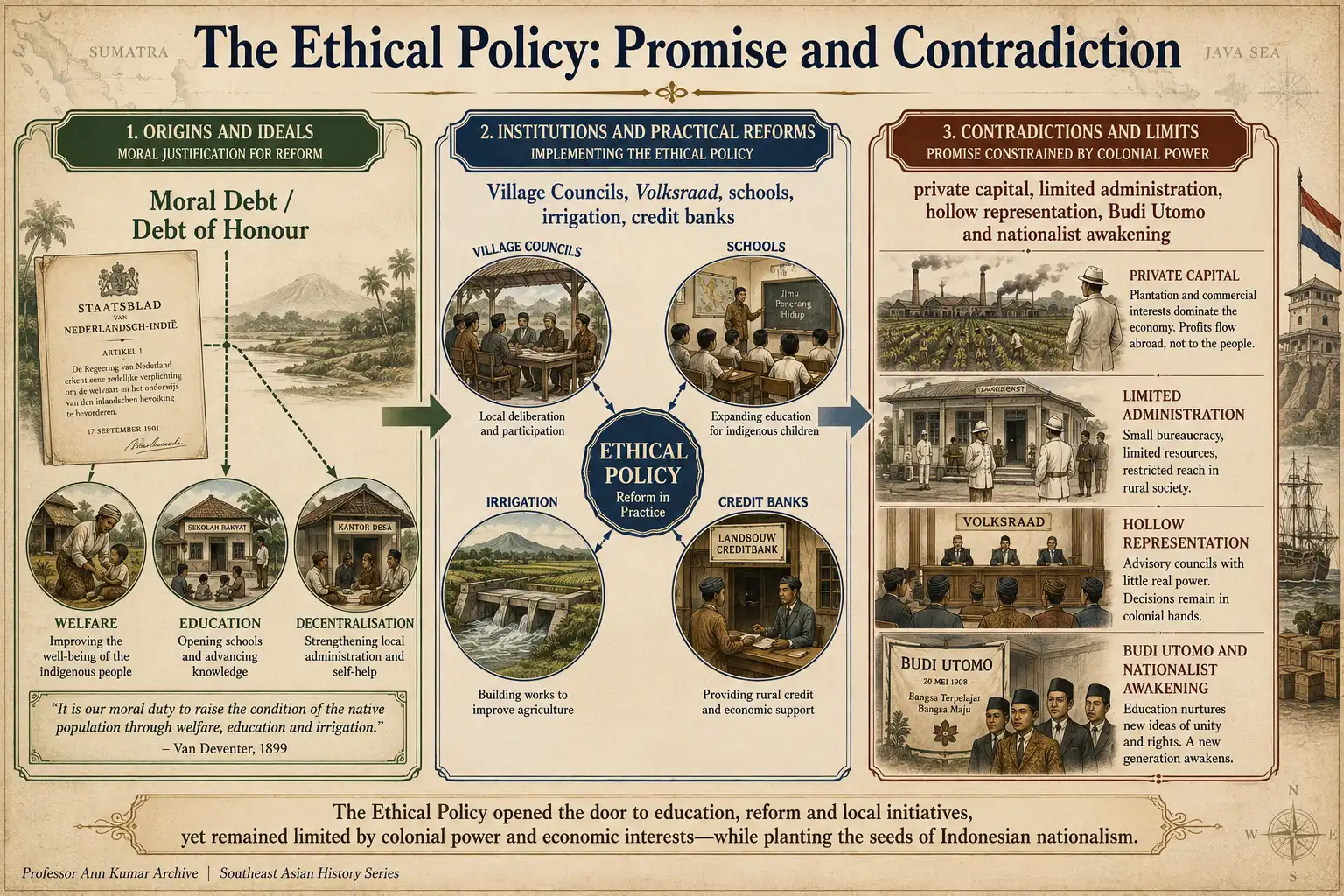
Professor Kumar introduces the Ethical Policy as the next major rethinking in Dutch colonial policy after the Liberal Period. Like the Liberal Period before it, the Ethical Policy got under way through influential writing. The first key text was C. Th. van Deventer’s article “A Debt of Honour,” published in 1899.
Van Deventer argued that the Netherlands had drawn immense wealth from the East Indies and that this created a moral debt. Between 1867 and 1878, he claimed, the Netherlands had taken 187 million guilders from the colony. This sum, he argued, formed a “debt of honour” that had to be repaid.
Brooshooft and the Ethical Trend
The second important text was P. Brooshooft’s brochure, The Ethical Trend in Colonial Policy, published in 1901. It gave the movement its name. Brooshooft argued that, in the name of free enterprise, European planters had seized the best land and worked it for their own profit.
He described impoverished Indonesians being driven into factories for slave wages and pointed to inequality throughout the colonial system: in administration, in pay, in law courts and in everyday political life. The language of the Ethical Policy therefore began in moral criticism of the Liberal Period’s plantation capitalism.
The Welfare Crisis in Java
The calls for reform were reinforced by economic crisis in Indonesia at the turn of the century. The Dutch government appointed a commission into the diminishing welfare of the people of Java. The commission found that population growth had outpaced agricultural resources and available capital.
It recommended measures such as the development of native industry to supplement agricultural income. Yet the Dutch government did not fully accept Van Deventer’s argument that it owed repayment for previous extraction. Instead, it agreed to take over the colony’s debt, which was itself substantial.
The Dream of a Dutch–Indian Society
Professor Kumar asks what the advocates of the Ethical Policy actually wanted. Some spoke of creating an entirely new society: a “Dutch–Indian Society” that would be neither simply Dutch nor simply Javanese, but a blend of the two.
Yet this vision was ambiguous from the beginning. Was it to be achieved by assimilating Indonesians to Western civilisation? Or by allowing diverse cultural traditions to coexist inside a single political entity? Both ideas had supporters, and the policy never fully resolved the tension between assimilation and pluralism.
Decentralisation and the Village
Politically and administratively, Ethical Policy reformers supported decentralisation. During the Liberal Period, the penetration of Western economy and institutions had weakened the village. Reformers now wanted to strengthen it again, partly as a training ground for parliamentary democracy.
The Village Act of 1906 aimed to convert the Indonesian village into something like a Western municipality, with a Village Council empowered to administer village affairs, including property and land. Yet Professor Kumar notes that this did not always become genuinely democratic. The forms were followed, but many resolutions originated in suggestions made by Dutch officials.
Provincial Councils, Regency Councils and the Volksraad
The reformers did not stop at the village level. Councils were established at higher levels. Above the Village Councils stood Provincial Councils and Regency Councils. At the apex was the Volksraad, or People’s Council, established in 1918.
This broader system of government and administration further weakened the old political influence of the Javanese regents. Members of the Regency Councils were often better educated and more adept in quasi-democratic procedure than the regents themselves, though they could not become regents because the hereditary principle was retained.
Welfare Branches and Administrative Energy
Under the Ethical Policy, there was also enormous growth in specialised branches of government concerned with native welfare. These included irrigation, rural credit banks, clinics, agricultural extension programmes and village schools.
The officials responsible for these reforms often bypassed the regents in their eagerness to get things done. Professor Kumar notes the Dutch reputation for administrative efficiency. The Ethical Policy therefore strengthened the practical reach of the colonial bureaucracy even while claiming to strengthen Indonesian welfare.
Snouck Hurgronje and Western Education
On the cultural side, many Ethical Policy reformers — especially Snouck Hurgronje — believed that neither Islam nor traditional law and custom, or adat, would be sufficient guides for Indonesians in the modern world. Western education was therefore essential.
Snouck argued that education was only the first step. It would need to be followed by the political and administrative education of the Indonesian elite. He warned that time was running out. Professor Kumar cites Benda’s judgement that Snouck foresaw the eventual demise of colonialism more clearly than almost anyone else, and stood almost alone in pressing for higher education, association with Dutch culture and the rapid Indonesianisation of colonial administration.
Education: Progress, but Not Enough
The Dutch did make progress in education, but Professor Kumar emphasises its limits. At the beginning of the Second World War, literacy in the Indies remained only 6.5 per cent. The Ethical Policy’s educational ambitions were therefore far larger than its achievements.
This limited progress mattered because education was the one reform most likely to produce political consequences. A small educated elite could read Dutch liberal ideals, administrative theory and ideas of representation, then compare them with the realities of colonial exclusion.
The Weakness of Ethical Reform
Professor Kumar’s assessment of the Ethical Policy is unsentimental. One weakness of the movement was that reformers, however benevolent, believed too readily that vested interests would sacrifice profit for native welfare.
From the beginning, reformist enthusiasm was checked by Western private enterprise. This was especially clear in the matter of native industry, which would have created competition for European business. Legge judged that the economic measures of the Ethical Policy were mostly palliatives to relieve particular areas of hardship, rather than measures of genuine structural change.
Dutch Capital and the Plantation Economy
The limited reforms were offset by the continuing effects of Dutch capital and the plantation economy that had begun under the Liberal Period. Banks, communications and transport grew, but so did urban migration and slums.
The plantation system also contributed to the breakdown of village society. Professor Kumar notes Boeke’s conclusion, based on inquiries in 1904 and 1906, that the peasant was rather worse off than before the first Ethical reforms, despite all the benevolent activity on his behalf.
The Contradiction of Colonial Democracy
Van Deventer once described the goal as the formation of a social entity in the Far East that would be indebted to the Netherlands for its prosperity and higher culture, and would gratefully recognise that fact. Professor Kumar’s response is dry and pointed: prosperity had not really accompanied Dutch civilisation, and Indonesians did not feel terribly grateful.
The Dutch also failed to open the middle and senior ranks of administration to Indonesians. This created a contradiction between the democratic ideas Indonesians encountered through Western education and the realities of colonial practice. The colony taught political modernity while withholding political equality.
Budi Utomo and the Political Consequences of Reform
The first Indonesian response to the Ethical Policy spirit was Budi Utomo in 1908. Based on a fusion of Dutch and Javanese ideas, it initially seemed to confirm reformist hopes that an educated Indonesian elite might participate in colonial modernisation without challenging Dutch authority too directly.
But Budi Utomo was soon followed by political organisations that demanded complete independence. The Ethical Policy had helped create the conditions for political mobilisation, but it could not contain the consequences of the consciousness it helped awaken.
“Too Much, Too Soon” — or “Too Little, Too Late”?
The Communist revolts of 1926–27 in West Java and Sumatra were, in Professor Kumar’s account, the death blow to the Ethical system. Conservative colonial opinion claimed that reformers had disrupted traditional Indonesian society by modernising it too quickly.
Benda’s response was different. The Ethical Policy was not the real cause of radicalisation; the deeper cause was the disruptive intrusion of Western economic and social forces from the Liberal Period onwards. The conservative accusation of “too much, too soon” was less persuasive than the judgement that reform had been “too little, too late.”
Form and Substance
The Ethical Policy was never officially abandoned, but its institutions underwent a subtle change. The Volksraad remained, but it was drawn largely from the orthodox elite and was therefore relatively pro-Dutch.
Legge’s phrase “form and substance” captures the problem. The outward form of modern representative procedure existed, but its substance was hollow. This gap between political procedure and colonial reality paralleled the wider contradiction of the late colonial state.
Return to Conservative Rule
After the failures and shocks of the 1920s, the Dutch returned to older habits: supporting the regents and priyayi on Java and adat chiefs elsewhere. This conservatism was reinforced by the Leiden Adat Law School under Van Vollenhoven, whose scholarly respect for customary law could be used by conservatives for their own ends.
In this final irony, respect for adat could become a way to hold Indonesians inside “traditional” structures while limiting modern political participation. The Ethical Policy’s reformist energy was absorbed back into colonial control.
This Page in the Archive’s Larger Argument
The Ethical Policy belongs in the Nationalist Awakening Hub because it helps explain the conditions under which modern Indonesian political consciousness developed. Dutch reformers sought to educate, administer and improve colonial society without surrendering colonial power. The result was contradiction.
Education produced expectation. Councils produced the language of representation. Welfare bureaucracy exposed the limits of benevolence. Private capital continued to dominate. Indonesian elites learned the vocabulary of modern political life while remaining excluded from real authority. In Professor Kumar’s account, the Ethical Policy did not prevent nationalism; it helped make nationalism thinkable.
Map / Diagram / Visual Context
Why This Lecture Matters
The Ethical Policy matters because it marks the moment when Dutch colonial rule tried to justify itself as moral reform. Yet its own reforms created new political expectations. Professor Kumar shows that the policy failed not simply because it was hypocritical, but because it could not resolve the contradiction between colonial benevolence and colonial power. It was, in Benda’s phrase, too little, too late.
Further Reading
- C. Th. van Deventer, “A Debt of Honour” / “Een Eereschuld” (1899).
- P. Brooshooft, The Ethical Trend in Colonial Policy (1901).
- Harry J. Benda, The Crescent and the Rising Sun.
- J. D. Legge, Indonesia.
- Christiaan Snouck Hurgronje, writings on Islam, education and Dutch colonial policy.
- Further readings on Budi Utomo, the Volksraad, the Leiden Adat Law School and the 1926–27 Communist revolts should be added when the archive bibliography is finalised.