Professor Ann Kumar Southeast Asian Civilisation Archive
The Colonial Engine
VOC monopoly, maritime violence, treaties, extraction, forced cultivation and the transformation of Southeast Asian worlds into colonial systems.
Hub: The Colonial EngineArchive role: Trade, monopoly, coercion and colonial transformationRelated hubs: The Framework · Indigenous Sovereignty · Nationalist Awakening
The Colonial Engine Hub traces how European trading power became territorial and administrative power. Professor Kumar’s lectures show the Dutch East India Company not simply as a commercial organisation, but as a force increasingly drawn into warfare, alliance, monopoly, treaty-making, debt, forced production and political intervention. The hub follows this process from the seventeenth-century VOC through the post-VOC Dutch state, the Culture System and the rise of plantation capitalism.
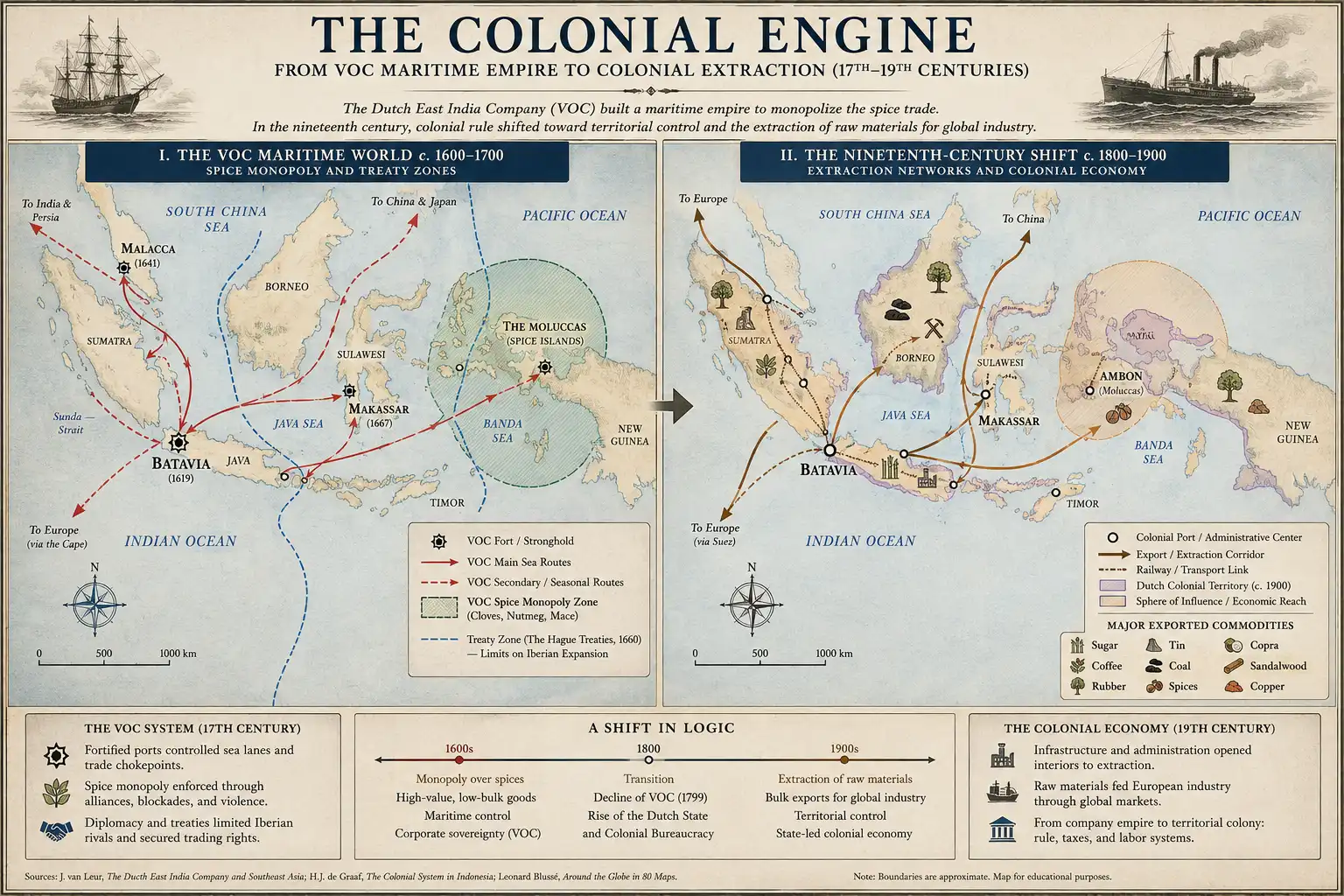
A map of the VOC maritime world showing Batavia, the Moluccas, Makassar, Java, shipping routes, spice monopolies, treaty zones and later nineteenth-century extraction networks.
This hub makes visible the transformation from maritime trade to coercive monopoly, territorial rule, forced cultivation and plantation capitalism.
Key Idea
Dutch colonial power did not arrive fully formed. It grew through the logic of monopoly. The VOC sought control over trade, but trade required forts, treaties, naval violence, local alliances, political intervention and eventually territorial administration. The Colonial Engine Hub follows that process as it hardened into systems of extraction.
Lectures in This Hub
These lectures trace the development of Dutch and European power from seventeenth-century commercial strategy to nineteenth-century systems of forced cultivation and plantation capitalism.
The VOC entered Southeast Asia as a trading company, but the pursuit of monopoly pushed it into military coercion, treaty-making and political intervention.
A focused teaching page on the Moluccas as a testing ground for VOC monopoly, violence, religious conflict, hongi patrols and the social cost of spice control.
Makassar’s free-port world challenged Dutch monopoly until war, alliance and the Bongaya settlement reshaped South Sulawesi politics and regional trade.
This lecture follows the transition from VOC collapse to Dutch state colonialism, administrative reform, the Java War and the forced-cultivation regime.
The dismantling of forced cultivation did not end extraction. It opened the way to private capital, plantation expansion and new colonial inequalities.
The lectures in this hub show how commercial ambition became institutionalised colonial power.
Monopoly and Violence
VOC strategy depended on controlling supply, eliminating rivals, restricting local trade and using naval and military force where commercial persuasion failed.
Trade Becomes Territory
A company founded for trade gradually became entangled in forts, ports, treaties, taxation, political succession and territorial administration.
Local Alliances
Dutch power often grew through intervention in existing Southeast Asian rivalries rather than through simple conquest from outside.
Debt and Dependency
Assistance to local rulers often produced debt, concessions, monopolies and growing Dutch leverage over political decision-making.
Forced Production
The Culture System shows how colonial power could turn land, labour and village administration into instruments of export production.
Capitalist Transition
The Liberal Period shifted extraction from forced state cultivation toward private plantation capital, but not toward equality or freedom.
Why This Hub Matters
The Colonial Engine Hub is essential because it explains how colonialism worked as a system. Professor Kumar’s lectures do not present Dutch rule as a single moment of conquest. They show a long transformation: trade into monopoly, monopoly into coercion, coercion into political intervention, intervention into territorial authority, and territorial authority into systems of forced and capitalist extraction. This hub provides the machinery behind many of the later crises of reform, resistance and nationalism.
Pathways from This Hub
The Colonial Engine lectures connect backward to indigenous political worlds and forward to the social transformations that produced nationalist awakening.
Later enrichment pages could draw together the VOC as a system of monopoly, the Moluccan spice world, Makassar as a free port, Java’s Culture System, and the transition from state extraction to plantation capitalism. A visual “Colonial Engine” diagram would be especially valuable for this hub.