
Professor Ann Kumar Southeast Asian Civilisation Archive
The Framework
Conceptual foundations for reading Southeast Asian civilisation: cores, zones, Islam, regional movement and historical method.
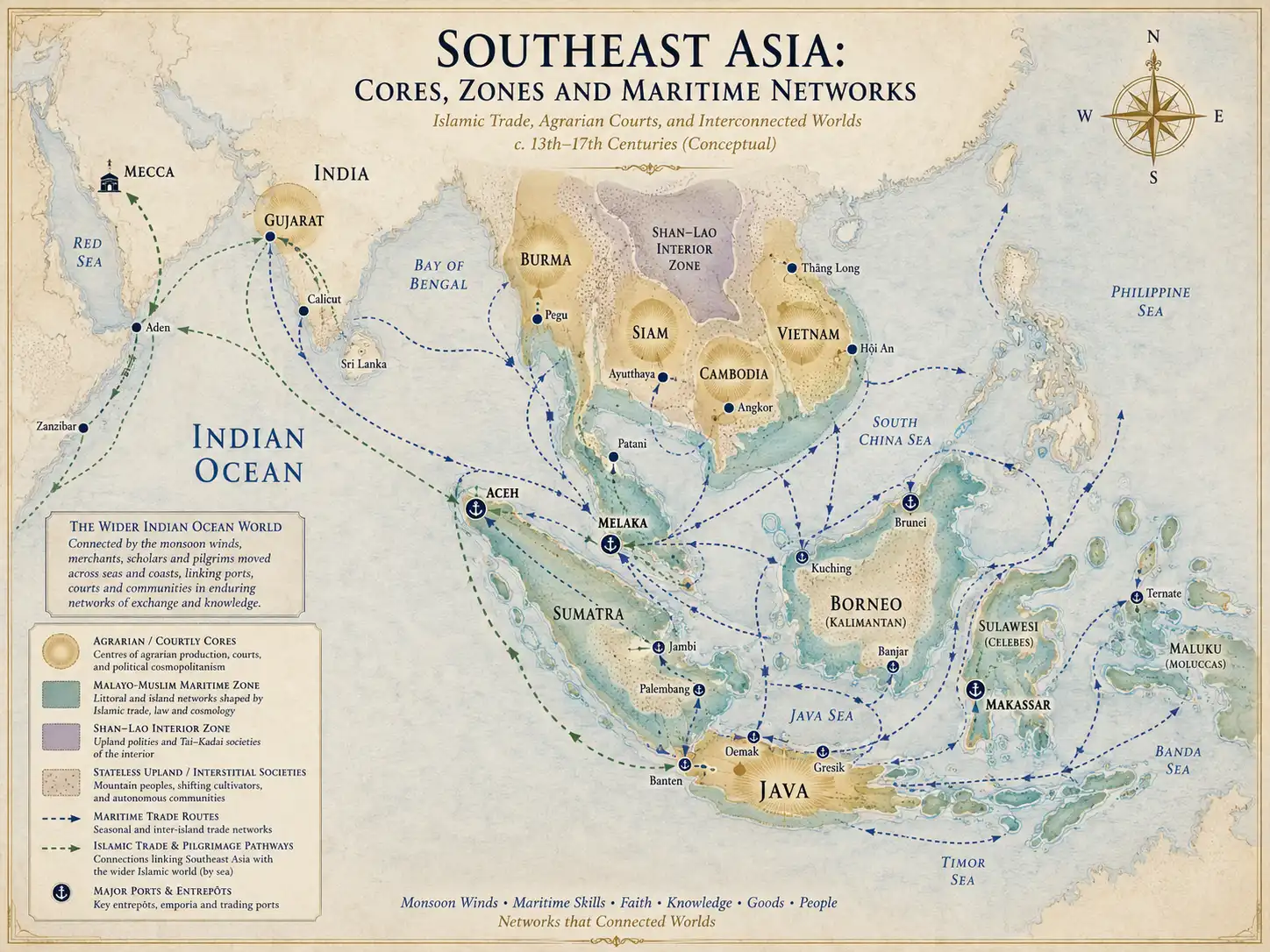
The Framework Hub introduces the large interpretive ideas that organise the archive. Professor Kumar’s lectures do not treat Southeast Asia as a passive region acted upon by outsiders. They ask how regional worlds worked from within: how political cores and frontier zones interacted, how trade and religion moved across maritime space, and how Islam became a force of law, scholarship, statecraft and social transformation before entering the Malay-Indonesian world.
Key Idea
Southeast Asian history is best understood through movement, relationship and layered political worlds: agrarian cores, maritime zones, local sovereignties, religious networks, trading systems and colonial intrusions. The Framework lectures provide the interpretive tools needed to read the rest of the archive.
Lectures in This Hub
These lectures introduce the archive’s core concepts. They should be read before, or alongside, the more detailed studies of Aceh, Mataram, South Celebes, the VOC and Indonesian nationalism.
Indonesian Cores and Zones
John Smail’s model of cores and zones provides a way of understanding Indonesian historical geography, regional difference, political development and the relationship between centres and margins.
Open lectureIslam as a Historical Force
Islam is introduced as a world-shaping civilisation of law, politics, trade, scholarship and mysticism before its Southeast Asian transformations in Aceh, Java, Makassar and the Malay world.
Open lectureKey Themes
The Framework Hub provides the vocabulary and conceptual structure for the rest of the archive.
Cores and Zones
The archive repeatedly asks how political and cultural cores related to frontier zones, coastal regions, maritime networks and areas of looser authority.
Movement Across Maritime Space
Trade, pilgrimage, scholarship, warfare and migration moved people and ideas through the archipelago long before European power became dominant.
Islam as Civilisational Force
Islam appears not only as belief, but as law, textual culture, mysticism, commercial network, royal ideology and social organisation.
Historical Method
Professor Kumar’s lectures encourage students to think comparatively and structurally, rather than treating European arrival as the beginning of Southeast Asian history.
Local Political Worlds
The Framework prepares readers to understand Javanese courts, Acehnese sultanate politics, Buginese kingship and Malay aristocratic society on their own terms.
From Concept to Case Study
The concepts introduced here return throughout the archive in the studies of Mataram, Aceh, South Celebes, the VOC, Dipanagara and nationalism.
Why This Hub Matters
The Framework Hub prevents the archive from becoming a simple chronological list of lectures. It gives visitors a way of reading the whole project: Southeast Asia as a region of interacting civilisations, local sovereignties, maritime systems, religious networks and historical transformations. It also establishes the archive’s central principle: Indigenous, Islamic and regional histories must be understood before colonial power can be properly interpreted.
Pathways from This Hub
Once readers have entered through the Framework, they can move into the three larger thematic pathways of the archive.
Archive Note
Original lecture scans, clean transcripts, summaries and bibliographic supplements will be added progressively. At this stage, this hub acts as a curated interpretive entrance to the Framework lectures and their role in the wider archive.