
Professor Ann Kumar Southeast Asian Civilisation Archive
Islam as a Historical Force
How Islam emerged as a world-shaping civilisation of law, politics, trade, scholarship and mysticism before entering the Southeast Asian world.
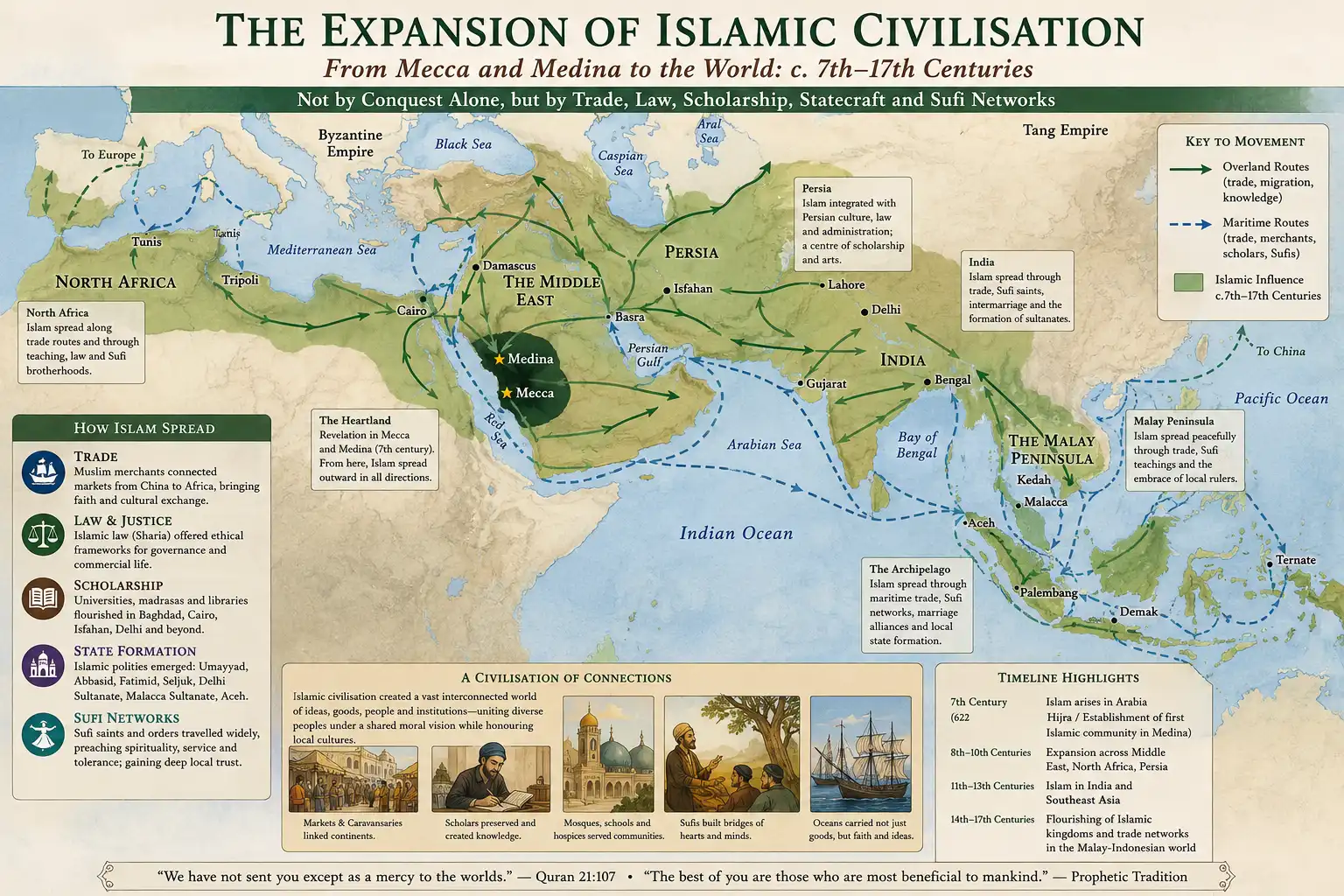
This lecture introduces Islam not simply as a religion, but as one of the great historical forces that periodically reconstructed the political and intellectual life of Southeast Asia. Professor Kumar begins well before the arrival of Islam in the Indonesian and Malay worlds. She first traces Islam’s emergence in Arabia, its rapid expansion across Western Asia, North Africa, Persia, India and beyond, and the development of Islamic law, statecraft, scholarship and mysticism. Only with that larger history in view can the role of Islam in Southeast Asia be properly understood.
Key Idea
Professor Kumar presents Islam as a historical force in the fullest sense: a religion, a legal order, a political community, a literary and intellectual civilisation, and a network of traders, scholars and mystics. In Southeast Asia, Islam did not arrive as a single event or through a single channel. Its power lay in its capacity to reshape existing societies while also entering into tension with older adat, Hindu-Buddhist and local political traditions.
Islam and the Problem of Historical Explanation
Professor Kumar opens by comparing Islamisation with the earlier “Hinduisation” of Southeast Asia. In both cases, scholars have often argued from limited evidence and large theoretical possibilities. Was a civilisation brought by conquest, by peaceful traders, by learned specialists, or by religious figures? In the case of Indian civilisation, the agents might be warriors, merchants or Brahman intellectuals. In the case of Islam, comparable roles have often been assigned to traders, rulers, scholars and Sufis.
The lecture’s first task is therefore methodological. Before asking how Islam shaped Southeast Asia, Professor Kumar asks what sort of historical force Islam had already become. It was not enough to treat Islam as an imported doctrine. By the time it entered the Malay-Indonesian world in historically significant ways, Islam had already become a vast civilisation: juridical, commercial, imperial, scholarly and mystical.
Mecca, Muhammad and the Urban Origins of Islam
The lecture begins its historical account by correcting an older simplification: the idea that monotheism was somehow the “natural religion of the desert.” Muhammad was not presented as a nomadic Bedouin prophet arising from an empty wilderness, but as a man born into an urban and commercial environment.
Mecca, at the traditional date of Muhammad’s birth in 570 AD, was already a wealthy commercial centre. It held an important position in the entrepôt trade between the Indian Ocean and the Mediterranean. It was also a centre of pilgrimage, built around the Ka‘bah, whose sanctuary drew people from across Arabia. Commerce, pilgrimage and political influence were therefore present from the beginning.
Muhammad belonged to the Quraysh family. Orphaned early, he was brought up first by his grandfather and then by his paternal uncle. He worked for a time in the caravan trade, married a wealthy widow, and later began meditating in a cave on Mount Hira outside Mecca. In 610 he began to receive revelations, traditionally from the archangel Gabriel. These revelations, taken together, would form the surahs of the Qur’an.
From Preaching to Persecution
Muhammad’s preaching called his fellow citizens to repentance before divine judgement. Yet after ten years of labour in Mecca, he had gathered only a small group of followers. He had also provoked contempt, ridicule and eventually persecution.
Professor Kumar stresses that this opposition was not only religious conservatism. Meccan leaders feared that Muhammad’s teaching would produce political change and damage the economic interests of the city. The Ka‘bah, dedicated to a pantheon of deities, was a centre of pilgrimage and therefore a source of revenue. A movement attacking the religious order of Mecca also threatened its commercial order.
The Hijra and the Making of a Political Community
Support came from Medina, a city north of Mecca troubled by prolonged conflict between rival Arab tribes. Exhausted by internal struggle, representatives from Medina invited Muhammad to come as a mediator. This invitation suggests that his reputation as a man of spiritual stature and worldly wisdom was already considerable.
After negotiations to secure the safety of himself and his followers, Muhammad left Mecca secretly in 622. This migration to Medina is known as the Hijra, and the year 622 became the first year of the Muslim era.
In Medina, the Muslim community took on a definite political form under a single leader. Professor Kumar emphasises that Muhammad did not imagine the believers merely as a church-like group living under some separate secular state. The Muslims — “those who submit” to God — were to order their entire life according to divine direction.
Medina, Mecca and the Survival of the Islamic Polity
Once established in Medina, the Islamic community faced two immediate tasks: internal consolidation and the bringing of Mecca within the fold. As long as Mecca remained hostile, the Medina community was not secure.
Mecca was subdued through a combination of military strategy and negotiation. Medina sat across Mecca’s northern trade routes, allowing Muslim forces to threaten caravan traffic. In 630, Muhammad was able to re-enter the city of his birth in triumph.
Only two years remained before Muhammad’s death. Professor Kumar emphasises the extraordinary historical fact that Islam not only survived its founder, but gathered adherents into an explosive dynamism that transformed the power structure of the Middle East almost immediately.
The Caliphate and the Problem of Succession
After Muhammad’s death, there were competing claims to the authority — both temporal and spiritual — that he had wielded. What is remarkable, Professor Kumar observes, is that the movement survived at all in a society divided by clan and regional jealousies.
Abu Bakr was elected Muhammad’s successor, or Caliph, inaugurating the period known to Muslims as the Orthodox Caliphate. This period lasted from 632 to 661 and included Abu Bakr, Umar, Uthman and Ali. The political authority of these early caliphs was far from stable; all except Abu Bakr met violent deaths.
After the murder of Ali, Muhammad’s son-in-law, the political centre of Islam shifted from Arabia to Syria under the Umayyad Caliphate. Veneration of Ali’s descendants later contributed to the growth of Shi‘ism, especially associated with Persia and with later communities such as the followers of the Aga Khan.
Expansion Without Simple Conversion by the Sword
The early Muslim armies expanded with extraordinary speed. Within a few years of Muhammad’s death, Syria, Iraq, Persia and Egypt had come under Muslim control, and campaigns eventually reached across North Africa and into the Iberian Peninsula.
Professor Kumar is careful not to reduce this to a crude picture of forced conversion. The Muslim armies were conscious of moral superiority over peoples they considered heathen or infidel, but Muslim dominion at first often meant little more to conquered populations than a change of masters. Existing traditions and social institutions were frequently left in place.
Over time, however, a deeper integration of peoples and cultures occurred. Arab elements penetrated older Hellenistic and Persian cultures, and the Arab colonies became centres from which the new religion was propagated. The process was neither simple destruction nor passive adoption, but the building of a new civilisation across older cultural worlds.
Umayyads, Abbasids and the Intellectual Life of Islam
The Umayyad Caliphate, centred on Damascus, brought Islam into contact with the Hellenistic traditions of the Eastern Roman world. This enriched Islamic civilisation but also contributed to tensions between religious and secular institutions, and to the rise of sects and heresies that weakened Umayyad authority.
The Abbasid Caliphate, centred on Baghdad, followed from 750. By this time the first great age of external conquest had given way to an age of internal development. The sciences of mathematics, astronomy, medicine, navigation and natural observation flourished. Greek logic and philosophy also entered Islamic intellectual life, though these posed more serious challenges to religious orthodoxy.
Professor Kumar avoids drawing too dark a picture of orthodoxy. Islamic civilisation saw many periods of great creativity, including in Muslim Spain. But she also notes that the effort to subordinate all intellectual activity to religious authority could restrict some branches of inquiry.
Law as the Central Force of Islamic Civilisation
The religious science that came to occupy the most prominent place was not theology, but law. Professor Kumar stresses that Muslim law went far deeper than Roman law because it embraced all life, both human and divine.
Islamic law was one of the most powerful agents in moulding the social and community life of Muslim peoples. Because of its comprehensiveness, it exerted steady pressure on individual and social behaviour, setting a standard to which communities increasingly conformed despite resistance from older laws and customs.
This point matters directly for Southeast Asia. When Islam entered Indonesian and Malay societies, it entered places already shaped by Hindu-Buddhist concepts, court traditions and especially adat, or customary law. The encounter between Islamic law and adat would become one of the central themes of Islamic Southeast Asian history.
Turkish Power and the Muslim Entry into India
By the end of the tenth century, Islamic civilisation had built up a rich intellectual and commercial world bound together by law, but it also suffered the kind of military decline that older empires had experienced. Turkish tribes from Central Asia penetrated the settled lands of Persia and Iraq.
The establishment of Turkish sultanates in Western Asia led to a renewed wave of military expansion, including into India. This Indian connection is particularly important for Southeast Asia because much of the later Islamic influence on the Malay-Indonesian world passed through Indian and Indian Ocean channels.
Mahmud of Ghazni began raiding northern India in the early eleventh century. His campaigns brought plunder and limited annexation, but not a stable conquest of all India. Later, Muhammad of Ghor and his generals established more durable Muslim power, leading to the Delhi Sultanate after 1206.
From this point until the eighteenth century, Muslim rulers dominated much of northern India. Southern India remained under Hindu kingdoms for longer, with Vijayanagara emerging in 1336 as a powerful Hindu kingdom in the Deccan and south. The eventual defeat of Vijayanagara in 1565 by a coalition of Muslim sultans marked the end of its imperial greatness.
Sufism and the Work of Conversion
Professor Kumar then turns to one of the most important themes for Southeast Asia: Sufism. The incorporation of nomadic and semi-nomadic peoples into Islamic society presented problems that formal law alone could not solve. A new spiritual force had grown within urban Islam.
Sufism gave expression to devotional feeling outside the strict circle of the guardians of the Law. It began as a more personal and informal movement, sometimes opposed by orthodox scholars, but over time organised itself into institutional forms. Mystics, whether as individuals or members of brotherhoods, became leaders in converting pagan and superficially Islamised tribes.
This is especially important for Southeast Asia because many scholars have argued that Sufis played a major role in the spread of Islam through the archipelago. Their flexibility, personal charisma, devotional practices and ability to speak within local spiritual worlds made them powerful agents of religious change.
Sufis, Scholars and Independent Muslim Rulers
The Sufi movement was not fully coordinated with orthodox scholastic organisation. There was no single central religious authority able to bring all branches of Muslim intellectual and devotional life under one discipline. The Caliphate could not be equated with the Papacy; from Umayyad times onward, theologians and legists refused to concede to it the authority to define orthodox dogma.
Independent Muslim rulers often resented interference either from caliphs or from the scholars and legists of Mecca and Medina. Many preferred their own spiritual directors, often Sufis. From about the tenth century onward, Muslim states increasingly diverged from the ideal patterns laid down by theorists and developed courtly ethics of their own, sometimes owing much to non-Arab or non-Islamic traditions.
This tension between ruler, law, scholar and mystic is of great importance for the later Indonesian material. Aceh, Mataram, Banten and other states did not simply “receive Islam.” They negotiated among royal authority, Islamic law, local custom, spiritual charisma and political expediency.
Mongols, Mamluks and Persianate Renewal
The thirteenth and fourteenth centuries brought catastrophe to much of Western Asia. Mongol invasions devastated north-eastern provinces, and in 1258 the historic Caliphate of Baghdad was brought to an end. Much of the eastern Muslim world, except for places such as Egypt, Arabia and Syria, became tributary to the Mongol empire.
Egypt was saved by the Mamluks, a military caste descended from Turkish and Kipchak slaves who seized political power. Under Mamluk rule, the old Arabic Muslim civilisation continued to flourish in the material arts, especially architecture and metalwork, though with some decline in intellectual vigour.
Meanwhile, a revived and in some respects brilliant Muslim civilisation grew within the Mongol dominions. It excelled in architecture, the fine arts and miniature painting, and was spiritually rooted in Sufism. Persian culture became particularly important, shaping the intellectual life of the new Islamic empires growing up in Turkey and India.
Ottoman, Mughal and Later Islamic Worlds
The expansion of the Ottoman Empire in Asia and North Africa, and the establishment of the Mughal Empire in India in the sixteenth century, brought much of the Muslim world once more under powerful, centralised states.
In both empires, there was strong emphasis on orthodoxy and sacred law. Church and state were not unified in a simple sense, since military and civil institutions could be built on independent and even non-Islamic lines. Yet they reinforced each other in a durable alliance that lasted into the modern period.
At the same time, the mystic stream of Muslim life continued to broaden. The seventeenth and early eighteenth centuries saw the apogee of the Sufi brotherhoods. Great orders spread networks of congregations across the Islamic world, while smaller local orders grouped members of different classes and occupations into compact communities.
The Geographical Reach of Islam
Professor Kumar concludes this broad survey by emphasising the extraordinary reach of Islam. By the modern period, Islam had become dominant across a wide belt of territory from North Africa and Western Asia through Persia, Central Asia, parts of China, Pakistan, the Malay Peninsula and the Indonesian archipelago.
It also extended down the western coast of the Indian Ocean into East Africa, and was present in the Balkans, South Russia and other regions. Of all the great religions prior to nineteenth-century Christian missionary expansion, Islam embraced perhaps the greatest diversity of races.
This diversity included Arabs and other Semitic peoples, Persians, Caucasians, Mediterranean Europeans, Slavs, Turks, Tartars, Chinese, Indians, Indonesians, Bantu peoples and West Africans. The lecture therefore positions Islam as a genuinely transregional civilisation before bringing the focus back to Southeast Asia.
Islam and Southeast Asia: The Question Prepared
The lecture does not yet provide a full account of Islamisation in Southeast Asia. Instead, it prepares the ground. By tracing Islam’s earlier history, Professor Kumar establishes the main elements students need to understand before returning to Indonesia and Malaysia: commerce, pilgrimage, law, state formation, Sufi charisma, Indian connections and the tension between Islamic norms and local custom.
The connection to earlier and later archive pages is direct. Aceh appears as a “gate of the Holy Land,” a centre of Islamic scholarship and Malay literary culture. Mataram shows how Islam entered an older Javanese courtly and agrarian world. Banten and Makassar show how Islam could animate maritime trading states. Later nationalist movements, including Sarekat Islam, would draw on the social power and associational reach of Muslim identity.
Map / Diagram / Visual Context
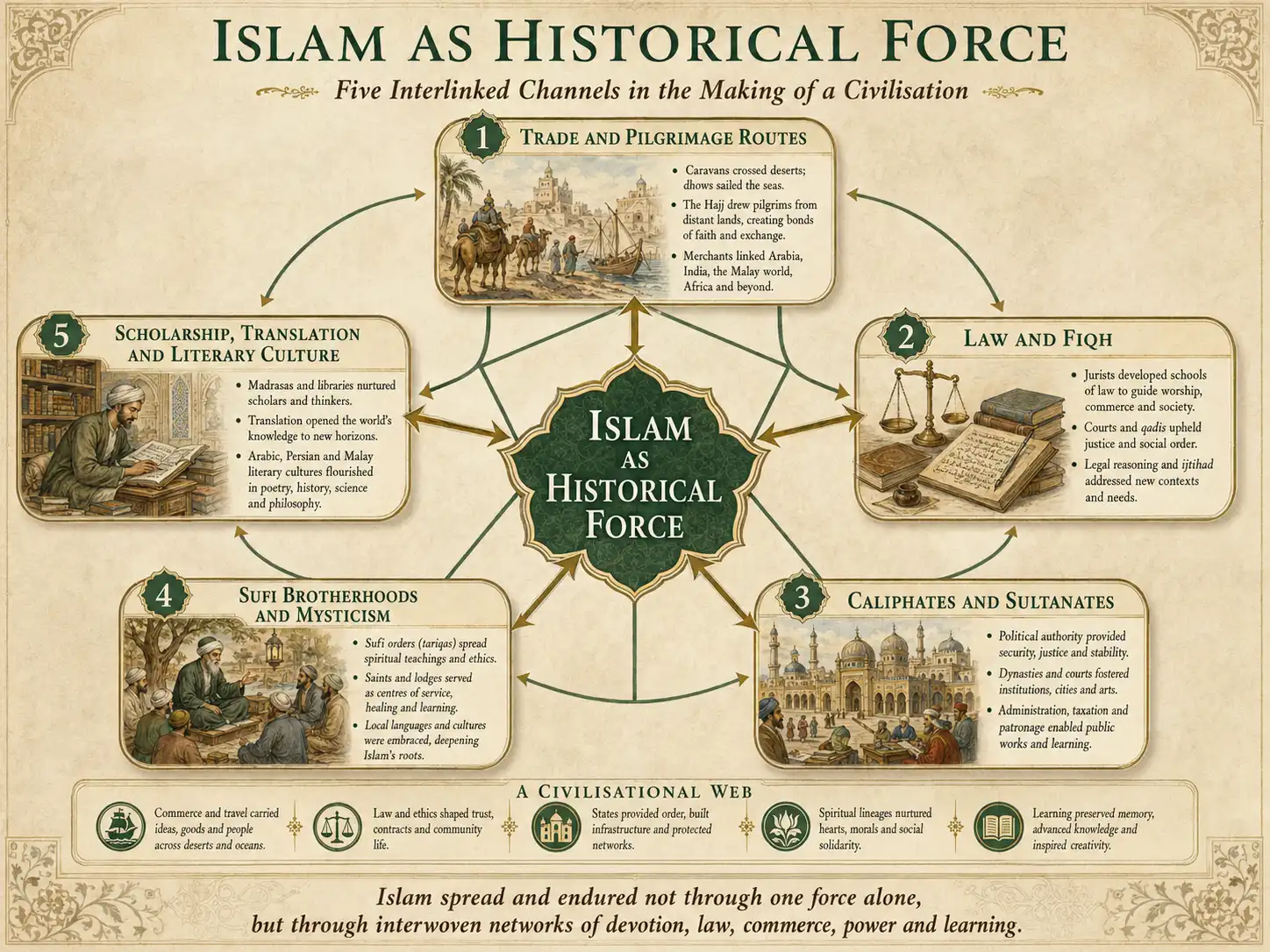
“Islam as Historical Force” — five linked channels: trade and pilgrimage routes; law and fiqh; caliphates and sultanates; Sufi brotherhoods and mysticism; scholarship, translation and literary culture.
Why This Lecture Matters
This lecture matters because it gives the archive its broad Islamic frame. Professor Kumar does not begin with Indonesia in isolation. She first shows Islam as a world civilisation whose legal, political, commercial and mystical forms had been shaped over many centuries before reaching Southeast Asia.
That larger context helps explain why Islam could become such a powerful force in the Malay-Indonesian world. It arrived with traders, scholars, pilgrims, texts, legal ideals, Sufi practices and political models. It could adapt to local societies, but it also pressed them toward new forms of order and identity.
The lecture therefore belongs naturally to The Framework Hub, while cross-linking strongly to Indigenous Sovereignty and Nationalist Awakening. It helps explain Aceh’s Islamic scholarship, Mataram’s Javanese-Islamic syncretism, Banten’s religious learning, Makassar’s Islamisation and the later political force of Islamic association in modern Indonesian nationalism.
Further Reading
- A. J. Arberry, ed., Islam Today, including the chapter on Malaysia by R. O. Winstedt.
- Sir Thomas Arnold, The Preaching of Islam.
- S. M. Ikram, Muslim Civilization in India, especially the chapter on the interaction of Islam and Hinduism.
- Gustave E. von Grunebaum, ed., Unity and Diversity in Muslim Civilization, including G. W. J. Drewes on Indonesia: mysticism and activism.
- A. H. Johns, “Sufism as a Category in Indonesian Literature and History,” Journal of Southeast Asian History, vol. II, no. 2, July 1961.
- G. W. J. Drewes, commentary on new light on the coming of Islam to Indonesia, Bijdragen tot de Taal-, Land- en Volkenkunde, vol. 124, part 4, 1968.