
Professor Ann Kumar Southeast Asian Civilisation Archive
Aceh: Islamic State, Trade and Scholarship
How Aceh became a maritime Islamic power linking trade, monarchy, pilgrimage and Malay-Muslim scholarship across the Indian Ocean world.
This lecture examines Aceh as one of the great Islamic maritime powers of the Indonesian world. Professor Kumar’s concern is not simply with Aceh as a later centre of resistance to Dutch expansion, but with Aceh’s own internal vitality: its rise as a trading state, its experiment in royal absolutism, its turbulent relationship between sultan and merchant elites, and its role as a gateway through which Islamic scholarship, Malay literature and pilgrimage routes connected Sumatra with India, Arabia and the wider Muslim world.
Key Idea
Aceh demonstrates that Southeast Asian sovereignty was not only inland, agrarian or court-centred. It could also be maritime, commercial, Islamic and cosmopolitan. Aceh’s power came from pepper, shipping, pilgrimage, scholarship and its attempt to centralise authority over powerful merchant elites. Its history shows an indigenous state actively shaping its world, rather than merely responding to Europeans.
A Maritime Islamic State
Professor Kumar presents Aceh as one of the major Islamic pasisir states of the Indonesian archipelago. It belonged to the coastal world of ports, merchants, shipping routes and Muslim intellectual exchange, rather than to the inland agrarian core represented by a state such as Mataram.
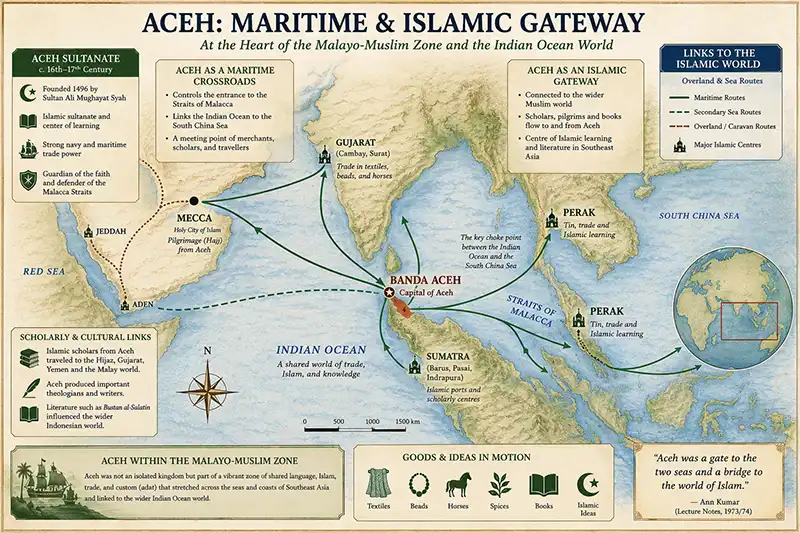
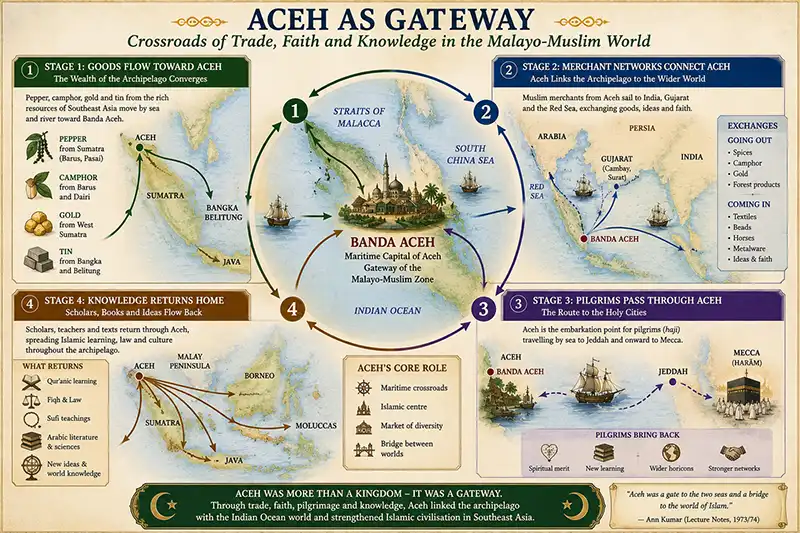
Aceh’s rise was rooted in geography and commerce. Its position at the northern end of Sumatra gave it access to the Straits of Malacca and to the wider Indian Ocean trading world. Its wealth depended especially on commodities such as pepper, camphor and gold from western Sumatra, and tin from the Malay Peninsula. These products linked Aceh to India, the Red Sea and the great markets of the Muslim world.
The state was created in the early sixteenth century under Sultan Ali Mughayat Syah and expanded under Ala’ad-din Ri’ayat Shah al-Kahar. Under these rulers, Aceh became an energetic Muslim power, challenging Portuguese Malacca and attempting to control the movement of trade through its own capital.
Banda Aceh and the Commercial World
Aceh’s capital was a polyglot port. It drew Muslim merchants from different parts of the Indian Ocean and Southeast Asian trading worlds. Malay, rather than Acehnese, became the language of wider communication, reminding us that Aceh’s political and cultural reach extended beyond one local ethnic community.
This is central to Professor Kumar’s wider interpretation. Aceh was not a closed local kingdom suddenly disturbed by Europeans. It was already part of an international Asian world. Merchants, scholars, pilgrims, soldiers, books and religious ideas all passed through it. Europeans entered this system as late and disruptive participants, not as the origin of Aceh’s historical life.
Aceh’s commercial power depended on its ability to channel goods through the capital and prevent rival ports from draining away profit. The sultanate’s relationship with trade was therefore political from the beginning. To command commerce, Aceh had to command ports, producers, merchant groups and regional routes.
The Orangkaya and the Merchant State
A central problem in Aceh’s history was the relationship between the ruler and the powerful merchant aristocracy known as the orangkaya. These were the “rich men” of the capital: commercial magnates whose wealth gave them political force.
Professor Kumar draws on Anthony Reid’s account of Aceh’s political development. In one phase, Aceh flourished as a centre for wealthy merchants, many of them of foreign origin. These merchant-officials had power, resources, armed followings and considerable autonomy. Yet they did not create a stable institutional structure for the state. The result was political volatility, including repeated changes of ruler.
Royal Absolutism and Iskandar Muda
The second major phase in Aceh’s political history was an attempt to impose royal absolutism. In 1589, Ala’ad-din Ri’ayat Shah Sayyid al-Mukammil restored dynastic authority and violently reduced the power of the orangkaya. Houses were destroyed, weapons seized and private fortifications restricted.
This centralising drive reached its height under Iskandar Muda, who ruled from 1607 to 1636. Professor Kumar presents him as the mightiest and most absolute of the Acehnese sultans. He expanded Aceh’s influence through military campaigns in eastern Sumatra and the Malay Peninsula, and he sought to monopolise the flow of export produce through the royal centre.
Iskandar Muda tightened control over the pepper-producing regions of western Sumatra. Governors were changed regularly and called to account. A large proportion of the pepper trade was brought under royal control. Foreign merchants could be forced to buy first from the ruler at high prices before entering the wider market.
The same policy that gave Aceh power also created strain. Iskandar Muda’s centralisation frustrated both European and Muslim merchants. In 1620–1622, the English and Dutch were expelled from Aceh. This episode shows that Aceh was not simply reacting to European pressure; it was actively trying to dictate the terms on which foreign trade could occur.
The State, Law and the Limits of Centralisation
Iskandar Muda also reorganised the ruling class. The old orangkaya were replaced or subordinated to a new political structure in which officials were made responsible for districts and for raising men for the sultan’s wars. Firearms were registered to prevent local magnates from building independent military power.
Professor Kumar notes the striking detail that each orangkaya was required to spend every third night in the palace, unarmed. This meant that a section of the elite was always physically within the ruler’s control. The device reveals both the strength and fragility of royal absolutism: the sultan could command, but he had to keep watch constantly.
Iskandar Muda also codified and enforced a complex legal order. The adat Aceh acknowledged him as its originator, and European observers described distinct courts for debtors, criminal cases, religious matters and disputes among merchants. Yet Professor Kumar is careful not to treat this as a modern bureaucracy. Officials do not appear to have been salaried, and commercial offices remained tied to gift-giving, patronage and royal favour.
Decline and the Return of the Orangkaya
After Iskandar Muda, Aceh’s centralised monarchy weakened. With the Dutch capture of Malacca in 1641 and the decline of royal trade, the orangkaya regained power. Under a succession of queens beginning in 1641, the leading merchant elites became increasingly influential.
The first queen came to the throne because there was no male heir: Iskandar Muda had killed his male heirs, and his son-in-law died early. But the continuation of female rule also suited the merchant oligarchy. A queen could reign while the orangkaya governed.
Later in the seventeenth century, another political force emerged: the territorial aristocracy of the Acehnese interior. This development reflected economic change. As trade declined, rice cultivation in the interior became more important, and power began to move away from the port-capital toward landed authority.
The interior aristocracy opposed the capital regime and demanded a return to male rule. In 1699, they obtained a letter from Mecca declaring female rule contrary to Islam. The fourth sultana was deposed, and an Arab Sayyid dynasty came to the throne. In the eighteenth and early nineteenth centuries, Aceh was repeatedly shaken by conflict between ruler, court, merchants and territorial chiefs.
Aceh as the Gate of the Holy Land
Aceh’s political story cannot be separated from its religious and intellectual role. Professor Kumar describes Aceh as both a major emporium of Muslim trade with India and the Red Sea, and as “the gate of the Holy Land”. Pilgrims from the archipelago travelled through Aceh on their way to Mecca, and some remained there to study before or after pilgrimage.
This role gave Aceh a spiritual authority that reached beyond its territorial borders. It became one of the chief channels through which Islamic learning, legal thought, mystical literature and Malay religious writing moved into Java and other parts of the archipelago.
Hamzah Fansuri and Malay Mysticism
The lecture’s intellectual centre lies in its discussion of Aceh’s scholars and writers. Sultan Iskandar Muda was a patron of Muslim mystics, including Hamzah Fansuri, one of the great figures of Malay mystical literature.
Hamzah’s family seems to have come from Barus in Sumatra, and he may have spent part of his childhood in Siam. Professor Kumar’s notes preserve a famous verse in which Hamzah searches for God from Mecca to Barus and Kudus, only to find the divine presence at last within his own house. The fragment is a compact expression of mystical inwardness and of Aceh’s connection to pilgrimage, Malay poetry and Islamic metaphysics.
Ar-Raniri, Abd al-Rauf and Islamic Scholarship
Under Iskandar Muda’s successor, the most influential scholar was Nur al-Din al-Raniri, a Gujarati scholar who represented a more orthodox reaction against Hamzah Fansuri’s mysticism. At his instigation, the sultan began persecuting teachers of mysticism, and ar-Raniri wrote a refutation of Hamzah’s teachings.
Ar-Raniri’s works included the Bustan al-Salatin, or “Garden of Kings”, a major mirror-for-princes text. Its presence in the lecture is significant because it shows how Aceh was not merely importing Islamic learning, but actively producing political and religious literature in Malay.
The first of the four sultanas, Taj al-‘Alam Safiat al-Din Shah, was the patroness of Abd al-Rauf of Singkel, the renowned orthodox mystic and scholar. Abd al-Rauf studied in Arabia for many years before returning to Aceh, where he wrote legal and religious works and became one of the most venerated figures in Acehnese Islamic memory.
Malay, Literature and the Wider Muslim World
Aceh’s importance was amplified by the role of Malay as a language of Muslim civilisation. Arabic and Persian works entered the region directly or indirectly and were adapted into Malay. These included romances, prophetic tales, wisdom literature and mirrors for rulers.
Professor Kumar’s material mentions the Amir Hamzah romances, Bayan Budiman, Laila and Majnun, Yusuf and Anbiya tales, as well as the Taj as-Salatin and the Bustan al-Salatin. Some of these works were also adapted into Javanese. Aceh therefore stands at a meeting point of trade, pilgrimage, translation, religious debate and political thought.
This is why Aceh belongs so strongly in the Indigenous Sovereignty Hub. Its significance does not lie only in later anti-colonial resistance. It lies in its own self-organising intellectual life: a place where Southeast Asians, Indians, Arabs, Persians, Malays and others participated in a shared Islamic literary world.
Aceh, Mataram and South Celebes
Aceh also works as a comparative case within the archive. Mataram represents an inland Javanese agrarian core shaped by court hierarchy, cosmological kingship and rice-based power. South Celebes offers a model of Buginese contractual kingship, in which ruler, adat and council remained in tension. Aceh represents a maritime Islamic port-state whose fortunes turned on trade, pilgrimage, pepper, Malay literary culture and the unstable partnership between ruler and merchant.
These comparisons reinforce Professor Kumar’s wider teaching purpose. Southeast Asian political life was not a single pattern. It contained cores and zones, inland courts and maritime ports, sacred kings and merchant oligarchs, adat councils and Islamic scholars. Aceh is one of the strongest examples of this plurality.
Map / Diagram / Visual Context
Why This Lecture Matters
This lecture is foundational for the Indigenous Sovereignty Hub because it shows Aceh as an internally dynamic Islamic power, not merely as a later object of colonial pressure. Aceh had its own commercial logic, political crises, legal culture, religious debates, literary production and regional ambitions.
It also complicates any simple idea of sovereignty. Acehnese authority was never settled in one place. It moved between sultan and orangkaya, port and interior, royal monopoly and merchant autonomy, Islamic legitimacy and political expediency.
Above all, Aceh shows that Islamic Southeast Asia was not peripheral. Through trade, pilgrimage, scholarship and Malay writing, Aceh was woven into a world stretching from Sumatra to Gujarat, Arabia, Persia, the Red Sea and Mecca.
Further Reading
- Anthony Reid, writings on Aceh, North Sumatra and Southeast Asian trade.
- B. Schrieke, Indonesian Sociological Studies.
- H. J. de Graaf, writings on Southeast Asian Islam to the eighteenth century.
- Syed Muhammad Naguib al-Attas, works on Hamzah Fansuri and Malay mysticism.
- Snouck Hurgronje, writings on Aceh, Mecca and Islam in the Indonesian archipelago.