
Professor Ann Kumar Southeast Asian Civilisation Archive
The Dutch Strategy in the Seventeenth Century
How the Dutch East India Company moved from maritime trade to coercive monopoly and colonial power in the Indonesian world.
This lecture examines the seventeenth-century strategy of the Dutch East India Company, or VOC, in the Indonesian archipelago. Professor Kumar’s central question is deceptively simple: what did the Dutch want? Her answer is subtle. The VOC did not begin with a fully developed plan for territorial empire. It sought trade, monopoly and strategic control — but the logic of monopoly drew it deeper and deeper into the political life of Southeast Asian states.
Key Idea
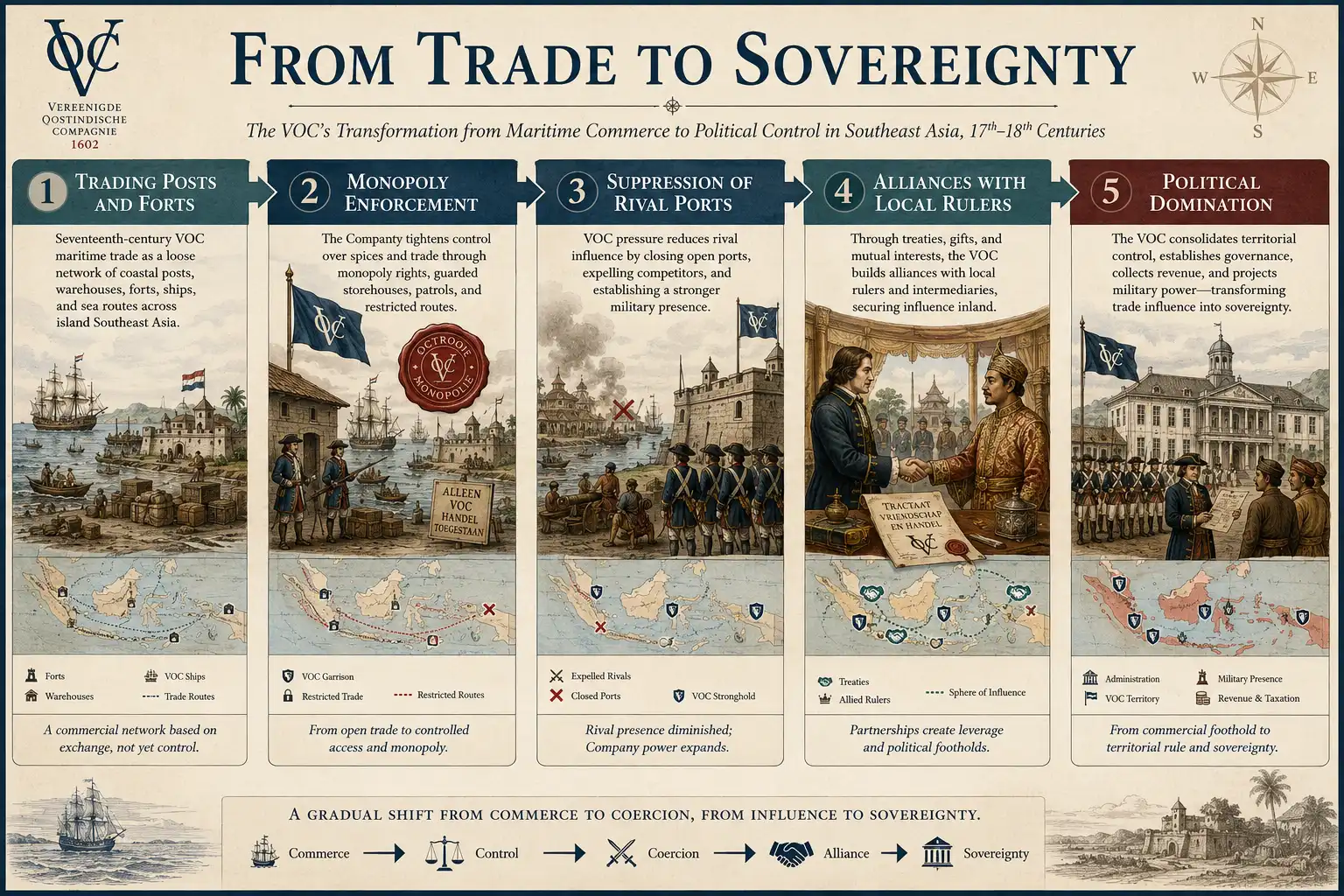
The VOC entered the Indonesian world as a trading company seeking commercial advantage, not as a conventional territorial state. Yet its attempt to monopolise sea-borne trade could not be sustained by forts and ships alone. To control commerce, the Dutch increasingly had to control ports, rulers, labour, crops and political alliances. Trade led to intervention; intervention led to sovereignty.
Coen’s Trade Empire
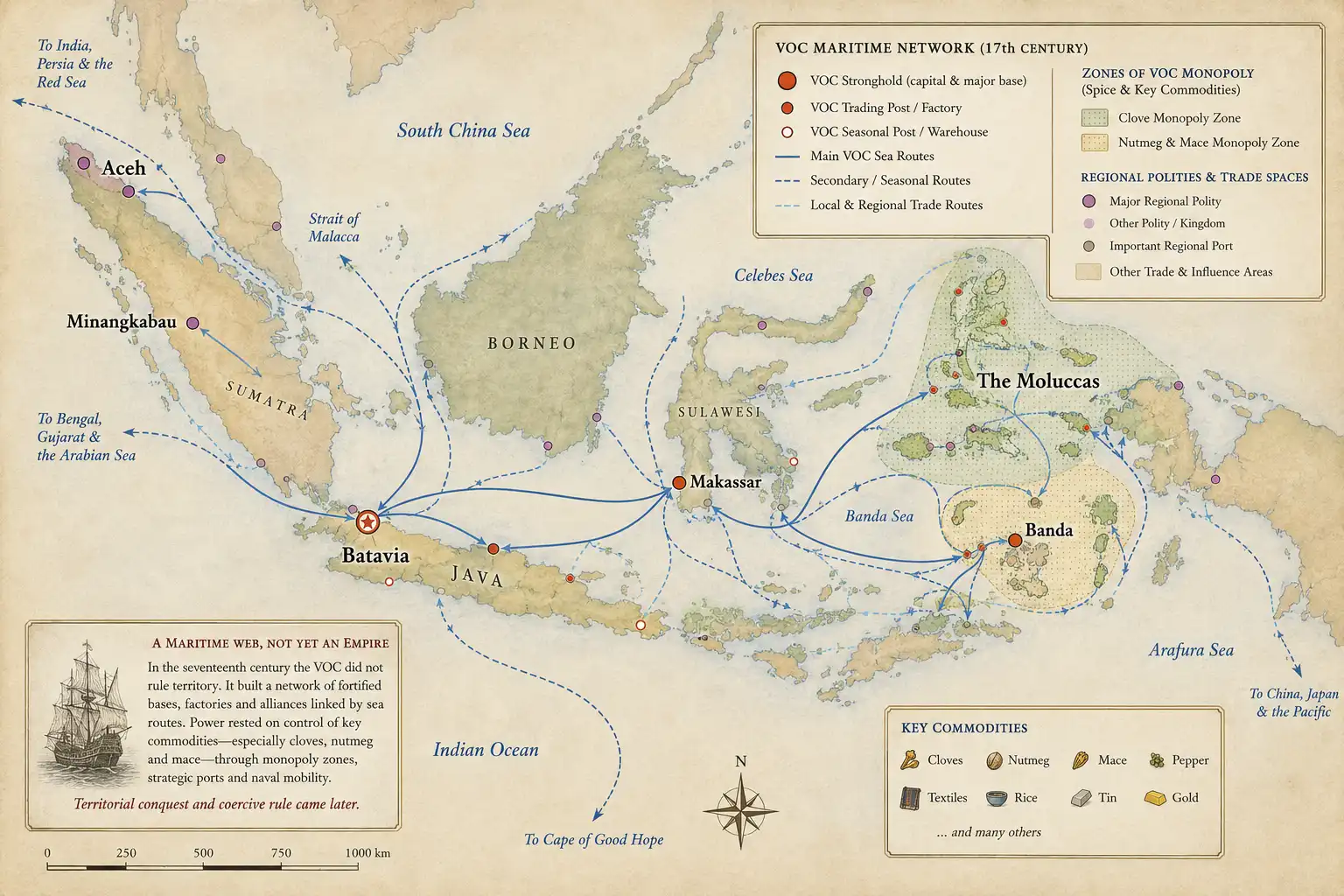
Professor Kumar begins by distinguishing Dutch intentions from Dutch outcomes. In the early seventeenth century, the VOC was not primarily interested in ruling the Indonesian archipelago as a single territorial possession. Its first ambition was commercial: to build a far-flung trade empire based on a network of small but strategically placed strongholds across Asia.
J. P. Coen, the founder of Batavia and one of the central architects of early VOC power, imagined a system of fortified towns, islands, naval bases and trading stations. These would allow the Company to act as the middleman of Asian commerce. The Dutch were not only carrying spices to Europe. They were moving Indian textiles into Southeast Asia, importing opium, entering the trade of Ceylon, the Coromandel coast, Japan and Vietnam, and trying to place themselves at the centre of a much larger inter-Asian commercial system.
The Limits of Forts and Ships
The weakness in this strategy soon became apparent. A few strongholds could not control the sea. The Portuguese had already discovered the difficulty of defending long lines of communication from one fortress to another. The Dutch had superior naval force, but the ocean was too large, the trading routes too flexible, and the commercial world too crowded to be controlled by artillery alone.
Rival European traders could find refuge in local ports. Asian merchants could avoid Dutch patrols. Indigenous rulers could profit by welcoming the English, the Portuguese, Malays, Chinese, Arabs, Indians and other commercial communities. A harbour outside Dutch control could become a loophole in the monopoly system. For the VOC, therefore, trade policy became political policy.
The Moluccas and the Spice Monopoly
The Moluccas were the first decisive testing ground. At first, local rulers saw the Dutch as useful allies against the Portuguese. Professor Kumar describes this early period as a kind of “honeymoon,” during which Dutch power appeared to offer a counterweight rather than a new stranglehold.
The relationship changed when islanders realised that Dutch monopoly was more severe than earlier European competition. Spices were not merely luxury exports for the Moluccans. They were part of a food and exchange system, because spice income enabled the islands to obtain rice from Java. Monopoly therefore struck at the basis of local life, not simply at elite trade.
The Banda Islands became the most violent example of this shift. In 1621, Coen sent a major expedition to enforce Company control over nutmeg production. The destruction of Banda marked one of the clearest moments at which negotiated trade gave way to direct coercion.
Religion, Resistance and Colonial Depth
Professor Kumar is careful not to reduce the Moluccan conflict to economics alone. The basic struggle was commercial, but economic pressure sharpened religious antagonism. Islam became a rallying point for resistance to Dutch control, while the Dutch encouraged Christianity for political reasons. In the Moluccas, therefore, trade, religion and coercion became intertwined.
The region was also one of the earliest parts of the archipelago to experience deep Dutch colonial influence. Professor Kumar notes that here, more than elsewhere, Dutch intervention had long-term cultural consequences, including the emergence of distinctive Christian and creole identities, especially in Ambon.
Makassar: The Free Port That Challenged Monopoly
After the subjugation of the Moluccas, the centre of anti-Dutch trade shifted to Makassar. Its location made it an ideal trading hub: it connected the Moluccas, Java, Banjarmasin, the Lesser Sundas and the southern Philippines. Makassar attracted Malays, Chinese, Indians, Arabs, Javanese, Portuguese, English and Danes. It was, in effect, the open port that Dutch monopoly could not tolerate.
Makassar’s rise was not merely commercial. In the early seventeenth century, Islamisation strengthened its wider links, while the Makassarese aristocracy itself became more directly involved in trade. Its rulers hired ships, built their own vessels in Java, used Portuguese pilots and adopted firearms and fortifications. By the mid-seventeenth century, Makassar had become a significant political and maritime power.
Dutch conflict with Makassar became unavoidable. A treaty in 1660 failed to secure Dutch aims. In 1666, a larger expedition under Cornelis Speelman attacked again, supported by Buginese forces under Arung Palakka. This alliance is crucial to Professor Kumar’s wider interpretation: Dutch expansion succeeded not simply because Europeans imposed themselves from outside, but because they entered existing rivalries within Southeast Asian political systems.
Arung Palakka and the Politics of Alliance
Arung Palakka’s role complicates any simple story of European conquest. He and his Buginese followers had their own history of conflict with Makassar. Their alliance with the Dutch gave the VOC military leverage, but it also served Buginese political purposes. Professor Kumar’s treatment of this episode is therefore not Eurocentric: she shows Dutch strategy succeeding through local fracture, rivalry and ambition.
The fall of Makassar also had unexpected regional consequences. Makassarese and Buginese warriors, sailors and traders migrated widely after the Dutch victory. Their influence spread into other parts of Southeast Asia, including Siam, Cambodia and Malaya. The defeat of one port therefore did not end South Sulawesi’s historical significance; it redistributed it.
Minangkabau, Aceh and the Western Archipelago
Dutch strategy also developed in western Sumatra. The Minangkabau region, though inland, was connected to the trading world through gold and pepper. Aceh had previously exercised commercial influence in the region, but the Dutch were able to use local resentment of Acehnese monopoly to establish themselves at Padang through the Painan contract of 1663.
Professor Kumar distinguishes the Minangkabau case from the Moluccas. The Minangkabau were producers of pepper and wet-rice farmers; they were not dependent on an external rice supply in the same way as the spice islands. Dutch control therefore did not have the same destructive social effect, although it still altered patterns of trade and migration.
Fragmented States, Connected People
By the late seventeenth century, the VOC had established firm control in the Moluccas, broken Makassar, gained influence in Minangkabau and entered the politics of Banten and Mataram. Yet Professor Kumar resists the idea that Indonesia at this time can be described as a single political unit. Java itself was divided among Banten, Cirebon, Mataram and Balambangan; the rest of the archipelago was equally fragmented.
At the level of state organisation, there was no Indonesian unity. At the level of trade, religion, migration and personal alliance, however, there were important connections. This distinction is central to the lecture. The Dutch dealt with many polities, but those polities were not sealed worlds. They were linked by merchants, scholars, exiles, soldiers and rebels.
Surapati as a Connecting Figure
One of the most vivid examples is Surapati. Professor Kumar presents him as a figure who linked Batavia, Banten, Mataram and East Java, and who was involved with multiple anti-Dutch groups in the decades around 1700. He was probably of Balinese origin, perhaps brought to Batavia as a slave, and later became a military leader whose career cut across ethnic, religious and political boundaries.
Surapati’s significance lies not only in his resistance to the VOC but in what his career reveals about communication between anti-Dutch elements: Javanese, Makassarese, Malay, Chinese and other trading communities whose interests were threatened by Dutch monopoly. He becomes, in Professor Kumar’s hands, a bridge between local resistance and later Indonesian national memory.
Aceh and the Wider Muslim World
The lecture ends by reminding students that Dutch expansion did not absorb all historical attention. Aceh remained connected to the Muslim world through pilgrimage, scholarship, trade and literature. Even during political decline, Aceh’s ties to the Holy Land, Gujarat, Persia and the wider Islamic intellectual world helped shape its identity.
Professor Kumar mentions major literary and religious figures such as Hamzah Fansuri, Nur al-Din al-Raniri and Abd al-Rauf of Singkel, as well as texts such as the Bustan al-Salatin. This material is important because it prevents the lecture from becoming a Dutch-centred story. European expansion was one strand in a much wider Indonesian and Islamic world.
Map / Diagram / Visual Context
Why This Lecture Matters
This lecture is foundational for the Colonial Engine Hub because it explains how Dutch colonial power emerged from the practical contradictions of commercial monopoly. The VOC sought to control trade, but trade could not be separated from ports, rulers, labour, religion, local rivalries and regional politics. Professor Kumar therefore shows colonialism not as a single act of conquest, but as a process: a trading company gradually pulled into sovereignty by the very logic of its commercial ambitions.
Further Reading
- H. J. de Graaf, writings on Javanese history and Southeast Asian Islam.
- B. Schrieke, Indonesian Sociological Studies.
- Sutan Sjahrir, Out of Exile, especially for reflections on Ambonese identity.
- Works on the VOC, Banda, Makassar and the Treaty of Bongaya should be added here as the bibliography page is finalised.