
Professor Ann Kumar Southeast Asian Civilisation Archive
About Professor Ann Kumar
Historian, author, linguist and Emerita Professor at the Australian National University, whose work has transformed understandings of Java, Indonesia and Southeast Asian civilisation.
Emerita Professor Ann Kumar is a distinguished Australian historian, author and linguist associated with the Australian National University in Canberra. Across a career of more than four decades, she has worked across languages, archives, manuscripts and regional historical traditions to deepen understanding between Australia and Southeast Asia.
Her scholarship ranges across Javanese history, Indonesian politics, Islamic and courtly traditions, Eastern philosophies, migration histories and cross-regional cultural contact. This digital archive preserves and re-presents one strand of that larger scholarly life: her teaching materials on Southeast Asian civilisation.
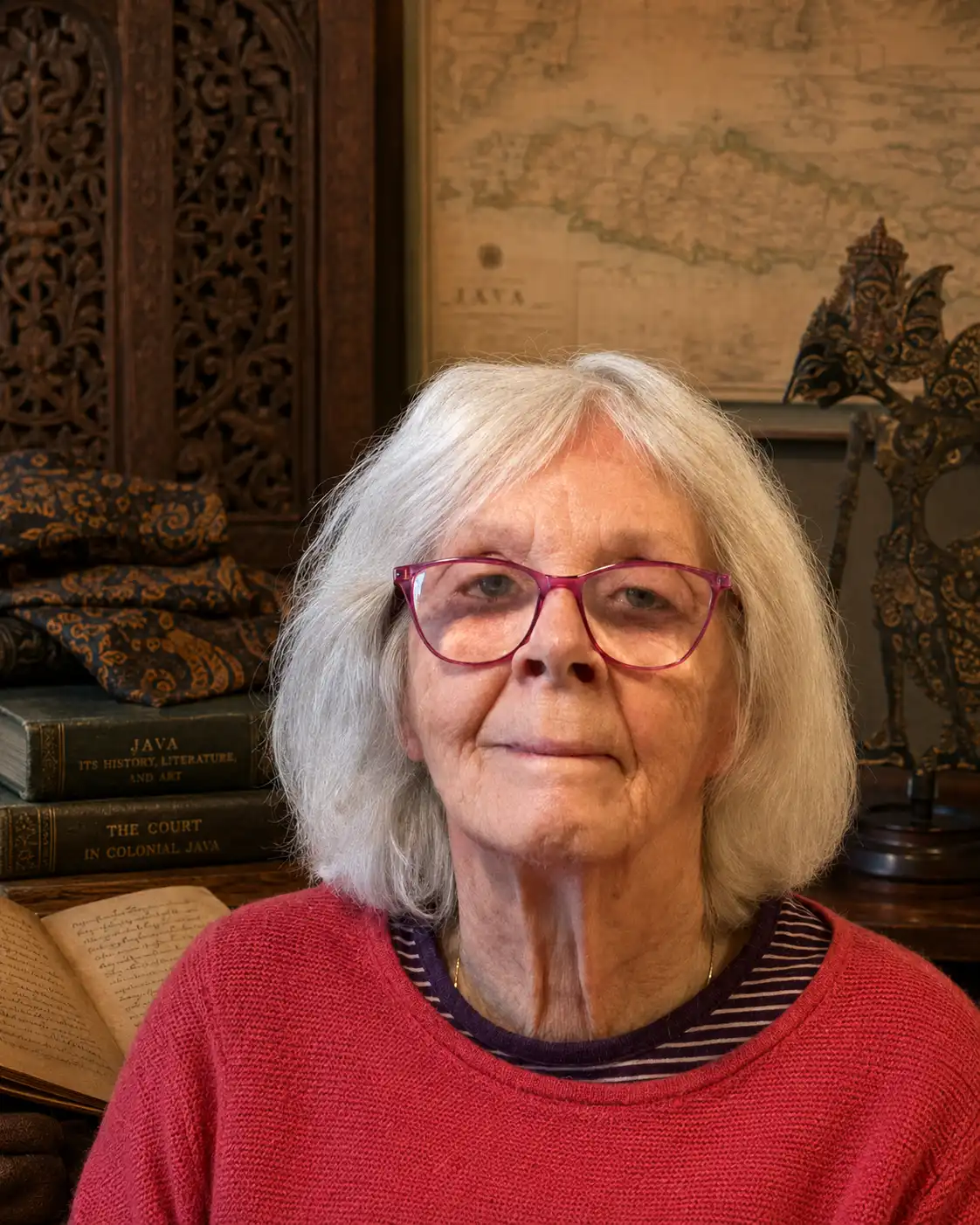
Scholar, Teacher and Interpreter of Southeast Asian Worlds
This archive preserves Professor Kumar’s teaching materials as part of a wider scholarly life devoted to Java, Indonesia, Southeast Asian civilisation, language, textual traditions and historical encounter.
Scholarly Significance
Professor Kumar’s work is marked by unusual range: close reading of Javanese and Indonesian sources, attention to courtly and religious worlds, interest in women’s historical agency, and a willingness to connect Southeast Asian history to wider questions of migration, language, civilisation and cross-cultural encounter.
Academic Profile
Professor Kumar’s research brings together historical scholarship, linguistic expertise, textual interpretation and cross-regional comparison.
Javanese History
Professor Kumar has written extensively on Java, including court culture, political authority, religious life, colonial encounter and historical memory.
Indonesian Politics and Society
Her work explores the ways Indonesian political worlds have been shaped by local institutions, religious traditions, colonial pressures and modern transformation.
Language and Civilisation
Her scholarship often moves across linguistic evidence, textual traditions and civilisational comparison, including later work on Japan and Austronesian connections.
Research Highlights
Several areas of Professor Kumar’s work have become especially associated with her wider scholarly reputation.
The Javanese “Warrior Women” — Prajurit Estri
One of Professor Kumar’s most celebrated historical contributions centres on her work with the translated diary of an anonymous late eighteenth-century guardswoman from the court of Mangkunegara I. Her research drew attention to an elite corps of highly trained women in the Central Javanese courts: cavalry-riding, firearm-bearing guards who also participated in refined courtly arts including music, writing and dance.
This work helped recover a striking dimension of Javanese court life: women as armed, educated and culturally accomplished participants in royal power. Her historical advocacy surrounding these records also contributed to renewed recognition of Mangkunegara I within Indonesian national historical memory.
Java, Japan and the Prehistory of Civilisation
In Globalizing the Prehistory of Japan: Language, Genes and Civilisation, Professor Kumar advanced an ambitious and cross-disciplinary argument about possible links between Java, Austronesian migration and the formation of early Japanese civilisation during the Yayoi period.
The thesis draws on several kinds of evidence: genetic and skeletal material, proposed linguistic parallels between Old Javanese and Old Japanese, and cultural comparisons involving hierarchy, wet-rice cultivation, ritual symbolism and social organisation. The argument remains debated within mainstream linguistics and archaeology, especially because rice agriculture and Yayoi cultural formation are also strongly associated with mainland East Asian contexts. Its significance lies not only in the claim itself, but in the boldness of the comparative question: how far might maritime Southeast Asia have shaped broader Asian civilisational history?
Java and Europe: Ambiguous Encounters
Professor Kumar’s work has also explored the complex historical relationship between Java and Europe. Rather than presenting colonial encounter as a simple story of European action and Javanese reaction, her scholarship emphasises ambiguity, adaptation, resistance, translation and the persistence of local agency.
Islam, Pesantren and Javanese Religious Life
Through her work on Javanese Muslim texts and religious worlds, Professor Kumar has helped illuminate the historical interplay between Islam, courtly culture, pesantren education, mysticism and politics. This is especially relevant to the present archive, where Islam appears as law, scholarship, statecraft, Sufi practice and social force.
Selected Publications
The following works indicate the breadth of Professor Kumar’s scholarship and its relevance to this archive.
Globalizing the Prehistory of Japan: Language, Genes and Civilisation
A cross-disciplinary work proposing deep historical links between Java, Austronesian migration and early Japanese civilisation.
Java and Modern Europe: Ambiguous Encounters
A study of the complex cultural, administrative and historical intersections between Java and European expansion.
Illuminations: The Writing Traditions of Indonesia
Co-authored with John H. McGlynn, this work documents the rich literary, manuscript, calligraphic and book traditions of the Indonesian archipelago.
The Diary of a Javanese Muslim: Religion, Politics and the Pesantren
A study of a late nineteenth-century Javanese Muslim diary, opening a rare window onto pesantren life, religious practice, politics and Javanese Islamic culture.
Surapati: Man and Legend
A major study of Surapati as historical figure and legend, directly connected to the archive’s treatment of resistance, memory and early anti-Dutch struggle.
Why This Archive Matters
The Professor Ann Kumar Southeast Asian Civilisation Archive preserves teaching materials that reflect a major scholarly method: reading Southeast Asian history through its own political forms, languages, religious traditions, textual worlds and regional systems. The lectures do not begin with Europe. They begin with cores and zones, indigenous sovereignties, Islamic networks, maritime trade, courtly power, colonial intrusion and nationalist transformation.
By presenting the lectures as a structured digital archive, the site aims to preserve Professor Kumar’s pedagogical voice while making the material accessible to new generations of students, researchers and readers.
Research Access
Professor Kumar’s research papers, chapters and public essays may be explored through university and scholarly repositories.
Explore the Archive
The archive can be entered through the complete lecture sequence or through the four thematic hubs.
Profile Note
This profile is intended as a concise introduction for archive visitors rather than a full academic biography. Publication details, repository links and additional career information can be expanded as the site develops.