Professor Ann Kumar Southeast Asian Civilisation Archive
Indigenous Sovereignty
Javanese, Acehnese and Buginese political worlds before and during the rise of European colonial power.
Hub: Indigenous SovereigntyArchive role: Southeast Asian political worlds in their own termsRelated hubs: The Framework · The Colonial Engine · Nationalist Awakening
The Indigenous Sovereignty Hub foregrounds Southeast Asian forms of political order before they were reduced to colonial categories. These lectures examine Javanese court-state power, Acehnese Islamic monarchy, Buginese contractual kingship, adat, Hadat, regional aristocracy, sacred legitimacy and the ways local rulers and communities negotiated both internal conflict and European intrusion.
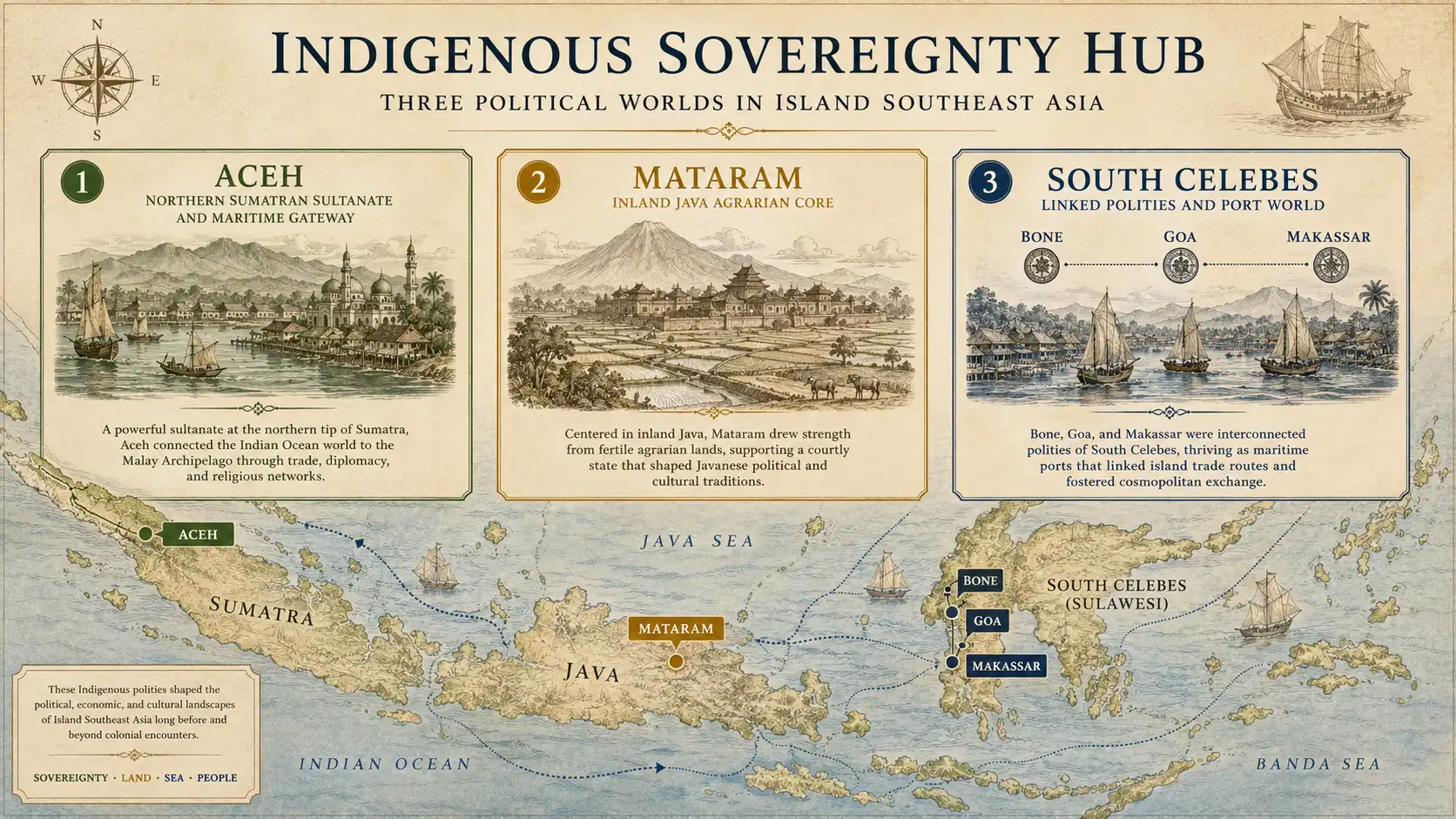
A regional map or triptych showing three indigenous political worlds: Mataram in inland Java, Aceh in northern Sumatra, and South Celebes with Bone, Goa and Makassar.
This hub emphasises that Southeast Asian political life was plural: agrarian court-states, maritime Islamic sultanates, and Buginese systems of ruler, council, adat and community.
Key Idea
Indigenous sovereignty in Southeast Asia was not a single form. It could be court-centred, Islamic, aristocratic, contractual, maritime, agrarian, ritual, commercial or local. Professor Kumar’s lectures show that European power entered political worlds that were already complex, historically active and internally contested.
Lectures in This Hub
These lectures should be read as case studies in Southeast Asian political thought and practice. They show how different societies organised authority, legitimacy, territory, religion and resistance before and during European expansion.
Arung Palakka’s career reveals the internal dynamism of South Celebes politics: exile, alliance, rivalry, war, Dutch intervention and Buginese ambition.
Mataram appears as a powerful inland Javanese agrarian court-state, organised through hierarchy, symbolic kingship, regional control and conflict with Batavia.
Aceh is treated as a maritime Islamic power: a pepper entrepôt, pilgrimage gateway, scholarly centre and contested monarchy shaped by sultan, orangkaya and ulama.
The lectures in this hub show how Southeast Asian sovereignty worked before colonial rule became dominant.
Political Plurality
Mataram, Aceh and South Celebes were not variants of one model. Each organised power through different institutions, values and historical pressures.
Adat and Customary Order
Custom, precedent and inherited political norms shaped authority alongside royal command, Islamic law and local aristocratic negotiation.
Court and Region
Southeast Asian rulers often struggled to hold outer regions, local lords and aristocratic networks to the centre.
Islamic Sovereignty
Aceh and Mataram show different ways Islam entered political life: through scholarship, pilgrimage, law, monarchy, syncretism and legitimacy.
European Intrusion
The VOC did not enter empty political space. It intervened in existing rivalries, treaties, successions, trade systems and regional conflicts.
Local Agency
These lectures restore agency to Southeast Asian rulers, councils, aristocrats, merchants, scholars and communities whose choices shaped the colonial encounter.
Why This Hub Matters
The Indigenous Sovereignty Hub is central to the archive because it prevents colonial power from becoming the starting point of the story. Professor Kumar’s teaching directs attention first to Southeast Asian political worlds themselves: their ideas of authority, their internal tensions, their moral orders, their regional ambitions and their capacity for adaptation. Only after these worlds are understood can Dutch and British colonial power be properly interpreted.
Pathways from This Hub
The Indigenous Sovereignty lectures connect directly to the archive’s wider interpretive pathways.
A later enrichment page may draw together the South Celebes material as a test case in indigenous civilisation, exploring Buginese documentary culture, contractual kingship, adat, Hadat and the internal political sophistication of South Sulawesi before and during Dutch intervention.