
Professor Ann Kumar Southeast Asian Civilisation Archive
Arung Palakka and South Celebes Politics
How a Buginese exile, warrior and king used Dutch alliance, popular loyalty and local political fracture to reshape South Sulawesi.
This lecture examines Arung Palakka, one of the most important Buginese political figures in Professor Kumar’s South Celebes material. His career sits at the meeting point of indigenous sovereignty and Dutch colonial strategy: he was not merely a Dutch instrument, nor simply an anti-Makassar rebel, but a powerful local actor who used exile, alliance and military opportunity to alter the political order of South Sulawesi.
Key Idea
Arung Palakka’s career shows that Dutch expansion in South Sulawesi cannot be understood as a simple story of European conquest. The VOC’s victory over Makassar depended on Buginese political ambitions, exile networks and local rivalries. Arung Palakka used Dutch power, but he also pursued his own project: the recovery and strengthening of Bone.
A Buginese Prince in a Makassarese World
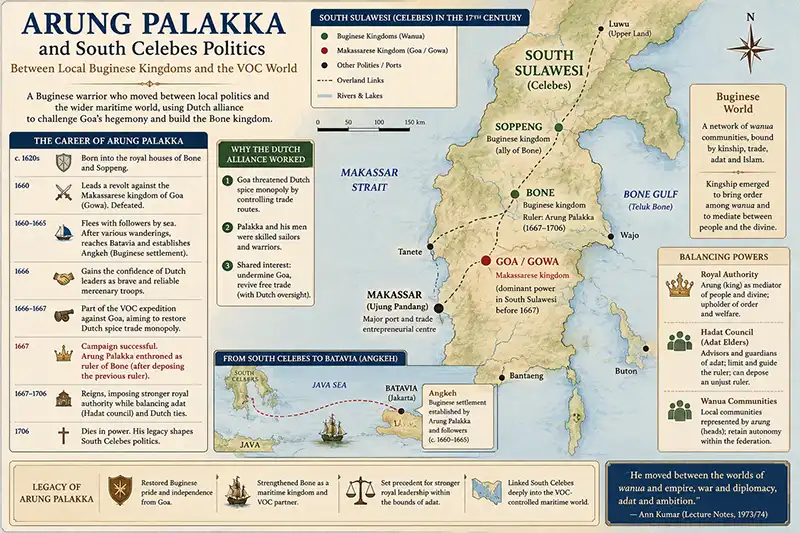
Professor Kumar introduces Arung Palakka as a figure related to the royal houses of Bone and Soppeng. He was born into a world in which the powerful Makassarese kingdom of Goa had overwhelmed the Buginese states. His political career therefore began not as an abstract struggle against colonialism, but as a local struggle within South Sulawesi’s own hierarchy of power.
This distinction is important. Arung Palakka’s alliance with the Dutch later became decisive, but his motives were rooted in Buginese politics. His enemy was not simply Makassar as a Dutch rival, but Goa/Makassar as a power that had dominated Bone and other Buginese communities.
The Failed Revolt of 1660
In 1660, Arung Palakka led a revolt against Goa’s domination. The attempt failed. He and a group of fellow rebels fled, eventually reaching Dutch Batavia. There they established a village called Angkeh.
The exile period is central to Professor Kumar’s interpretation. Arung Palakka did not simply disappear after defeat. In Batavia, he and his followers became a disciplined, mobile and politically detached military group. They were no longer tied only to particular wanua communities or local loyalties. Exile created a new kind of following.
From Exiles to Mercenaries
In Batavia, Arung Palakka and his men attracted Dutch attention through their bravery and resourcefulness as military auxiliaries. Professor Kumar presents this as one of the turning points in his fortunes. The qualities that had made him dangerous to Makassar made him useful to the VOC.
This does not mean he became merely a Dutch servant. Rather, the relationship was reciprocal and strategic. The Dutch needed local forces capable of mobilising Buginese resentment against Goa. Arung Palakka needed a powerful ally capable of helping him return to South Sulawesi. Both sides saw opportunity.
The Dutch Campaign Against Goa
When the Dutch decided in late 1666 to take harsher measures against Goa for interfering with their spice trade monopoly, Arung Palakka and his followers became vital to the expedition. Their role was not simply military. They were the bridge between VOC force and Buginese political mobilisation.
The Dutch campaign succeeded because it could present itself not only as an external attack on Makassar, but also as an opportunity for Buginese recovery. Arung Palakka’s presence gave the campaign local legitimacy among those who had suffered under Goa’s domination.
The Throne of Bone
After the Dutch campaign succeeded, Arung Palakka attained the throne of Bone, deposing the previous ruler. His kingship was unusual. In Buginese political thought, rulers were not expected to be absolute. They were constrained by adat, by councils and by the older federated structure of wanua communities.
Arung Palakka, however, managed to impose his will on the Hadat in a way Professor Kumar describes as most unusual. His authority therefore becomes an important exception in the broader Buginese model of consultative, adat-bound kingship.
Three Sources of Exceptional Power
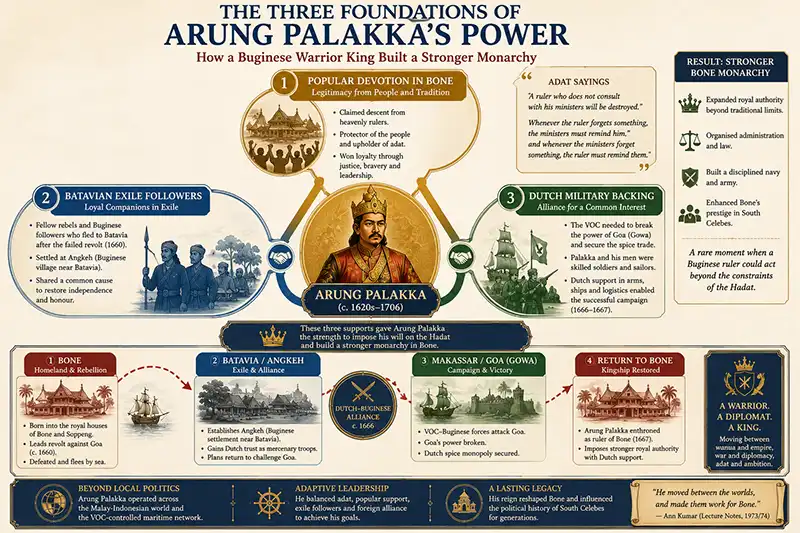
Professor Kumar identifies three exceptional factors that explain Arung Palakka’s unusually strong position. The first was the direct devotion of the people, impressed by his role in freeing them from Goa’s domination. He also made a positive effort to cultivate popular favour.
The second was the support of his band of Batavian exiles. These followers had been detached from narrower local loyalties and had become personally loyal to him. They gave him a power base that did not depend entirely on the old structures of Bone.
The third was Dutch backing. VOC support gave him military and political weight beyond what a Buginese ruler would normally possess. Together, these three supports allowed him to act with a force that later rulers could not easily reproduce.
Islam, Goa and Forced Conversion
Professor Kumar also notes the religious dimension of the conflict. Goa had adopted Islam in the early seventeenth century and then Islamised the principal Buginese states by force after they had rejected voluntary conversion. This religious pressure formed part of the historical background to Buginese resentment.
The point is not that Arung Palakka’s career can be reduced to religion. Rather, religion, conquest and political domination were intertwined. Goa’s power over the Buginese states had military, political and religious dimensions, and Arung Palakka’s opposition drew on that wider history.
After Arung Palakka
Arung Palakka’s strong monarchy did not become the normal Buginese pattern. Professor Kumar emphasises that subsequent rulers did not possess the same extraordinary sources of strength. Without his personal prestige, exile following and Dutch backing, the Hadat gradually regained its older power.
This is important because it prevents the reader from mistaking Arung Palakka’s reign for the ordinary structure of Buginese kingship. He was exceptional. His career illuminates the flexibility of South Sulawesi politics precisely because it deviated from the normal balance between ruler, adat and council.
Arung Palakka in the Archive’s Larger Argument
Arung Palakka belongs at the centre of the archive because his career resists simple categories. He was an indigenous ruler, a rebel, an exile, a military entrepreneur, a Dutch ally and a Buginese king. His story shows that Southeast Asian actors were not passive objects of European policy. They calculated, allied, resisted, adapted and used imperial rivalries for their own ends.
The lecture therefore belongs primarily to Indigenous Sovereignty, because it is about Buginese political agency. But it also belongs beside the Colonial Engine material, because it shows how the VOC’s expansion depended on the ambitions and grievances of local powers.
Map / Diagram / Visual Context
Why This Lecture Matters
Arung Palakka’s career is one of the archive’s clearest examples of indigenous agency within colonial history. His alliance with the Dutch was real, but it did not make him a mere instrument of Dutch policy. He pursued Buginese aims through VOC opportunity. Professor Kumar’s treatment therefore complicates the usual colonial narrative: Dutch expansion succeeded through Southeast Asian politics as much as against them.
Further Reading
- Leonard Y. Andaya, The Heritage of Arung Palakka: A History of South Sulawesi (Celebes) in the Seventeenth Century.
- C. C. Macknight, writings on South Sulawesi and the emergence of civilisation in South Celebes.
- K. J. Noorduyn, “Origins of South Celebes Historical Writing,” in An Introduction to Indonesian Historiography.
- Further bibliography on Bone, Gowa, Makassar and Buginese political culture should be added when the archive bibliography is finalised.