
Professor Ann Kumar Southeast Asian Civilisation Archive
Indonesian Cores and Zones
John Smail’s framework for understanding Southeast Asian civilisation beyond Eurocentric timelines.
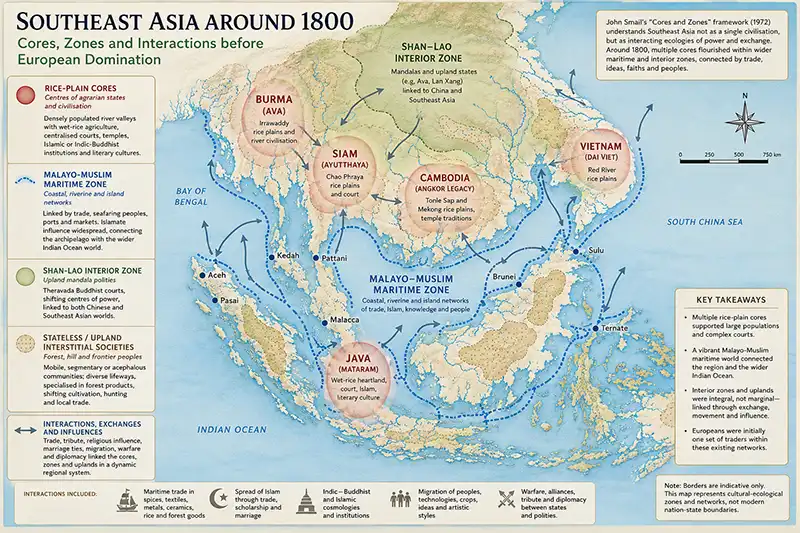
This lecture introduces the organising framework of Professor Kumar’s Southeast Asian Civilisation course: John Smail’s distinction between “cores” and “zones.” Rather than beginning with European arrival, the model asks how Southeast Asian societies were already organised — through rice plains, courts, ports, trade routes, religious traditions, linguistic fields, and shifting relationships between settled states and mobile peoples.
Key Idea
Smail’s “cores and zones” model helps students see Southeast Asia as a set of indigenous political and cultural formations rather than as a passive region waiting for European history to begin. Cores were crystallised political societies with agricultural surplus and strong civic traditions. Zones were looser fields of cultural influence, trade, mobility and small political units. European traders initially entered this world as one group among others.
Why Begin with Cores and Zones?
Professor Kumar’s adoption of the Cores and Zones model is one of the most important intellectual decisions in the lecture series. It prevents the course from becoming a Eurocentric story in which Southeast Asian history becomes meaningful only when the Portuguese, Dutch, British or Spanish arrive.
Instead, the model asks what kinds of political, economic and cultural structures already existed. It encourages the reader to think about rice plains, courts, trading ports, religious traditions, language communities, uplands, forests, maritime routes and shifting frontiers of influence.
What Is a Core?
Professor Kumar explains that in some cases one might almost retain familiar terms such as “country” or “state,” except that these words imply fixed boundaries too strongly. A “core” is better understood as a grouping of relatively homogeneous people formed by historical events into a political entity.
Smail calls this process “crystallisation.” It raises an important question: did a pre-existing cultural unity allow political organisation to develop, or did a small centre — perhaps something like a city-state — extend its influence until it drew in a larger population? Professor Kumar suggests that the answer is probably a bit of both.
Cores generally required agricultural surplus. This is why Southeast Asian cores were associated with rice plains, dense populations and elaborate civic traditions. Surplus made political organisation possible. It supported courts, bureaucracies, armies, temples, officials and ritual centres.
Crystallisation and Political Formation
The term “crystallisation” is useful because it suggests process rather than fixed essence. A core does not simply exist from the beginning. It forms. It hardens. It takes shape around agriculture, population, political leadership, religion, language and the ability to command resources.
This helps explain why the model is so useful for Indonesian history. Java, for example, appears as a core because it had dense rice agriculture, courtly political traditions, and a long history of Hindu-Buddhist, Islamic and later Dutch-bureaucratic overlays. It was not merely an island; it was a political-cultural centre of gravity.
What Is a Zone?
A zone is different. Professor Kumar explains that Smail appears to define a geographical area in terms of the characteristics of its dominant group — for example, the Shan-Lao group or the Malay group. Such a group may possess considerable cultural unity without political unity.
Zones are often organised into many small political entities: mini-cores, chiefdoms, sawbwa-ships, port-polities, river-mouth settlements or small states. The zone as a whole is not politically unified. Nor is it culturally homogeneous. Dominant groups live among other peoples, producing relationships of symbiosis, imitation, exchange, tension and oscillation.
The Constellation Metaphor
One of Professor Kumar’s most evocative teaching moments is her question: is a zone comparable with a constellation? The analogy is valuable because a constellation is not one object. It is a pattern perceived across distance, made up of distinct points that are related by the observer’s act of connection.
The same is true of zones. A zone is not a unified state. It is a field of related societies, ports, routes, identities and cultural practices. Its unity is real, but looser than the unity of a core.
Leach, Shans and Kachins
To explain the complexity of zones, Professor Kumar refers to Edmund Leach’s study Political Systems of Highland Burma. Leach examined relationships between Shans and Kachins, including cases in which Kachins adopted Shan ways of life.
The important point is that identity in such settings could be fluid. Some Kachins moved towards the Shan way of life, widely regarded in that context as more “civilised,” while others oscillated between Shan and Kachin identity. Zones therefore require a historical imagination that can handle movement, mixture and shifting social boundaries.
Cores, Zones and Stateless Societies
Smail’s comparative table distinguishes between cores, zones and stateless societies. Cores are associated with rice plains, dense populations, civic traditions and political crystallisation. Zones are associated with looser fields of culture and trade, often with smaller political units. Stateless societies are associated with swidden cultivation, sparse population and upland or interstitial locations.
The point is not to rank societies from primitive to advanced, but to distinguish different forms of social and political organisation. A rice-plain court, a maritime trading network and a swidden upland society are not failed versions of one another. They are different solutions to different ecological, economic and political conditions.
A Simplified Teaching Table
The original lecture includes a comparative “Cores and Zones — about 1800” table attributed to John Smail. The simplified version below is intended as a teaching guide rather than a replacement for the full source table.
Cores and Zones — Simplified Teaching Table
| Type | Economic base / population | Typical location | Political form | Examples / fields |
|---|---|---|---|---|
| Cores | Rice plains; dense population; agricultural surplus | River valleys, deltas, irrigated lowlands | Crystallised states, courts, bureaucracies, kingdoms | Java, Burma, Siam, Cambodia, Vietnam, northern/central Philippines |
| Zones | Trade, rice pockets or mixed economies; often less dense | Interior uplands, coasts, rivers, islands and maritime corridors | Small polities, mini-cores, port-states, chiefdoms, overlapping authority | Shan-Lao zone; Malayo-Muslim maritime zone |
| Stateless societies | Swidden agriculture; sparse population | Mainland hills, island interiors, interstitial areas | Non-centralised cultures and local social systems | Upland and forest societies between larger cores and zones |
Where Does Indonesia Fit?
Indonesia is especially interesting because it contains both cores and zones. Java appears as a major core: agricultural, densely populated, politically crystallised and historically shaped by courtly, religious and bureaucratic traditions. The Malayo-Muslim world, by contrast, is better understood as a maritime zone: trade-based, mobile, linguistically connected through Malay, Islamic, and spread across coasts, rivers and islands.
This distinction helps the whole archive make sense. Mataram belongs largely to the Javanese core. Aceh, Makassar, the Moluccas and the Malay-speaking trading world belong more naturally to the Malayo-Muslim maritime zone. The Buginese complicate the picture, combining local political structures, maritime mobility and regional expansion.
Europeans Inside the Pattern
Professor Kumar’s treatment of Europeans is one of the most important parts of the lecture. In the early centuries of European expansion, Portuguese and Dutch arrivals changed the pattern comparatively little. They could be seen, at first, as another trading people operating within the Malayo-Muslim zone.
They established trading posts rather than territorial empires. Batavia itself, although it became the Dutch centre on Java, was outside the Javanese core area that the Dutch took over only later. This point is essential: European power did not immediately dominate the whole structure. It entered an already existing world of trade, ports, courts and zones.
The Philippine Exception
Professor Kumar notes one major early exception: the Philippines. There, Europeans did significantly reorganise the pre-existing pattern. Spanish rule set in motion the political events that led to the formation of a new core.
This exception matters because it shows that the model is not anti-European in a simplistic sense. It does not deny European impact. Rather, it asks when, where and how European power transformed existing Southeast Asian structures.
Why This Framework Matters for the Archive
The Cores and Zones framework is not merely a theoretical preface. It explains why the archive is arranged thematically. The lecture pages do not simply march from European arrival to nationalism. They move between Java, Aceh, Makassar, the Moluccas, South Celebes, the VOC, the Culture System and Indonesian nationalism because Southeast Asian history itself was multi-centred.
The framework also explains why the archive gives such weight to Indigenous Sovereignty. Buginese kingship, Mataram, Aceh, Islamic scholarship, Malay literary networks and Makassar’s free-port world were not marginal backdrops to Dutch action. They were historical formations in their own right.
This Page in the Archive’s Larger Argument
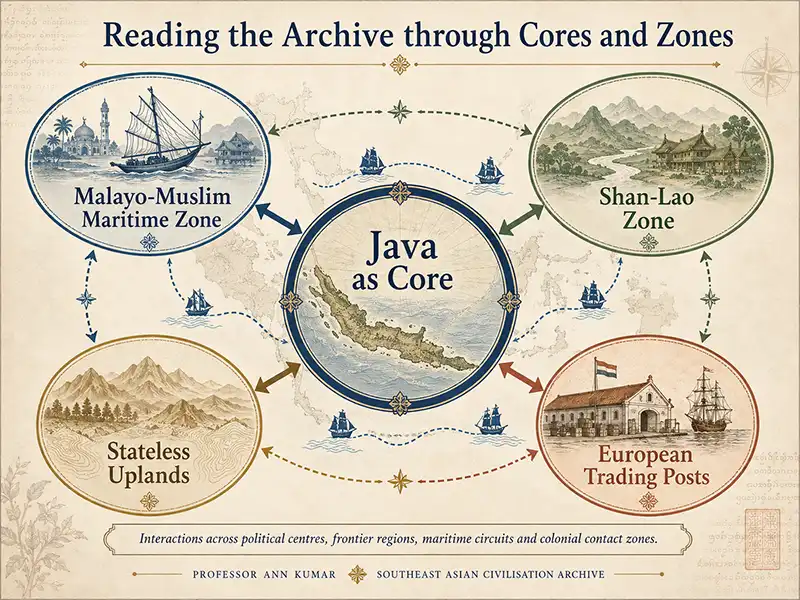
This page belongs first because it gives the reader the conceptual map for everything that follows. The Javanese core helps explain Mataram, the Culture System and the density of colonial extraction on Java. The Malayo-Muslim zone helps explain Aceh, Makassar, the Moluccas, Malay literary networks and the difficulty of monopolising sea trade.
The framework also helps explain Indonesian nationalism. Modern Indonesia did not arise from one ancient state. It emerged from the gradual political integration of cores, zones, islands, languages, religions and colonial administrative structures into a single national idea. Smail’s model allows the archive to show both diversity and connection.
Map / Diagram / Visual Context
Why This Lecture Matters
Indonesian Cores and Zones is the conceptual foundation of the archive. It teaches readers to see Southeast Asian history as a field of indigenous centres, maritime networks and shifting zones of influence. It also explains why European traders were not, at first, the whole story. They entered a world already structured by agriculture, trade, religion, courts, languages and mobility.
Further Reading
- John R. W. Smail, writings on Cores and Zones in Southeast Asian history.
- Edmund Leach, Political Systems of Highland Burma.
- Works on Southeast Asian state formation, maritime trade zones, Java, the Malayo-Muslim world and upland societies should be added when the archive bibliography is finalised.