
Professor Ann Kumar Southeast Asian Civilisation Archive
The Rise of Indonesian Nationalism, 1900–1942
From Budi Utomo and Sarekat Islam to Sumpah Pemuda, PNI, repression and the Japanese occupation.
This lecture examines the social background to Indonesian nationalism. Professor Kumar does not present nationalism as a neat line of progress from one organisation to the next. Instead, she shows a much messier process: Javanese cultural associations, Islamic reform, anti-Chinese commercial feeling, Dutch education, Eurasian politics, socialist organising, regional youth movements, language politics and colonial repression all contributed to the gradual making of “Indonesia” as a political idea.
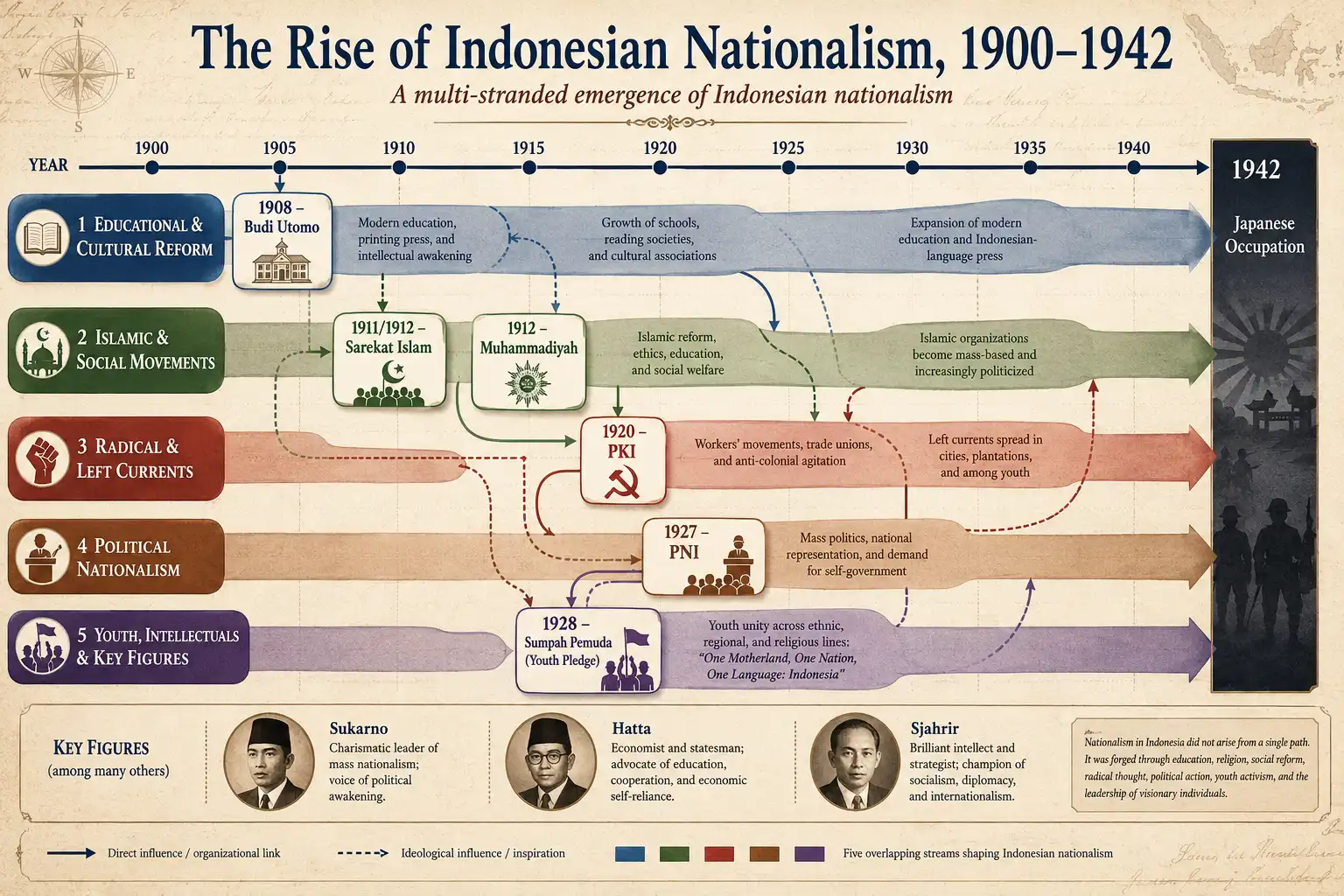
Key Idea
Indonesian nationalism did not emerge fully formed. The words “Indonesia” and “nationalism” were themselves only gradually accepted as political terms. Earlier movements were not mere false starts: Budi Utomo, Sarekat Islam, Islamic reform, socialism, regional youth groups and later PNI nationalism all represented different social bases, loyalties and pressures that eventually made a common Indonesian political identity possible.
Against the Simple Line of Development
Professor Kumar begins by describing the common picture of Indonesian nationalism as a line running from Budi Utomo in 1908, through Sarekat Islam in 1912, the PKI in 1920, and the PNI in 1927 — the party most closely associated with the winning of Indonesian independence.
But she immediately warns that the story is not so simple. These movements followed one another chronologically, but they did not form a tidy logical sequence. One did not necessarily develop into the next. Nor can the earlier organisations be dismissed as false starts that simply died out. They represented currents of thought, pressure and power that continued to matter.
The Problem with the Term “Indonesian Nationalism”
Professor Kumar pays close attention to language. The phrase “Indonesian nationalism” can make the process look more unified than it was. Both words represented ideas accepted slowly and at first by only a small number of people.
“Indonesia” was not widely used as a political term until the mid-1920s. Earlier politically active people often joined organisations with quite different unifying principles: Javanese culture, Islam, anti-Chinese commercial feeling, socialism, regional loyalty, youth association or elite education.
The Dutch East Indies as a Common Reality
Part of the idea of Indonesian unity was created by the Dutch presence itself. Not because the Dutch intended to create nationalism, but because the Dutch East Indies increasingly existed as a single administrative, economic and educational reality.
As government and economic modernisation expanded, a small class of Indonesians emerged whose lives were tied more to the administration and modern institutions of the whole Indies than to the older concerns of their local societies. They worked in administration, education, hotels, offices and other modern sectors. Their training often had little relevance to traditional social worlds.
Indonesian students in the Netherlands were especially important in this respect. Removed from local identities and gathered in small numbers, they recognised a common identity earlier than many others. Their Indies Association was later reconstituted as the Perhimpunan Indonesia.
Dutch Education and the Small Modern Elite
Dutch-language education helped mould those who received it into a more common social and intellectual world. It gave members of the emerging elite more in common with one another than they otherwise would have had.
But Professor Kumar stresses the small scale of this group. Dutch education reached only a tiny minority. In 1937, in a population of around 68 million, only a small number of Indonesian children were receiving Dutch-language education, and university students were fewer still. This helps explain the narrowness of the modern Indonesian elite.
Religion and the Limits of National Loyalty
Even where people recognised some common Indonesian or Indies identity, it did not necessarily become their chief loyalty. Religion could matter more. Professor Kumar gives different examples of how religious identity operated across groups.
Ambonese Christians, whose conversion and acculturation were closely linked to European and Dutch influence, could feel alienated from the rest of Indonesia. The Toba Bataks, who converted later and under different missionary influences, did not follow the same separatist pattern and later became prominent in commerce and government.
Islam, the majority religion, also worked in varied ways. It could provide a powerful framework for mobilisation, but it was not simply identical with nationalism. Since Islam is international, Muslim loyalties could reach beyond the national state.
Race, Status and the Dutch–Indonesian Divide
Professor Kumar also places nationalism against the changing status order of colonial society. Earlier colonial distinctions had partly involved religion, with native Christians sometimes associated with the Dutch. Over time, especially in the twentieth century, the status system became more clearly based on race.
The Dutch community became larger and more European in style, helped by steamships, the Suez route and the arrival of more Dutch women. The older “Indische” style of life gave way to a more sharply European identity. Paradoxically, the Ethical Policy, despite its concern for native welfare, could widen the gap because its programmes were organised along European administrative lines with little connection to older indigenous procedures.
Eurasians and the Indische Partij
One group that might have formed a bridge between Dutch and Indonesians were the Eurasians, who formed the majority of those legally classified as European. For a time, it seemed possible that Eurasians might challenge the racial status order.
In 1912, E. F. E. Douwes Dekker founded the Indische Partij. Its slogan was “the Indies for those who make their home there.” The party imagined an independent state governed by those of whatever race who actually lived in the Indies.
The party was not large and was not popular with the Dutch government. Most Eurasians did not wish to endanger their position, and by 1919 many had attached themselves more firmly to Dutch power, emphasising their Europeanness rather than bridging the racial divide.
The Chinese Community and Anti-Chinese Mobilisation
Between the Dutch and Indonesians on the colonial status scale stood the Chinese. They formed a significant commercial group and, in Professor Kumar’s account, are essential for understanding the motivation of some early Indonesian movements, especially Sarekat Islam.
Sarekat Islam grew out of Sarekat Dagang Islam, or the Islamic Trading Association, formed in 1909 by R. M. Tirtoadisoerjo, a Javanese aristocrat and merchant. It developed as a cooperative trading association partly concerned with Chinese business practices and prepared to boycott Chinese competitors.
In 1911, the movement gained the support of Haji Samanhudi, a major batik merchant from Surakarta. Anti-Chinese feeling, commercial self-assertion and Islamic identity all fed into the organisation that H. O. S. Tjokroaminoto would help reshape as Sarekat Islam in 1912.
Sarekat Islam: Mass Movement and Many Meanings
Sarekat Islam spread rapidly. Unlike Budi Utomo, which remained largely aristocratic, bureaucratic and Javanese-cultural, Sarekat Islam developed a mass membership, including many peasants. By 1919, it had grown to more than two million members.
Its appeal was not uniform. Some members were concerned with Chinese competition. Others were drawn by Islam, grievances against local conditions, peasant discontent, or the movement’s ability to act as a clearing-house for complaint. Professor Kumar stresses that local branches could differ greatly in spirit because the central organisation did not impose a single policy.
Reform Islam and Muhammadiyah
Sarekat Islam also reflected the rise of Reform Islam, a movement that sought to return to what its adherents saw as the fundamental truths of the Qur’an while discarding later accretions and compromises with local beliefs. Reform Islam offered a way to become modern while retaining a distinct Muslim identity.
In Indonesia, Reform Islam was represented not only by Sarekat Islam but also by Muhammadiyah, founded in Yogyakarta in 1912. Muhammadiyah was not primarily a political organisation at first, but a social and educational movement with youth and women’s associations, clinics, orphanages and a modern school system.
Traditional Islam and Nahdlatul Ulama
Reform Islam provoked opposition from traditional ulama and pesantren teachers, who accused modernists of being half-Christianised and not true Muslims. Yet even traditionalist Muslims were influenced by the modernists, because they too had to organise through modern associations and school systems.
The most important political organisation of conservative Muslims was Nahdlatul Ulama, founded in 1926. It later became one of the major streams in Indonesian politics, alongside secular nationalism, modernist Islam and communism.
Socialism, PKI and the Split in Sarekat Islam
Sarekat Islam’s history was further complicated by the arrival of socialist ideas. Dutch socialists such as Sneevliet and Baars worked to organise trade unions, and after 1916 a strong socialist wing developed within Sarekat Islam, led by figures such as Semaun.
The Muslim wing centred around Haji Agus Salim. After unrest and government repression, Sarekat Islam lost much of its following, and the Muslim and socialist wings became bitterly divided. In 1920, the socialists founded the Perserikatan Komunis di India, later the Partai Komunis Indonesia, or PKI, which joined the Comintern.
In 1921, the Muslim wing forced the Communists out of Sarekat Islam. The movement that had once gathered many grievances under one label now split along ideological lines.
The Revolts of 1926–27 and the End of a Generation
In December 1926, a revolt broke out in parts of West Java and Central Sumatra, led in many cases by local PKI figures. Professor Kumar describes it as weak and easily suppressed, but politically decisive.
The Dutch government became determined not to allow such mobilisation again. It rounded up those it considered subversive and exiled many to New Guinea, especially Boven Digoel. The repression effectively finished the communists as a major open political force for a generation.
PNI and the Explicitly Nationalist Turn
By the end of the 1920s, the earlier internationalist movements — communism and pan-Islam — had either been suppressed or lost momentum. A new movement filled the vacuum: the PNI, founded in July 1927 and led by Sukarno.
Professor Kumar identifies the PNI as the first movement that can properly be called nationalist in the narrower political sense. It made “Indonesia” the centre of political loyalty and turned national independence into the explicit goal.
Sumpah Pemuda and the National Language
In October 1928, the famous congress of youth organisations produced the Sumpah Pemuda, or Youth Pledge: one nation, the Indonesian nation; one people, the Indonesian people; one language, the Indonesian language. The present flag and national anthem were also adopted in this period.
Professor Kumar stresses the importance of the national language. Indonesian was based on Malay, a minority language when compared with Javanese, but one already used as a lingua franca and by the indigenous press. Its use was democratic in structure when compared with Javanese, because it did not carry the same elaborate hierarchy of speech levels.
The 1930s: Repression and the Powerless Volksraad
The 1930s were a period of severe repression in Indonesian political life. Professor Kumar describes the Ethical Policy as definitely abandoned. The Dutch even forbade the use of the word “independence.”
Most political groups participated in the largely powerless Volksraad, while a few refused to cooperate. The most prominent leaders of the period were Sukarno, who focused on building a mass following, and Hatta and Sjahrir, who were more concerned with organising small nationalist cadres.
In 1933–34, all three were banished from Java: Sukarno to Bengkulu, Hatta and Sjahrir to Digoel. They were only released when the Japanese occupied Indonesia.
1942: Japanese Occupation as Break
At the beginning of 1942, the Japanese defeated the Dutch and occupied the Netherlands Indies. This marked a dramatic break. The Japanese, unlike the Dutch, made at least a show of encouraging Indonesian nationalism under the rhetoric of Asian co-prosperity, though their real aim was to enlist Indonesians in the Japanese war effort.
They sought the cooperation of leaders such as Sukarno and Hatta. Although the Japanese kept nationalist leaders under tight control, they gave them propaganda organisations and access to a wider public than they had ever possessed under Dutch rule.
The Japanese also replaced the divided Dutch education system with a more unified school system using Indonesian as the language of instruction. This had major effects on nationalist sentiment. At the same time, the occupation was harsh, exploitative and often brutal, with forced labour, rice requisitions, inflation and collapse of export industries.
PETA and the Creation of an Indonesian Officer Cadre
One Japanese policy had especially important consequences: the creation of PETA, the Indonesian volunteer army. The Dutch had used Indonesian soldiers before, but PETA was officered by Indonesians up to the level of battalion command.
For the first time, an Indonesian officer cadre came into being. This created a fourth post-independence power group alongside secular nationalists, Muslims and communists: the army.
This Page in the Archive’s Larger Argument
This lecture completes the transition from colonial reform to nationalist politics. The Ethical Policy helped create education, councils and elites, but it did not provide political equality. The Liberal Period and plantation capitalism disrupted older social forms. Islamic reform, commerce, socialism, youth movements and Dutch repression each added new pressures.
Professor Kumar’s larger argument is that Indonesian nationalism was made through many overlapping forces. It was not simply the inevitable result of Dutch rule, nor the smooth unfolding of one nationalist idea. It was a difficult convergence of social groups, languages, religious currents, regional identities, ideological conflicts and historical opportunities.
Map / Diagram / Visual Context
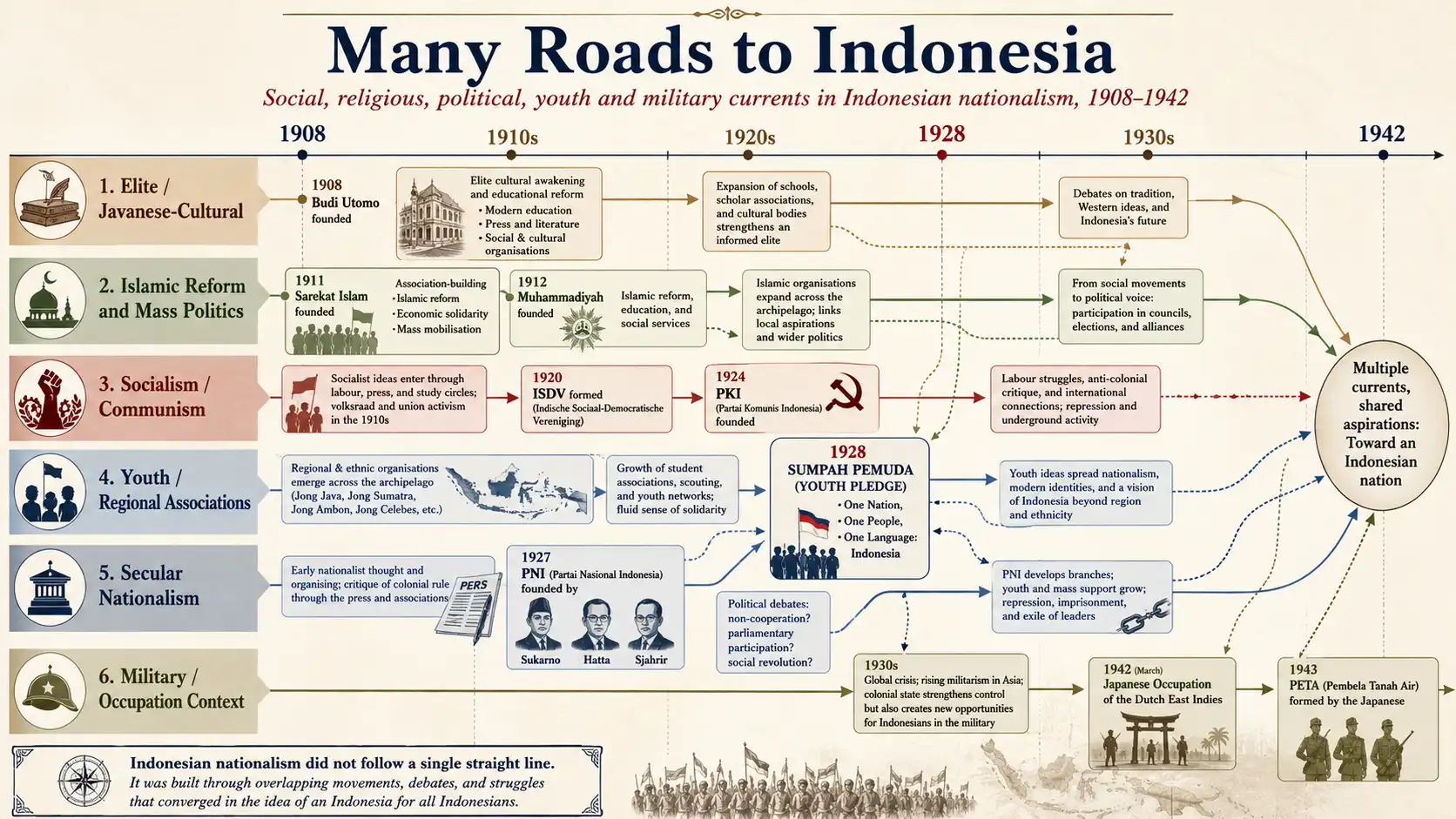
Why This Lecture Matters
This lecture matters because it prevents Indonesian nationalism from being reduced to a clean list of organisations and dates. Professor Kumar shows nationalism as a social formation: produced by education, class, race, religion, commerce, language, youth culture, repression and war. The Indonesian nation was not simply announced; it was assembled through contested movements and uneven loyalties.
Further Reading
- George McTurnan Kahin, Nationalism and Revolution in Indonesia.
- Harry J. Benda, The Crescent and the Rising Sun.
- J. D. Legge, Indonesia.
- Works on Sarekat Islam, Budi Utomo, Muhammadiyah, Nahdlatul Ulama, PKI, PNI and Sumpah Pemuda should be added when the archive bibliography is finalised.