
Professor Ann Kumar Southeast Asian Civilisation Archive
Surapati: Rebel, Warrior and Legend
How a probable Balinese slave became a military leader, anti-Dutch rebel and connective figure in the making of Indonesian historical memory.
This lecture section presents Surapati as one of the most striking figures in Professor Kumar’s seventeenth-century material. He appears at the point where Dutch monopoly, Balinese slavery, Bantenese politics, Makassarese exile, Mataram court intrigue and Javanese resistance all intersect. Surapati is not treated as a modern nationalist in the full twentieth-century sense, but as a connective figure whose career reveals earlier networks of anti-Dutch opposition across the archipelago.
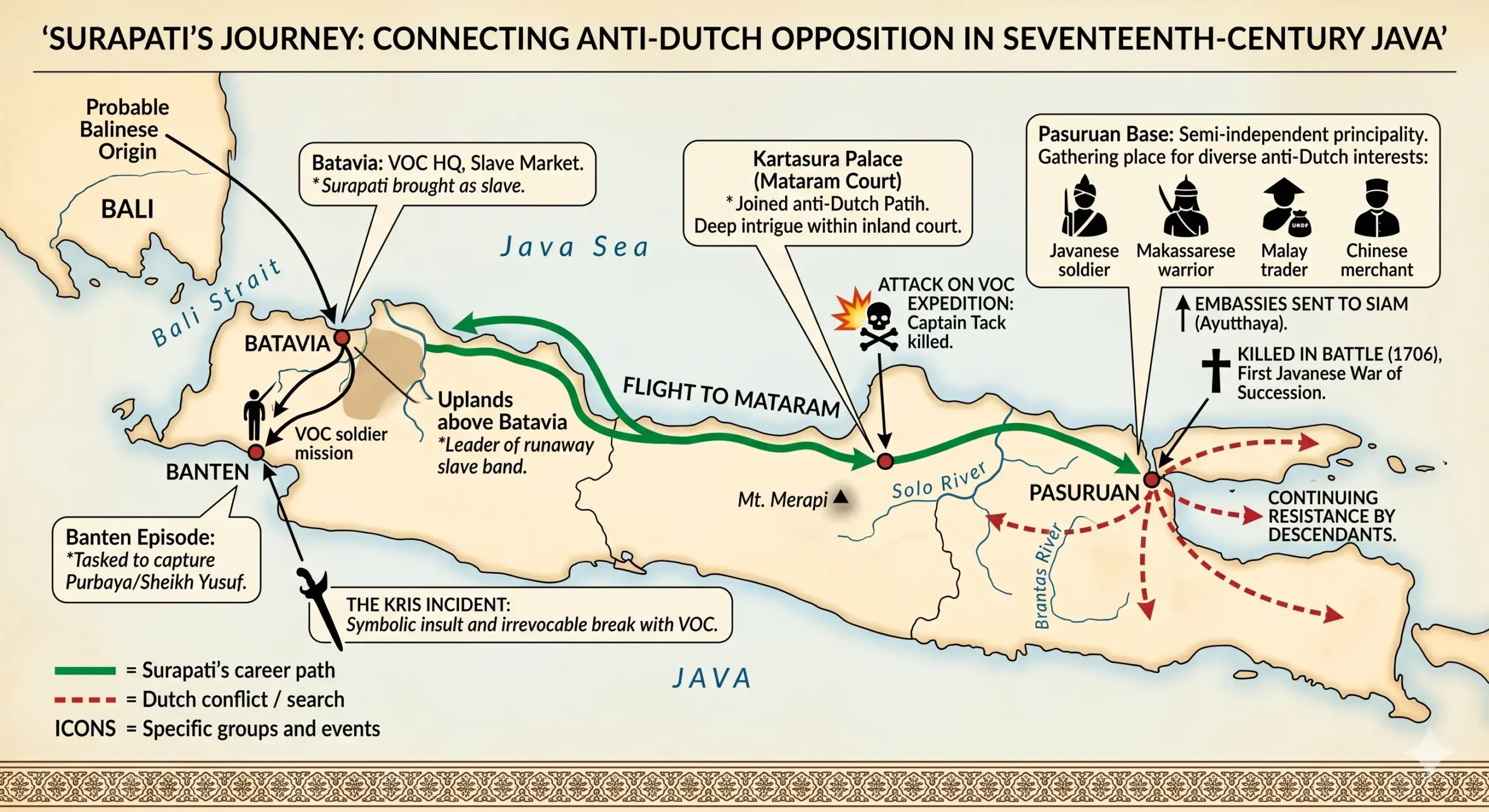
Key Idea
Surapati matters because he links otherwise separate worlds. At the level of state organisation, seventeenth-century Indonesia was politically fragmented. At the level of people, trade, exile, Islam, military service and anti-Dutch interest, however, connections existed. Surapati’s career makes those connections visible.
Fragmented States, Connected People
Professor Kumar introduces Surapati while asking a larger historical question: was the modern nation of Indonesia entirely a Dutch creation, or were there earlier ties between the different parts of the archipelago? Her answer is careful. At the level of state organisation, there was no single Indonesian unity in the seventeenth century. The archipelago was divided into many political units, each with its own interests.
Yet at the personal and social level, there were people whose lives linked different regions and communities. Surapati is one of these figures. He appears across the histories of Batavia, Banten, Mataram and East Java, and becomes involved with many of the anti-Dutch groups active in the decades immediately before and after 1700.
A Non-Royal Protagonist
Surapati is unusual because he was not of royal birth. Professor Kumar notes that he was one of the few important protagonists of the period whose origins were not aristocratic. Although the details are uncertain, he was probably in origin a Balinese slave brought to Batavia.
This background matters. Batavia contained a significant number of Balinese slaves, many of them victims of wars between Bali’s petty principalities. Some escaped, formed gangs and fled to the uplands above Batavia. It is in this world that Surapati first appears, as the leader of a band of Balinese.
From Runaway Leader to VOC Soldier
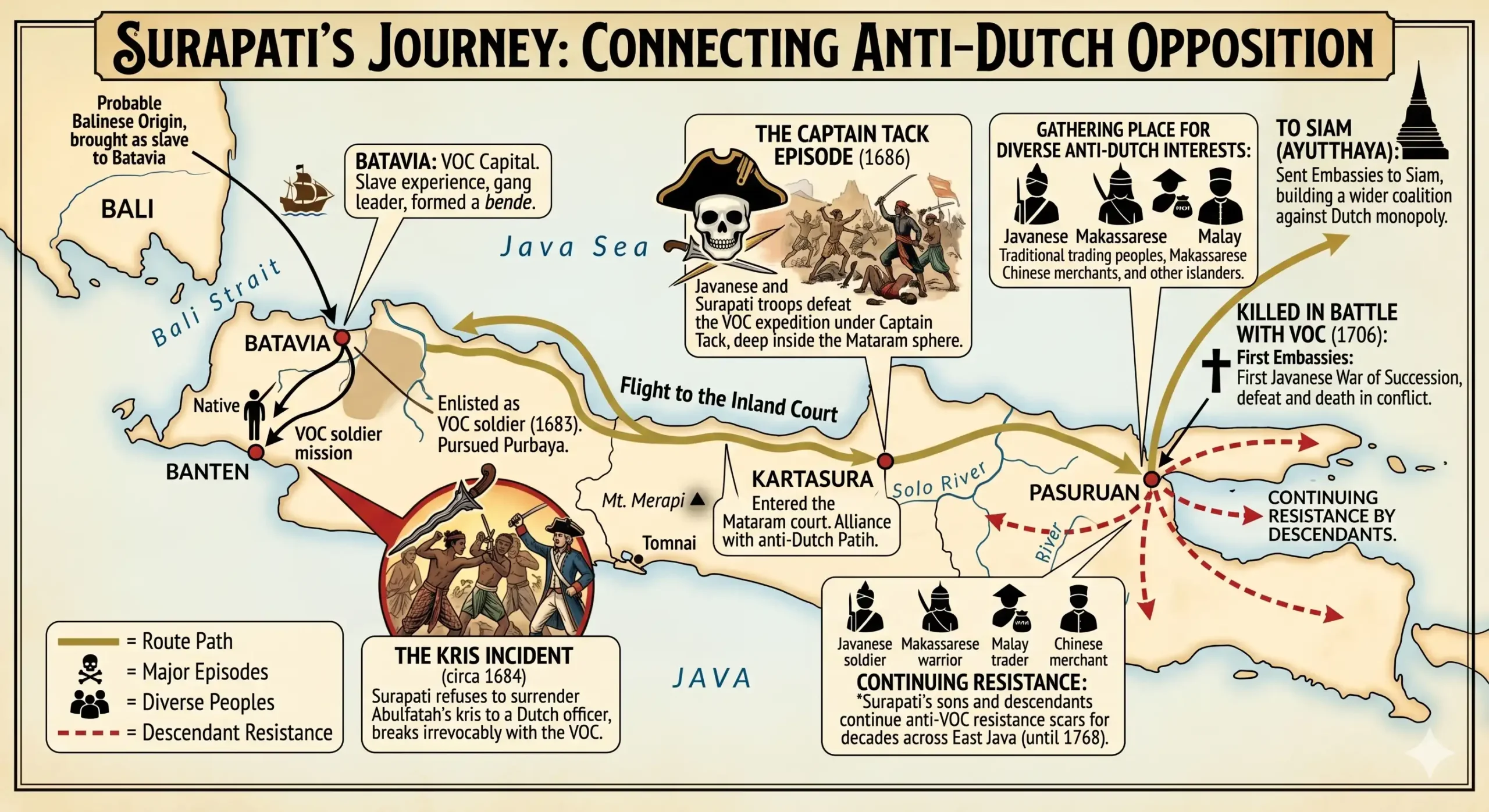
For a time, Surapati enlisted in the VOC army. This brought him into the affairs of Banten, where he was given the task of locating Abulfatah and his party and arranging for their surrender. The party included Abulfatah’s loyal son Purbaya and the Makassarese Muslim scholar Sheikh Yusuf.
This episode already reveals the wide network of connections surrounding Surapati. Bantenese politics, Makassarese exile, Islamic scholarship and Dutch military service all meet in one event. Surapati begins as someone working within the VOC system, but he will soon break decisively from it.
The Kris Incident
Surapati arranged for the surrender of Abulfatah’s party, but the behaviour of a Dutch officer transformed the situation. The officer demanded that Abulfatah’s personal kris be surrendered. In Abulfatah’s terms, this was a humiliating demand.
The demand caused the Banten party to flee and led to a quarrel between Surapati and the Dutch officer. That quarrel became the point of no return. Surapati broke irrevocably with the VOC.
Flight to Mataram
After the break with the VOC, Surapati was pursued by Dutch forces and escaped into the capital of Mataram. There he joined forces with the Patih, who was pursuing an anti-Dutch policy.
This move is central to Surapati’s significance. He does not remain a local runaway leader or a Banten episode. He enters the politics of Java’s great inland court. His career begins to connect Batavian slavery, Bantenese resistance and Mataram court politics.
Mangkurat II and Captain Tack
At this time, the ruler of Mataram, Mangkurat II, was under pressure because of debt from the Trunajaya war. When he learned that the VOC was sending an expedition to Kartasura under Captain Tack, he feared that the Dutch were coming to extract payment or enforce concessions.
In fact, Tack had authority to reduce the debt if Mataram renounced claims to sovereignty over Cirebon. He was also instructed to get Surapati. Mangkurat II was unwilling to take open arms against the Dutch himself, but he allowed Surapati to make an attack.
The attack took the Dutch by surprise. The expedition suffered heavy losses, including the death of Captain Tack himself. This moment gave Surapati one of his most dramatic victories and deepened his reputation as a formidable anti-Dutch figure.
Pasuruan: A Semi-Independent Domain
After the killing of Tack, Mangkurat II lost courage in the face of VOC anger and promised to punish those responsible. Surapati left Kartasura for East Java, where he established a semi-independent principality at Pasuruan.
Pasuruan became a gathering place for anti-Dutch elements from many regions: Javanese, Makassarese, Malays and Chinese. Professor Kumar emphasises that these were mostly trading peoples who had the most to lose from Dutch monopoly. Surapati also sent embassies to Siam, showing that his connections extended beyond Java.
The First Javanese War of Succession
In 1703, the First Javanese War of Succession broke out. Surapati took the anti-Dutch side. The Dutch-backed candidate eventually won, and thereafter the VOC turned its attention to Surapati’s domain.
In 1706, the Dutch sent an expedition to Pasuruan, and Surapati himself was killed in battle. The following year, a second Dutch expedition took Pasuruan. His sons escaped deeper into eastern Java, where they and their descendants continued to cause trouble for the Dutch for many years.
Communication Among Anti-Dutch Groups
Professor Kumar’s conclusion is cautious but suggestive. From Surapati’s career, she argues, one can perhaps deduce a certain amount of communication and co-ordination between those elements whose interests led them to oppose the Dutch.
These were mainly Islamic trading communities — Banten, Makassar, Malays from Borneo and others — though Surapati’s own religious identity is not securely known. Professor Kumar notes that many Balinese in Batavia became Muslims and were absorbed into the Batavian population, but she does not overstate the evidence.
Surapati and National Memory
Surapati later became a national hero of the modern Indonesian republic. Professor Kumar explains why: he was involved with almost every anti-Dutch group in the decades around 1700, and his life cuts across the fragmented political map of the archipelago.
He is therefore an ideal transitional figure for the archive. He belongs to the Colonial Engine because his life was shaped by VOC monopoly, military service and Dutch coercion. But he also belongs to the Nationalist Awakening Hub because later Indonesian memory could see in his career an early pattern of resistance linking different peoples against Dutch power.
Surapati in the Archive’s Larger Argument
Surapati is important not because he proves the existence of Indonesia before Indonesia, but because he prevents us from seeing the seventeenth-century archipelago as mere fragmentation. His career reveals lines of movement, alliance and shared interest: from Bali to Batavia, Banten to Mataram, Kartasura to Pasuruan, Java to Siam.
In this sense, he is one of Professor Kumar’s most vivid connective figures. Through him, the archive can show how anti-Dutch feeling, Islamic trading networks, court politics, migrant communities and commercial grievances moved through the archipelago long before the formal language of nationalism emerged.
Map / Diagram / Visual Context
Why This Lecture Matters
Surapati is one of the archive’s best figures for showing how early anti-Dutch resistance could cross boundaries of ethnicity, region and status. His story touches slavery, military service, honour, Islam, court politics, trade and rebellion. Professor Kumar’s treatment is careful: she does not turn him into a modern nationalist too early, but she does show why later Indonesia could remember him as a hero of resistance.
Further Reading
- H. J. de Graaf, writings on seventeenth-century Java, Mataram and VOC-Javanese relations.
- B. Schrieke, Indonesian Sociological Studies.
- Works on Surapati, Mataram, Banten and early anti-Dutch resistance should be added when the archive bibliography is finalised.
- For a later archive enrichment feature, Surapati could be developed into an interactive journey map linking Batavia, Banten, Mataram, Pasuruan and Siam.