
Professor Ann Kumar Southeast Asian Civilisation Archive
Java Under the VOC: Forced Deliveries, Coffee-Sergeants and the Chinese Crisis
How the Dutch East India Company governed Java through local aristocrats, commodity extraction, forced deliveries and the administrative foundations of colonial rule.
This lecture examines how the VOC’s presence in Java changed during the eighteenth century. Professor Kumar shows that Dutch authority did not develop simply through outright conquest. Instead, the Company increasingly worked through existing Javanese political structures, especially the regents, while binding Java more tightly to systems of commodity extraction, forced delivery and administrative supervision.
Java became the central arena in which the VOC moved from a maritime trading company toward something closer to a territorial colonial power. The result was a hybrid order: Dutch commercial demands imposed through Javanese aristocratic intermediaries.
Key Idea
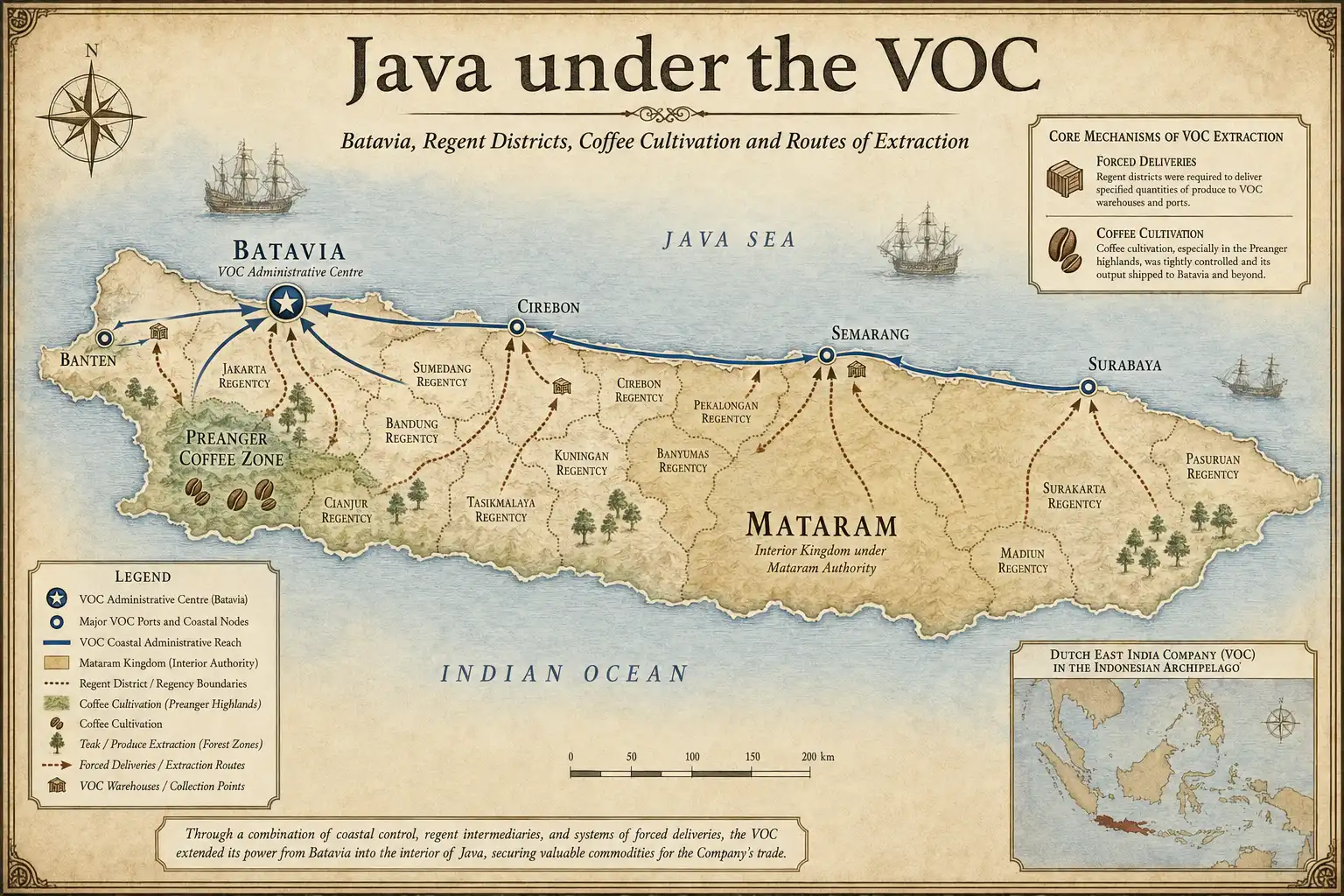
Java under the VOC was governed through layered authority. Dutch officials did not administer every village directly. They relied on Javanese regents, local elites and existing administrative habits, while reshaping these structures around export crops, tribute, forced deliveries and Company revenue. This system became one of the foundations of later Dutch colonial rule.
From Maritime Trade to Java-Centred Extraction
By the late seventeenth and eighteenth centuries, the VOC’s earlier dream of a far-flung Asian trade web had begun to fail. Many posts were expensive to maintain, wars were costly, and Company servants engaged in private trade and other forms of malpractice. Increasingly, the VOC turned toward Java as the centre of a more dependable extractive system.
Java offered advantages that scattered forts and trading posts could not. It had fertile land, dense population, established political institutions and a long-standing administrative culture. These features made it possible for the VOC to obtain commodities through existing forms of authority rather than through direct European administration alone.
Professor Kumar’s lecture therefore presents Java as a turning point in the nature of Dutch power. The Company remained commercial in purpose, but its methods became increasingly territorial, administrative and coercive.
Java’s Existing Political Structure
Java already possessed one of the most sophisticated political cultures in Southeast Asia. Courts such as Mataram governed through elaborate hierarchies of aristocrats, officials and regional governors. Authority radiated outward from the royal court through a network of subordinate elites who administered land, collected tribute and maintained order.
The Dutch quickly recognised the usefulness of this system. Direct rule over millions of people would have been impossible for the Company. Instead, Dutch administrators relied on the existing class of Javanese aristocrats known as regents or bupati.
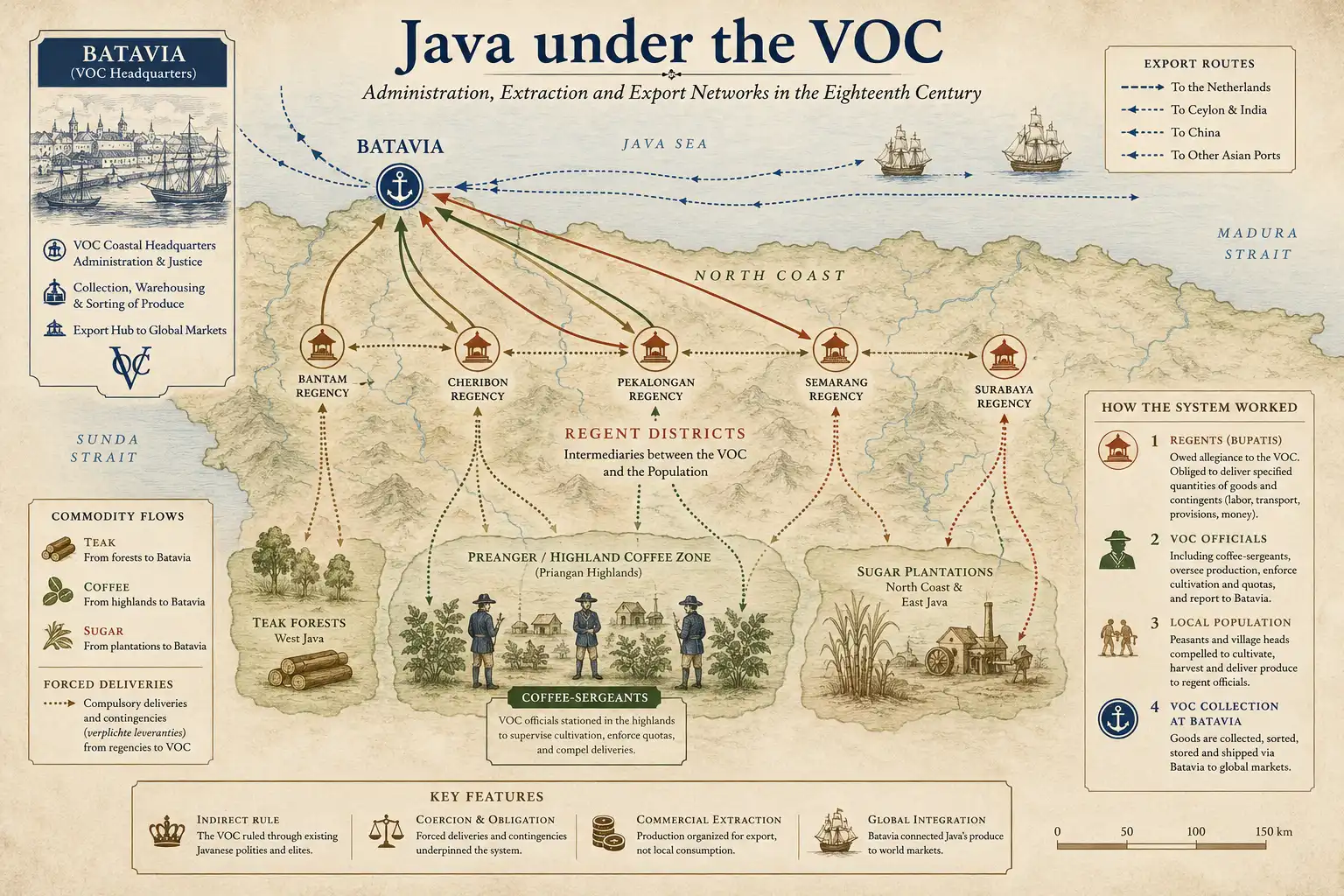
These officials became crucial intermediaries between Dutch colonial authority and the rural population. They collected obligations, supervised labour and helped ensure the delivery of agricultural products demanded by the Company.
The Regent System
The regent system became the backbone of Dutch administration in Java. Regents governed districts on behalf of the colonial state while preserving many outward forms of traditional authority. This arrangement allowed the Dutch to govern extensive territories with relatively small numbers of European officials.
Professor Kumar stresses that the regent system should not be understood as simple collaboration. It was a complex political accommodation. Dutch authorities gained revenue, order and access to labour. Javanese aristocrats preserved rank, prestige and influence, even as their authority was increasingly redirected toward Company purposes.
This was one of the great paradoxes of Dutch rule in Java. Dutch power became decisive, yet much of the administrative work remained in Javanese hands.
Forced Deliveries and Contingencies
VOC extraction in Java rested on systems known as forced deliveries and contingencies. In forced delivery areas, regents were required to provide specified quantities of produce to the Company, often at fixed or increasingly unfavourable prices. In other districts, contingencies operated more like tribute, requiring the delivery of a portion of local production.
These arrangements tied Javanese agriculture to Company needs. They also blurred the boundary between traditional tribute and colonial extraction. What might have appeared as local administrative continuity became, in practice, an increasingly disciplined system for moving products from village fields to Dutch-controlled markets.
Coffee, Teak and the Preanger
The VOC increasingly depended on Java for export produce. Teak was important because Java still possessed extensive forests. Coffee became especially significant after its introduction into the hilly regions of West Java, particularly the Preanger.
Coffee production required organisation, supervision and discipline. It also required the cooperation of regents, who were expected to deliver agreed quantities while mobilising labour and land within their districts. The burden of these arrangements ultimately fell on cultivators.
Java’s fertile agricultural landscape made this transformation possible. Rice production had long supported dense population and complex political organisation. Under Dutch influence, however, agricultural labour was increasingly drawn toward export commodities demanded by international markets.
The Coffee-Sergeants
The humble beginnings of later Dutch colonial administration can be seen in the appointment of overseers, or opzieners, sometimes known as coffee-sergeants. Their task was to ensure that cultivators complied with instructions to plant and deliver the required crops.
These officials stood between the Company, the regents and the cultivators. They were supposed to supervise production and keep an eye on local officials. In practice, they also became part of the system’s corruption and informal credit arrangements, sometimes advancing money to regents and profiting from their intermediary position.
Batavia and the Administrative Centre
Batavia stood at the centre of this system. Founded by the Dutch earlier in the seventeenth century, it functioned as the headquarters of the VOC and the administrative heart of its Asian empire.
From Batavia, the Company dealt with Javanese rulers, regents, Chinese commercial networks, soldiers, merchants and European competitors. It was both a port city and a political command centre.
As Java became more important to VOC finances, Batavia’s relationship to the interior changed. The Company was no longer merely operating from a coastal base. It was increasingly entangled in the governance, succession politics, agriculture and labour arrangements of Java itself.
The Chinese Crisis of 1740
The Chinese community in Batavia was central to the city’s commercial life. Chinese residents worked as artisans, traders, restaurateurs, arak distillers and commercial agriculturalists, especially in sugar. Their presence had originally been encouraged by Dutch leaders who regarded Chinese labour and enterprise as essential to Batavia’s success.
Over time, however, Dutch authorities became anxious about unemployed Chinese migrants and itinerant groups. Regulations were introduced for the deportation of Chinese people deemed not usefully employed. Abuses followed. Some officials extorted money under threat of deportation, and rumours spread that deported Chinese were being thrown overboard at sea.
These tensions led to flight, armed resistance and then massacre. In 1740, violence erupted in Batavia, where the remaining Chinese population was attacked. The crisis then spread beyond the city along the north coast of Java and into the politics of Mataram.
Mataram, Succession and VOC Intervention
The Chinese crisis became entangled with Javanese politics. Pakubuwana II, ruler of Mataram, initially joined forces with anti-Dutch elements before changing course and making peace with the VOC. Javanese involvement, however, developed its own momentum. The anti-Dutch party continued the struggle, and Pakubuwana II was temporarily displaced.
The VOC eventually restored him, with the assistance of allies such as Cakraningrat IV of Madura. But the political cost was high. Pakubuwana II was compelled to cede the north coast of Java and renounce claims over Madura. The capital was shifted to Surakarta.
No lasting peace followed. Mangkubumi and Mas Said rose in rebellion, and the war gradually took on the character of resistance to Dutch control. The eventual result was the partition of Mataram.
The Partition of Mataram
In 1755, the Treaty of Giyanti divided Mataram into two principalities: Surakarta, under Pakubuwana III, and Yogyakarta, under Mangkubumi, who took the title Hamengkubuwana. Both states acknowledged VOC sovereignty.
In 1757, a third smaller principality, the Mangkunegaran, was created for Mas Said. The territories of these principalities were fragmented and interspersed, a deliberate arrangement that prevented dangerous concentrations of power.
The partition of Mataram shows how VOC intervention reshaped Javanese sovereignty. The Company did not merely support one ruler against another. It reorganised the political geography of central Java in ways designed to make future resistance more difficult.
Balambangan and the Oosthoek
The final major Dutch campaign on Java was the conquest of the Oosthoek, centred on Balambangan. This region belonged more to the Balinese cultural sphere than to the Javanese and became a refuge for anti-Dutch elements: descendants of Surapati, Chinese who had fled after the 1740 troubles, Buginese, Makassarese and Madurese.
One striking cultural result of the Dutch conquest was the enforced shift from Hinduism to Islam, intended to weaken Balambangan’s ties with Bali. This episode reveals that Dutch action was never purely commercial or administrative. It could intervene directly in religious and cultural alignments where these affected political control.
A Hybrid Colonial System
Java under the VOC was therefore neither fully traditional nor fully European. It was a hybrid system in which Javanese aristocrats, Dutch officials, Chinese commercial actors and local cultivators were all drawn into a changing structure of power.
The Company’s authority grew through alliance, coercion, administrative improvisation and economic need. Its officials relied on regents while also supervising and constraining them. They preserved existing structures while redirecting their purpose. They depended on local intermediaries while making those intermediaries serve global trade.
Professor Kumar’s lecture highlights the long-term importance of this development. When the VOC collapsed at the end of the eighteenth century, the administrative structures it had helped build in Java did not vanish. They became the foundation of the later Dutch colonial state.
Map / Diagram / Visual Context
Key Terms
VOC
The Dutch East India Company; a commercial corporation that increasingly acted as a political and administrative power in Java.
Regents / Bupati
Javanese aristocratic officials who governed districts and became crucial intermediaries between Dutch authority and rural society.
Forced Deliveries
Obligations requiring specified quantities of produce to be delivered to the Company, often under unfavourable conditions.
Contingencies
Tribute-like deliveries of produce from districts to the VOC, part of the wider extractive structure.
Coffee-Sergeants
Overseers who supervised coffee cultivation and delivery, especially in the Preanger highlands.
Chinese Crisis of 1740
The Batavian massacre and wider conflict involving Chinese communities, VOC authorities and Javanese politics.
Why This Lecture Matters
This lecture shows how Dutch colonial rule in Java was built through existing Javanese institutions rather than through simple replacement. Regents, forced deliveries, contingencies, coffee-sergeants and court politics formed a system that allowed the VOC to extract wealth while governing indirectly.
The lecture also explains why Java became central to the Dutch colonial project. The Company’s maritime trade empire faltered, but Java offered land, population, administrative intermediaries and export crops. The structures created under the VOC survived the Company’s collapse and shaped the later Dutch colonial state.
Further Reading
- J. S. Furnivall, Netherlands India: A Study of Plural Economy.
- H. J. de Graaf, works on the VOC, Mataram and eighteenth-century Java.
- Leslie H. Palmier, writings on social status and the Javanese nobility.
- Van Welderen Rengers, The Failure of a Liberal Colonial Policy.
- Further readings on Batavia, the Chinese community, the Preanger coffee system and the Treaty of Giyanti should be checked against the final archive bibliography.
Archival Note
This page is a breakout / enrichment treatment drawn from Professor Kumar’s wider lecture on changes in the nature of the VOC empire. It focuses specifically on Java as an administrative and extractive colonial system: regents, forced deliveries, contingencies, coffee-sergeants, the Chinese crisis, the partition of Mataram and the foundations of later Dutch colonial rule.