
Professor Ann Kumar Southeast Asian Civilisation Archive
The Cultivation System / Cultuurstelsel
How Van den Bosch turned Java into a state-managed engine of export production — and how forced cultivation reshaped Dutch wealth, Javanese labour and colonial criticism.
This focused teaching page draws out one of the central subjects of Professor Kumar’s Lecture I: the Dutch Cultivation System, or cultuurstelsel. Introduced by Johannes van den Bosch after the Java War, the system revived the tribute logic of the old VOC while placing it inside a modern colonial state. It made Java profitable for the Netherlands, but at heavy cost to Javanese peasants, village life and colonial legitimacy.
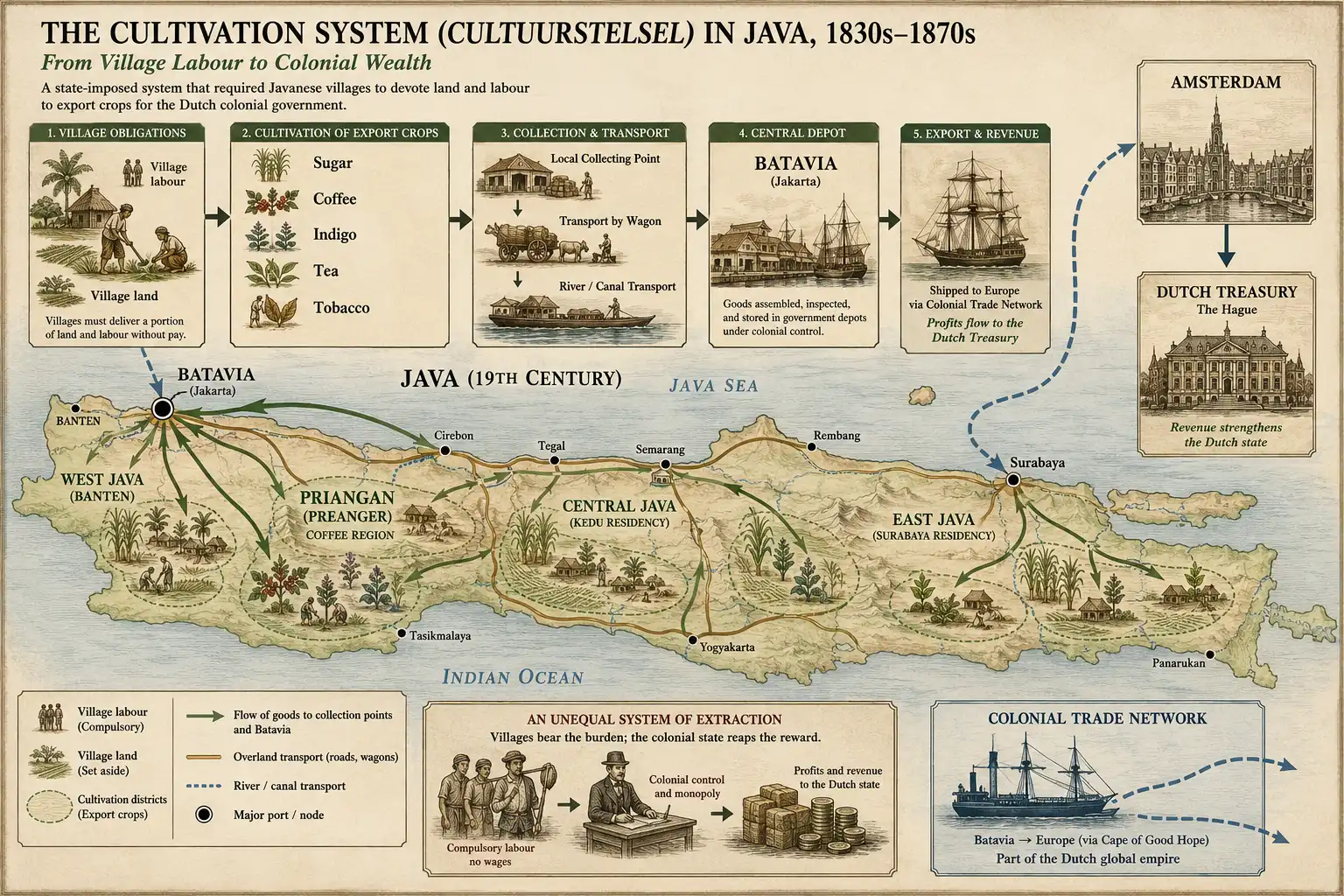
Key Idea
The Cultivation System was not merely an agricultural policy. It was a fiscal machine. After the Java War left the colonial government in financial distress, Van den Bosch revived forced production in a new form, requiring Javanese communities to provide land and labour for export crops. The system enriched the Netherlands while imposing deep burdens on Java.
After the Java War: Fiscal Crisis and Colonial Opportunity
Professor Kumar places the Culture System immediately after the Java War of 1825–1830. The war had ravaged Java and worsened the financial position of the Dutch colonial government. The Dutch had gained more direct control, but at enormous cost. A new system was needed to make the colony pay.
Into this crisis came Johannes van den Bosch, who arrived as Governor-General in 1830. His appointment reflected his reputation for colonial profitability. He had previously been sent on a special mission to restore prosperity to the Dutch West Indies and had managed to make that colony yield a substantial annual profit to the Netherlands.
A Rejection of Daendels and Raffles
Van den Bosch was not an admirer of the reforms associated with Daendels and Raffles. Daendels and Raffles had both, in different ways, moved towards more direct administration, a reduction of regent power and a more regularised state system. Raffles in particular had attempted to replace forced deliveries with land tax.
Van den Bosch moved in the opposite direction. He revived the old logic of compulsory production. The aim was not to create a freer agricultural economy, nor to leave production to private enterprise, but to make Java serve the fiscal needs of the colonial state.
What Was the Cultivation System?
The Dutch term cultuurstelsel literally means a cultivation arrangement or cultivation system. Professor Kumar explains that its provisions harked back to the VOC’s contingencies and forced deliveries. Javanese peasants were required to deliver specified quantities of export produce, or to provide the land and labour necessary to produce them.
In theory, the system could be described as an organised agricultural scheme. In practice, it returned Java to a tribute-like structure in which village labour, land and crop choice were subordinated to the colonial state’s need for export revenue.
The NHM and the New Colonial Machine
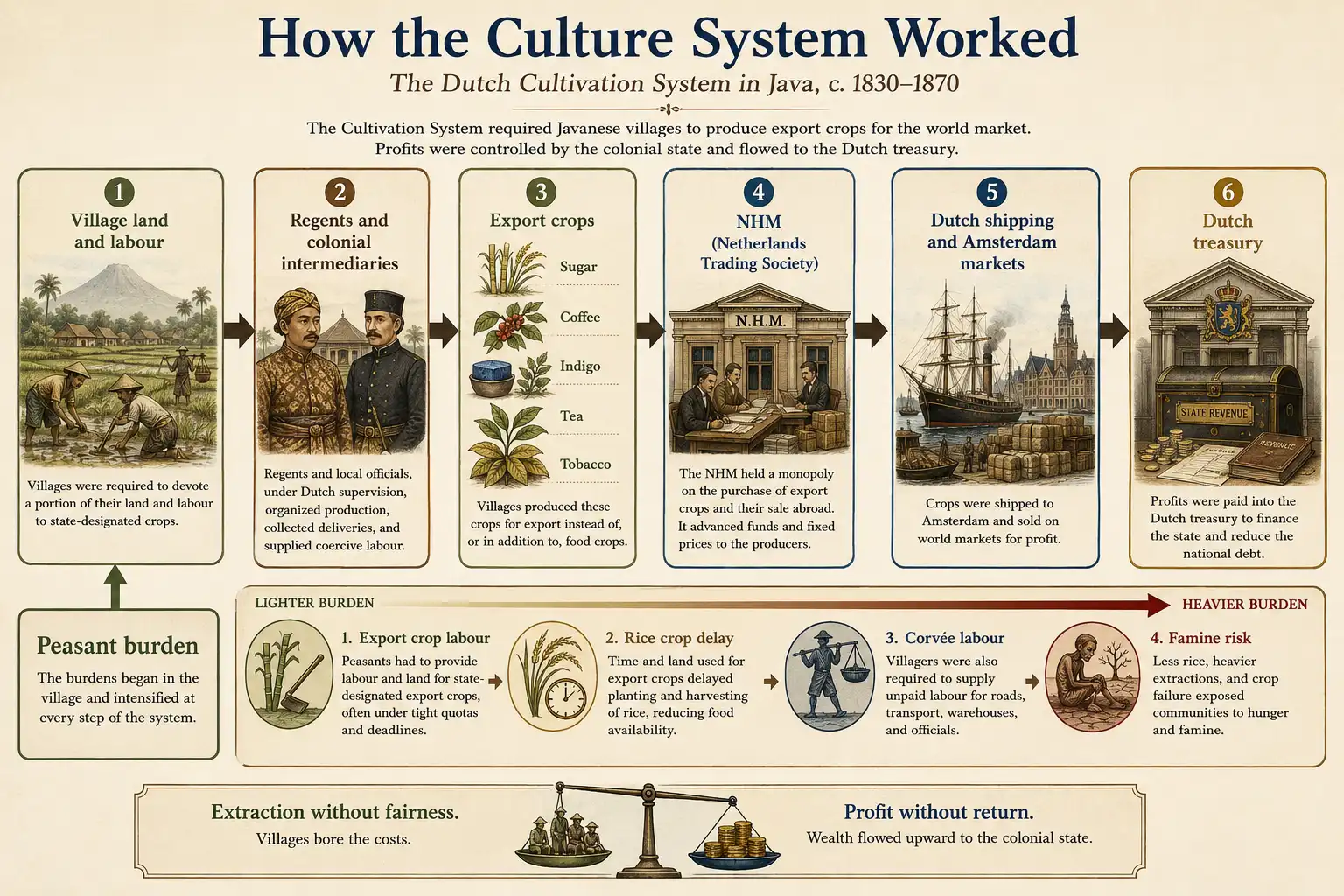
The Culture System differed from the old VOC model in one institutional respect. The government itself no longer exported the products directly in the way the VOC had done. That work was now carried out by a semi-official body, the Nederlandsche Handelsmaatschappij, or NHM.
But Professor Kumar stresses that this difference did not alter the central fact. Van den Bosch had returned to the old tribute system. Java was once again organised as a machine for collecting export produce and sending it to Europe.
The Restoration of the Regents
Van den Bosch also restored the position of the Javanese regents. He believed that the Java War and wider unrest had been worsened by the erosion of their traditional authority. He disapproved of the way earlier reforms had reduced them to government servants who could be transferred from place to place.
He therefore recognised hereditary succession in the regencies and returned to a system in which regents derived income from large landholdings and rights to peasant labour rather than from salaries. This was not a return to pre-colonial autonomy. It was a colonial use of traditional authority.
What Was Grown?
Van den Bosch began with indigo and sugar, but the list of compulsory export products expanded. Coffee, tea, tobacco, pepper, cinnamon, cotton and other products were added over time. The system therefore touched multiple regions, crops and labour regimes.
These crops were not grown primarily for local subsistence. They were produced for export and for Dutch revenue. Under the Culture System, Java’s agricultural landscape was increasingly drawn into the rhythms of European demand, colonial accounting and global commodity markets.
Profit for the Netherlands
The system did exactly what Van den Bosch hoped it would do. It made the colony pay. Over time, it provided a growing proportion of the Dutch domestic budget. Professor Kumar notes that by 1833, according to Hall, a profit of three million guilders was paid into the Dutch treasury.
Enormous quantities of produce flowed into Holland. The system revived Dutch shipping, made Amsterdam a great entrepôt for tropical products and helped pay off the Netherlands’ public debt. From the Dutch perspective, it was a spectacular fiscal success.
The Burden on Javanese Peasants
Professor Kumar then asks the crucial question: what was the effect of the Culture System on the Javanese? The answer is mixed in the historiography, but the burdens were severe. Peasants had to grow government export crops before they grew the rice crops needed to feed themselves and their families.
Van den Bosch had laid down that no more than 66 days per year should be spent on government crops. In practice, coffee alone could require at least 90 days. In addition, the corvée requirement for road-building and other public works remained. Professor Kumar notes that a peasant could end up working as many as 200 days a year for the government.
Famine and Contested Assessment
During the years 1848–1850 there was widespread famine in Central Java. Professor Kumar connects this to the burden of forced cultivation and the shortage of time left for peasants to grow food for themselves.
Yet she also preserves the complexity of the historical debate. Urquhart argued that our picture of the Culture System was painted by the liberals who later abolished it, and that they deliberately painted it in very dark colours. Hall, by contrast, noted that the population of Java increased under the system, that rice cultivation rose in aggregate figures and that some introduced export crops may have brought benefits.
Professor Kumar therefore does not present the Culture System as a simple morality tale. She acknowledges both its enormous burdens and the contested nature of its historical interpretation.
Liberal Criticism
The famines of the 1840s made a deep impression in the Netherlands. From this point, Dutch liberals began a long and bitter campaign against the Culture System. Professor Kumar notes that “liberal” is an ambiguous word. It included humanitarian reformers who wanted a freer and more humane society for the Javanese, but also free-enterprise liberals who objected to government monopoly and wanted the colony opened to private capital.
This ambiguity matters. Opposition to the Culture System did not necessarily mean opposition to colonial exploitation. Some critics wanted justice; others wanted opportunity for private planters and businessmen. Both currents helped bring the system under attack.
Max Havelaar
In 1860, the movement against the Culture System gained momentum with the publication of Max Havelaar. Its author, Eduard Douwes Dekker, wrote under the pseudonym Multatuli, meaning “I have suffered much.”
The novel was based on Douwes Dekker’s own colonial career and told the story of an official dismissed because he tried to protect local people from oppression under the Culture System. Professor Kumar notes that Multatuli was especially critical of the Dutch practice of getting the regents to do their extortion for them.
Van der Putte and Sugar Contracts
The second major publication of 1860 was Isaac van der Putte’s pamphlet, The Regulation of Sugar Contracts in Java. Van der Putte had worked in the sugar industry and later became familiar with free cultivation as a tobacco planter in eastern Java.
Professor Kumar stresses his practical knowledge of how the Culture System operated. Van der Putte argued that famine had awakened public conscience in the Netherlands. He rejected the idea that the chief causes of suffering were natural disaster, local misgovernment or isolated abuses. The primary cause, he argued, was the Culture System itself, which was “rooted in unrighteousness.”
Towards Free Enterprise
Critics of reform warned that abolishing the Culture System would deprive the Netherlands of a large Indonesian contribution to its budget. Van der Putte argued instead that wise reforms and the liberation of land and labour would generate equally large revenue through direct taxation.
Professor Kumar notes the resemblance to Raffles’ ideas. Dutch liberals such as Thorbecke regarded Raffles with some admiration. When Thorbecke’s Liberal government came to office in 1862, Van der Putte became Minister of Colonies, and during his tenure from 1863 to 1866 colonial policy began moving in the direction of free enterprise.
This Page in the Archive’s Larger Argument
The Cultivation System is one of the clearest examples of the Colonial Engine at work. It shows Dutch colonial government organising land, labour, crops, aristocratic authority, trade companies and fiscal policy into a single system of extraction. It also shows how that system generated its own criticism, first through famine and moral outrage, then through liberal demands for free enterprise.
This page should be read alongside the broader transition lecture, From c. 1800 to the End of the Culture System, and before the next lecture on the Liberal Period. Together, they trace the shift from forced state cultivation to plantation capitalism — not the end of colonial exploitation, but a change in its form.
Map / Diagram / Visual Context
Why This Lecture Matters
The Cultivation System matters because it reveals colonialism as a practical machinery of extraction. It was not only an ideology or a set of laws, but a working system that connected Javanese villages to Dutch budgets and European markets. Professor Kumar’s treatment shows why the system was profitable, why it was burdensome, why it was historically contested and why its eventual dismantling opened the way to a new phase of colonial capitalism.
Further Reading
- Eduard Douwes Dekker / Multatuli, Max Havelaar.
- Isaac van der Putte, The Regulation of Sugar Contracts in Java.
- J. S. Furnivall, Netherlands India.
- D. G. E. Hall, writings on Southeast Asian history and the Dutch colonial system.
- J. B. Money, Java, or How to Manage a Colony.
- Further readings on Van den Bosch, the NHM, Java’s sugar economy and liberal colonial reform should be added when the bibliography page is finalised.