
Professor Ann Kumar Southeast Asian Civilisation Archive
From c. 1800 to the End of the Culture System
How the Dutch East Indies moved from VOC inheritance to colonial state-building, reform, war and forced cultivation.
This lecture begins where the VOC story ends: with the dissolution of the Dutch East India Company and the transfer of responsibility for the East Indies to the Dutch state. Professor Kumar traces the competing reform and conservative visions that followed, the interventions of Daendels and Raffles, the shock of the Java War, and the creation of the Culture System under Van den Bosch. It is a lecture about the making of colonial government out of Company inheritance, fiscal crisis and administrative experiment.
Key Idea
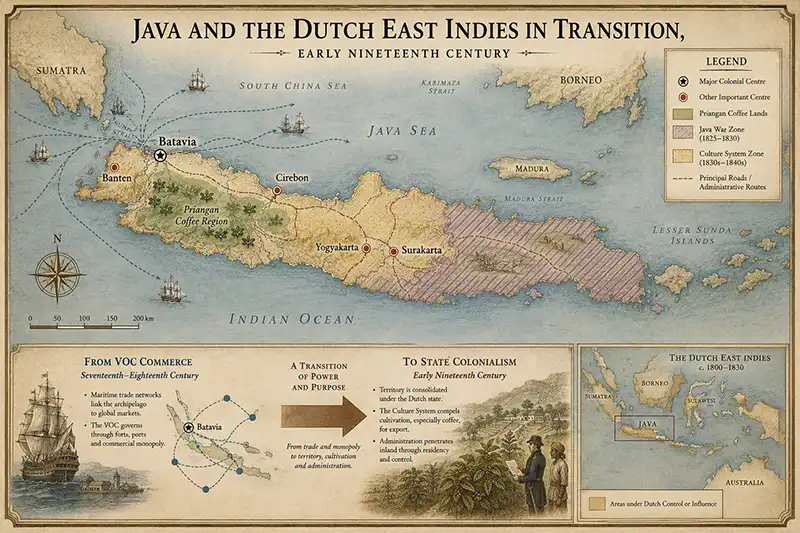
After 1800, Dutch rule in Indonesia was no longer the rule of a chartered company but the responsibility of a state. Yet the old VOC inheritance did not disappear. Reformers tried to modernise administration and taxation, while conservatives preserved forced production. War, debt and fiscal pressure eventually produced the Culture System — a state-run machine for extracting export crops from Java.
After the VOC: Who Should Govern the Indies?
Professor Kumar begins with the date reached in the previous lecture: the dissolution of the Dutch East India Company on 31 December 1799. Once the Dutch state inherited responsibility for the East Indies, an acute controversy emerged over how the colony should be governed.
Liberal opinion in the Netherlands wanted direct administration and the abolition of the old VOC system of contingencies and forced deliveries. Their position found important expression in the report of Dirk van Hogendorp, a former governor in Java. Opposed to them stood a more conservative group, represented by Nederburgh, who argued that Indonesians had to be compelled to grow export crops both for their own good and for Dutch profit.
In the short term, the conservatives won. The old VOC system continued more or less unchanged for another decade. Yet the forces of Enlightenment reform, the French Revolution, European war and British industrial power were soon to push the Indies into a period of dramatic administrative change.
Daendels: The Thundering Marshal
The process of change began in 1808, when Herman Willem Daendels became Governor-General. A Dutchman by birth and a Napoleonic marshal by career, Daendels was given dictatorial powers to reorganise the administration and strengthen Java’s military defences in the French interest.
Professor Kumar presents Daendels as a figure of tremendous energy — the “Thundering Marshal” — determined not merely to hold Java but to govern it. He built barracks, hospitals, gun foundries, ships and roads. To fund these projects, he increased forced coffee cultivation on a large scale.
He also reorganised the governmental structure of Java. The Javanese regents, whom Van Hogendorp had criticised as “ignorant, idle, and extortionate,” were reduced to the position of civil servants subordinate to Dutch officials. Yet they still derived income from land and people rather than from regular salaries. Daendels also tried to stamp out corruption among Dutch officials, though his high-handed methods made enemies among both Dutch and Javanese elites.
The British Interregnum and Raffles
Daendels’ military strengthening of Java helped provoke the British takeover. The British wanted to spoil Napoleon’s wider strategy and prevent Java becoming part of a French-aligned encirclement of British interests. After the conquest, Thomas Stamford Raffles became Lieutenant-Governor of Java and the other Dutch possessions in Indonesia.
Raffles continued the movement towards direct administration begun by Daendels. In 1813, the Sultanate of Banten was abolished and annexed; Cirebon was treated in the same way. He also tightened control over the Javanese principalities of Yogyakarta and Surakarta.
Raffles approved Daendels’ reduction of the regents and went further, depriving them of political and revenue powers. The regents were increasingly excluded from government and administration. Raffles also introduced his most important innovation: a general land-tax system designed to replace contingencies and forced deliveries with a modern tax regime.
Raffles’ Land-Tax Experiment
Raffles declared the government to be the sole owner of land, making the Javanese tenants who paid land tax or land rent. The tax was levied not on individuals but on desas, and graded according to the fertility of the soil. The most fertile areas paid the highest proportion of yield, while less fertile areas paid less.
Raffles hoped the system would increase government revenue and improve the position of Javanese peasants. In theory, the abolition of forced deliveries would protect cultivators from a system in which regents had to collect fixed amounts of produce regardless of harvest conditions.
In practice, the system failed to achieve its aims at first. A comprehensive land survey was needed, but the necessary information was lacking. The survey began but could not be completed for want of time and staff. Arbitrary estimates followed, and Raffles’ administration struggled financially.
Slavery, Scholarship and the Limits of Reform
Raffles’ activities were many-sided. As a disciple of Wilberforce and the abolitionist movement, he took measures that reduced slavery in Indonesia, including restrictions on slave trading and the old institution of debt-slavery.
He was also deeply interested in Javanese history and civilisation, producing his monumental History of Java. During his administration, the Batavian Society of Arts and Sciences became more active. Yet Raffles was not universally admired by his own countrymen. His administration did not pay its way, and he faced allegations and criticism from other British officials.
The Dutch Return
Despite Raffles’ recommendation that Britain retain Java, his successor John Fendall handed it back to the Dutch in August 1816. The restored Dutch regime retained Raffles’ land-rent system and confirmed some of his measures against slavery.
It also continued the reduction of regent authority by limiting hereditary succession and arranging fixed salaries. But financial difficulties persisted. Forced coffee cultivation in the Priangan district was maintained because the colony still did not pay its way.
The direction of reform remained unsettled. The state wanted administrative regularity, but it also needed revenue. This tension would become decisive after the Java War.
The Java War and Dipanagara
The situation changed dramatically with the Java War of 1825–1830. Professor Kumar describes it as a holocaust that ravaged Java for five years. By 1808, about 60 per cent of Java had been under direct Dutch rule; by 1830, this had increased to 93 per cent.
The rebel leader was Prince Dipanagara of Yogyakarta. His rebellion was not simply a matter of disappointed succession, although succession politics formed part of the background. The immediate provocation was the Dutch decision to build a road across part of his property where there was a sacred tomb.
Dipanagara’s autobiography reveals the syncretic religious world that shaped him: Islamic orthodoxy combined with Javanese tradition, pesantrén education, ascetic retreats in caves, visions of Sunan Kalijaga and the Ratu Adil. His rebellion drew on spiritual authority as well as political grievance.
Guerrilla War and Treacherous Capture
During the five years of war, there were no major pitched battles. Dipanagara and his allies were effective at guerrilla tactics, and it took the Dutch considerable time to gain the upper hand.
In 1829, Dipanagara’s two chief allies surrendered. In 1830, he agreed to negotiate and was treacherously arrested by the Dutch general at the meeting. He was banished to Celebes and died there in 1855, having written his autobiography in exile.
Van den Bosch and the Culture System
The Java War worsened the colonial government’s financial position. The new Governor-General, Johannes van den Bosch, arrived in 1830 with a reputation for restoring colonial profitability. He had previously been sent to the Dutch West Indies and had succeeded in making that colony yield profit.
Van den Bosch was not an admirer of Daendels’ and Raffles’ reform ideas. On arrival, he introduced what became known as the Culture System, or cultuurstelsel. Its main provisions harked back to VOC contingencies and forced deliveries. The Javanese were required to deliver specified quantities of export produce, or provide the land and labour necessary to produce them.
The Dutch government itself no longer exported the products directly as the VOC had done. That role was now played by the semi-official Nederlandsche Handelsmaatschappij, or NHM. But the central fact remained: Java was once again organised as a machine for collecting export produce to ship back to Europe.
The Return of the Regents
Van den Bosch also restored the position of the Javanese regents. He believed unrest, including the Java War, had been worsened by the erosion of their traditional authority. He therefore recognised hereditary succession in the regencies and returned to the older system in which regents derived income from landholdings and rights to peasant labour rather than from salaries.
In effect, the colonial state rebuilt extraction through indigenous elites. Reform gave way to fiscal necessity. The regents became central intermediaries in a system that combined traditional hierarchy with modern state revenue demands.
Profit and Burden
The Culture System achieved what Van den Bosch intended. It made the colony pay and contributed an increasing share of the Dutch domestic budget. Products such as indigo and sugar were joined by coffee, tea, tobacco, pepper, cinnamon and cotton. Enormous quantities of produce flowed into the Netherlands.
The profits revived Dutch shipping, made Amsterdam a great entrepôt for tropical products and helped pay off Dutch public debt. For the Netherlands, the system was extraordinarily lucrative.
For the Javanese peasant, the burden could be severe. Export crops had to be grown before food crops. Although Van den Bosch prescribed limits on labour obligations, coffee required more time than allowed, and corvée labour still remained for road-building and other public works. Professor Kumar notes that peasants could end up working as many as 200 days a year for the government, leaving too little time to grow food for themselves.
Famine, Criticism and Liberal Opposition
The famines of 1848–1850 in Central Java had a major impact in the Netherlands. From this time, Dutch liberals began a long campaign against the Culture System.
Professor Kumar notes that “liberal” is an ambiguous word. Some liberals opposed the system for humanitarian reasons and wanted a freer society for the Javanese. Others were liberal in the economic sense: advocates of private enterprise who wanted to break government monopoly and open the colony to private capital.
The critique gained momentum in 1860 with two important publications. The first was Max Havelaar, written by Eduard Douwes Dekker under the name Multatuli, meaning “I have suffered much.” The second was Isaac van der Putte’s pamphlet on sugar contracts in Java. Both helped expose the moral and economic contradictions of the system.
This Lecture in the Archive’s Larger Argument
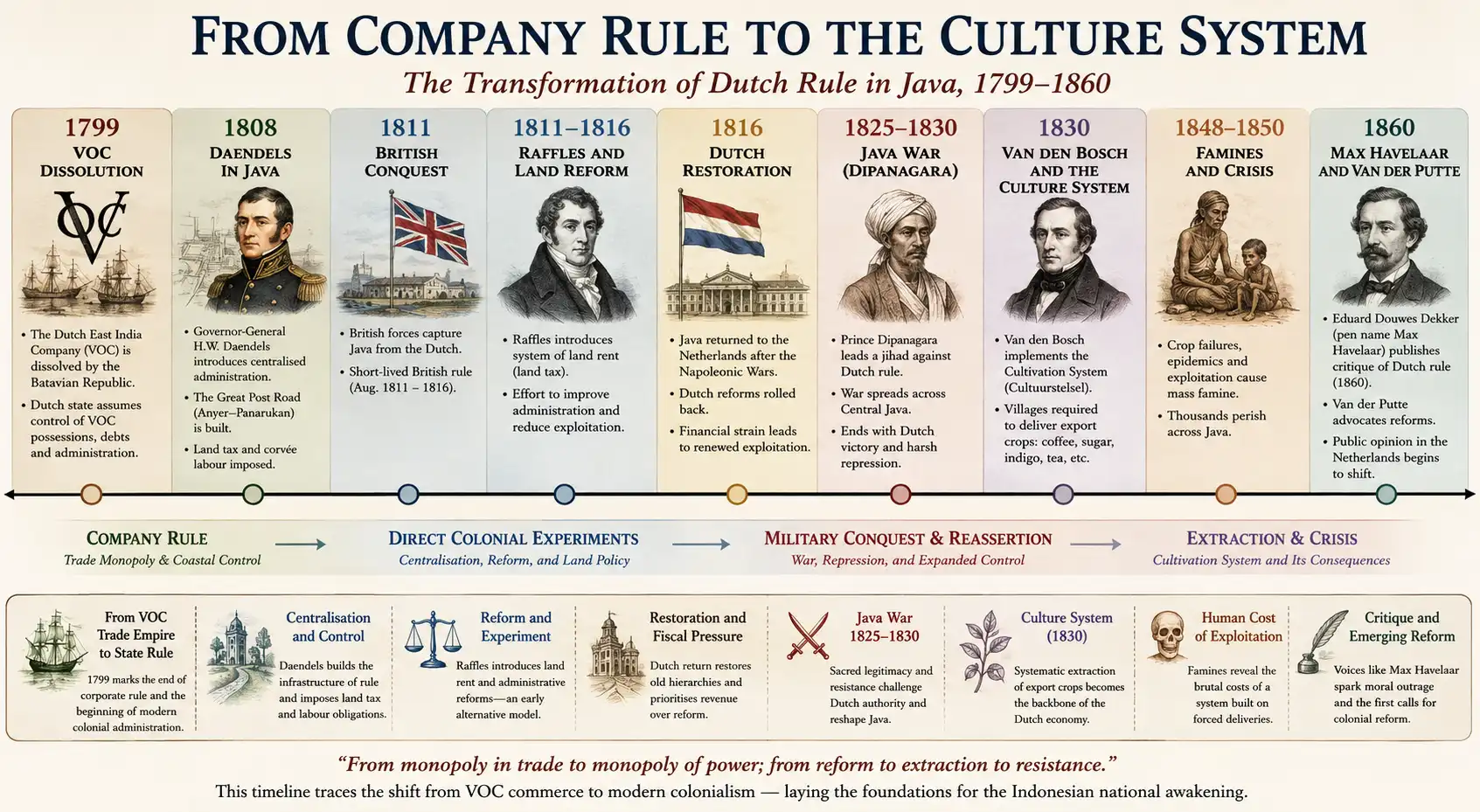
This lecture is central to the transition from the VOC world to the modern colonial state. It shows how Dutch rule passed through competing phases: conservative continuation of forced deliveries, Napoleonic administrative reform, British land-tax experiment, restored Dutch rule, war, fiscal crisis and finally the Culture System.
It also prepares the next lecture: the Liberal Period and the Ethical Policy. Once the Culture System had produced both enormous Dutch profit and visible Javanese suffering, colonial debate shifted again. The question became not only how the Netherlands could extract wealth from Java, but how long such extraction could be morally and politically defended.
Map / Diagram / Visual Context
Why This Lecture Matters
From c. 1800 to the End of the Culture System explains how the Dutch colonial state emerged from the ruins of the VOC. It shows that colonial rule was not static: it was repeatedly remade through reform, war, fiscal pressure and moral controversy. The Culture System appears not as a strange exception, but as the outcome of a long struggle between revenue, administration, peasant welfare and imperial power.
Further Reading
- Thomas Stamford Raffles, The History of Java.
- H. R. C. Wright, East-Indian Economic Problems of the Age of Cornwallis and Raffles.
- John Bastin, Raffles in Java and Sumatra.
- Eduard Douwes Dekker / Multatuli, Max Havelaar.
- Isaac van der Putte, The Regulation of Sugar Contracts in Java.
- Further readings on Daendels, Dipanagara, Van den Bosch and the Culture System should be added when the bibliography page is finalised.