
Professor Ann Kumar Southeast Asian Civilisation Archive
South Celebes as a Test Case of Indigenous Civilisation
Macknight, Noorduyn and the evidence for indigenous Southeast Asian political, documentary and cultural vitality before colonial rule.
This enrichment page draws from Professor Kumar’s South Celebes material in the Buginese lecture notes. It focuses on a striking interpretive claim: South Celebes can be read as a test case for the vitality of indigenous Southeast Asian civilisation. The argument rests especially on the work of C. C. Macknight and K. J. Noorduyn, whose scholarship Professor Kumar uses to show that Buginese and Makassarese societies developed complex political, documentary and cultural forms before significant Muslim or European influence.
The page belongs under the Indigenous Sovereignty hub because it strengthens one of the archive’s central themes: Southeast Asian societies were not passive recipients of civilisation from India, China, Islam or Europe. They generated their own forms of political organisation, historical memory, practical knowledge and written record.

Key Idea
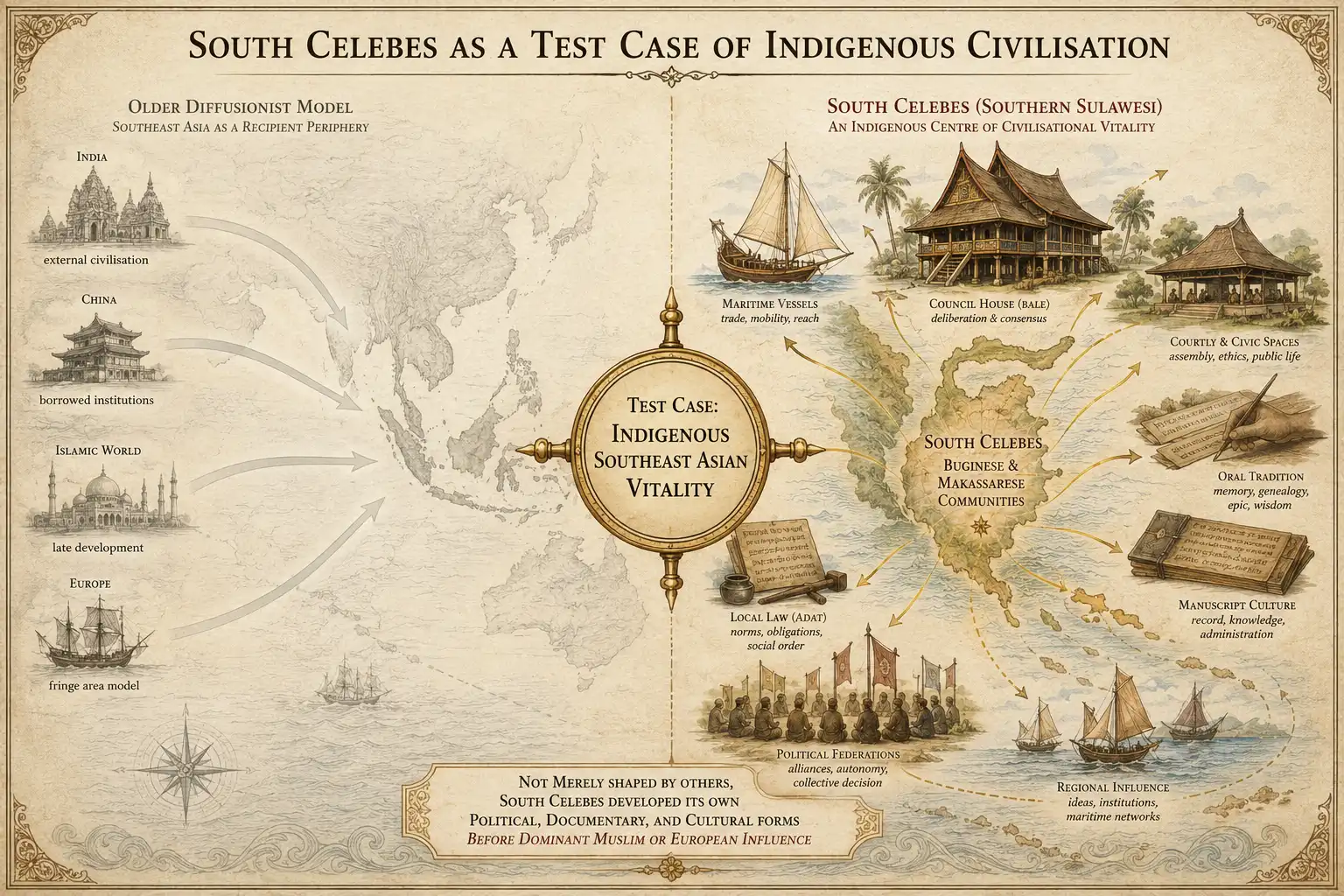
South Celebes matters because it challenges the idea that Southeast Asian civilisation developed only through diffusion from larger external centres. In Professor Kumar’s reading of Macknight and Noorduyn, the Buginese and Makassarese world offers evidence of an indigenous civilisational tradition: politically organised, historically self-conscious, practically literate and capable of recording its own world in distinctive documentary forms.
Why South Celebes Matters
Professor Kumar places South Celebes within a larger argument about indigenous agency in Southeast Asian history. The Buginese and Makassarese communities were not marginal peoples waiting to be shaped by Islam, Europe, India or China. They formed political systems, maintained adat traditions, developed chronicles and diaries, created practical records, and projected influence across the Malayo-Indonesian world.
This matters for the whole archive. The Cores and Zones framework encourages us to read Southeast Asia through its own political and cultural formations rather than through a European-centred chronology. South Celebes becomes one of the best examples of this method in practice.
Macknight’s “Test Case” Argument
Professor Kumar draws on C. C. Macknight’s work to make a significant interpretive point. Macknight argues that, while South Celebes may not have been an urban society in the seventeenth century, it can still fairly be characterised as civilised. The question then becomes how that civilisation arose in the years before 1600.
The importance of the argument lies in what it excludes. Macknight stresses that this development occurred before significant Muslim or European influence, and with only the faintest trace of the Indian tradition so familiar elsewhere in Southeast Asia. South Celebes therefore becomes a test case for the vitality of indigenous Southeast Asian cultures.
Against the “Fringe Area” Model
The older diffusionist view treated Southeast Asia as a peripheral region, developing late as ideas and institutions moved slowly outward from larger civilisational centres. Macknight’s argument, as used by Professor Kumar, challenges this view directly.
South Celebes shows that an island Southeast Asian society could develop complex and distinctive forms without being explained primarily as a derivative of India, China, Islam or Europe. This does not mean that later Muslim and European influences were unimportant. It means that they entered a world that already possessed its own political and cultural coherence.
In this sense, South Celebes strengthens the intellectual foundation of the entire archive. It supports the argument that Southeast Asian history should be read through indigenous structures, local categories and regional networks, rather than as a prelude to colonial rule.
Noorduyn and South Celebes Historical Writing
Professor Kumar then turns to K. J. Noorduyn’s work on the origins of South Celebes historical writing. Noorduyn’s argument is especially valuable because it shifts attention from political theory to documentary practice. The Buginese and Makassarese world did not merely possess oral tradition or myth. It developed a strong habit of recording facts.
South Celebes chronicles are described as dry, factual and non-poetical when compared with Javanese historiography. Their sources appear to have been the historical diaries of the region. This makes them distinctive within the wider Indonesian documentary world.
Royal Diaries and Historical Memory
The royal diaries of South Celebes recorded far more than dynastic succession. They noted births, marriages, deaths, events in the royal family, court affairs, expeditions, pacts and visits. They also recorded extraordinary natural phenomena such as eclipses, earthquakes and comets.
Professor Kumar’s notes include the remarkable example of an elephant presented by a Portuguese merchant. Such details matter because they show the range of attention in South Celebes documentary culture. The diary was not merely a court register. It was a way of noticing and preserving the events that made up the world.
A Culture of Record-Keeping
One of the most striking features of the South Celebes material is the breadth of its record-keeping. Professor Kumar notes, following Noorduyn, that the habit of keeping diaries seems to have been especially characteristic of South Celebes and peoples influenced by South Celebes culture. It was not found in the same form in Java or Malay literature.
This habit extended beyond royal affairs. Private diaries were also kept, including some in Malay from the Malay colony. South Celebes therefore appears as a society with a broad documentary impulse: a desire to preserve facts, events, observations, obligations and practical knowledge.
Practical Knowledge: Weapons, Ships, Finance and Law
South Celebes documentary culture was not confined to court history. Professor Kumar’s notes emphasise that practical and material information was recorded in diaries and separate notebooks. These records included material on weapons, fishing implements, houses, ships, financial matters, inventories, laws and customs.
This is an especially important point. It shows that written culture in South Celebes was not merely ceremonial or literary. It was also technical, administrative and practical. Knowledge about ships, weapons, finances and law was sufficiently valued to be written down and preserved.
The existence of translations of Spanish works on artillery and gunpowder further complicates any simple picture of an isolated or technologically static society. South Celebes communities were capable of absorbing, translating and adapting practical knowledge from outside while retaining their own documentary forms.
Sea Maps and Maritime Knowledge
Professor Kumar’s notes also point to Buginese maps of the sea with precise geographical annotations. This is a powerful detail because it connects South Celebes writing to maritime practice. Buginese and Makassarese societies were not only land-based political communities. They were active maritime peoples whose knowledge of movement, coastlines, routes and seas could be recorded visually and textually.
These maps belong naturally beside the archive’s broader interest in the Malayo-Muslim maritime zone, Makassar as a free port, and the movement of Buginese and Makassarese peoples after the Dutch conquest of Makassar. South Celebes civilisation was documentary, political and maritime at once.
Writing Before Conversion
Writing in South Celebes seems to have begun comparatively late, perhaps in the sixteenth or fifteenth century. Yet its significance is considerable. Both Christian and Muslim calendars appear to have been known before conversion to Islam, with the Christian calendar apparently used by preference.
This detail is historically suggestive. It points to a society already engaged with wider worlds before formal Islamisation, while still developing a documentary habit that cannot simply be reduced to Muslim or European influence.
South Celebes was not untouched by external contact. Rather, it used contact selectively and actively. This is the key distinction. External influences entered a local system that already had its own structures of memory, authority and practical intelligence.
Indigenous Civilisation and the Archive’s Larger Argument
This page belongs with the Buginese kingship and Arung Palakka pages, but it performs a slightly different role. The kingship page explains political structure. The Arung Palakka page explains power, war and alliance. This page explains why South Celebes can stand as evidence of indigenous civilisational capacity.
It therefore works as an interpretive bridge. It connects the Buginese material to the archive’s wider insistence that Southeast Asian societies had their own historical momentum. They possessed not only rulers and wars, but also record-keeping, law, technical knowledge, maritime mapping and intellectual habits of preservation.
For Professor Kumar’s archive, this is a crucial point. South Celebes gives visible substance to the claim that indigenous Southeast Asian civilisation was not simply borrowed, derivative or belated. It was capable of organising, recording and explaining itself.
Map / Diagram / Visual Context
Why This Page Matters
South Celebes as a Test Case is one of the archive’s clearest enrichment pages because it turns a broad intellectual claim into concrete evidence. The claim is that Southeast Asian societies possessed indigenous civilisational vitality. The evidence is found in Buginese and Makassarese political culture, chronicles, royal diaries, practical notebooks, technical translations and sea maps.
The page should be labelled as an enrichment or breakout page rather than a standalone original lecture. Its value lies in drawing out a theme already present in Professor Kumar’s lecture notes and making it visible as part of the Indigenous Sovereignty hub.
Further Reading
- C. C. Macknight, “The Emergence of Civilization in South Celebes and Elsewhere in Island Southeast Asia.”
- K. J. Noorduyn, “Origins of South Celebes Historical Writing,” in Soedjatmoko et al., eds., An Introduction to Indonesian Historiography.
- Leonard Y. Andaya, The Heritage of Arung Palakka: A History of South Sulawesi (Celebes) in the Seventeenth Century.
- Further readings on Buginese chronicles, Makassarese and Buginese maritime traditions, South Sulawesi manuscripts and indigenous Southeast Asian historiography should be added when the archive bibliography is finalised.
Archival Note
This is a breakout / enrichment page based on Professor Kumar’s South Celebes and Buginese lecture material in AK PDF 007. It should not be presented as a separate original lecture unless further evidence confirms that status. Its function is to draw out the Macknight and Noorduyn material as a focused Indigenous Sovereignty resource.