
Professor Ann Kumar Southeast Asian Civilisation Archive
The Rise of Mataram: Organisation and Conflict with the VOC
How an inland Javanese agrarian state absorbed the north coast, reshaped Islamic culture, organised power through court and region, and first confronted Dutch Batavia.
This lecture examines the rise of the Javanese state of Mataram, its internal organisation, and its first major confrontations with the Dutch East India Company. Professor Kumar treats Mataram as more than a political rival to Batavia. It was an inland agrarian court-state with its own cosmology, administrative hierarchy, regional tensions, economic base and religious transformations. Its conflict with the VOC reveals both the strength of Javanese statecraft and the vulnerabilities that later allowed Dutch intervention.
Key Idea
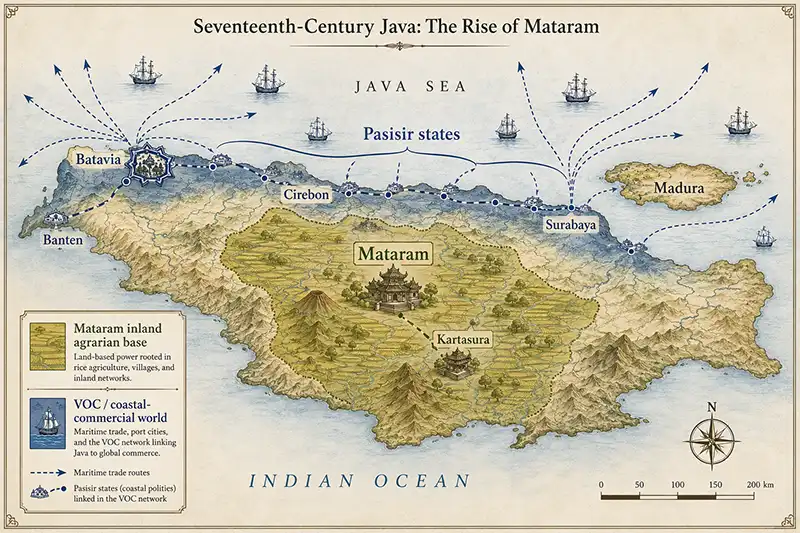
Mataram was a powerful Javanese core state whose strength rested on agrarian resources, courtly authority, symbolic kingship and regional subordination. Its first direct conflict with Batavia showed that it could mount formidable military campaigns, but its deeper weakness lay in the difficulty of holding distant regions and local lords to the centre. The VOC would later exploit those internal tensions rather than conquer Mataram by direct assault.
Mataram and the New Dutch Settlement
Professor Kumar begins by placing Mataram beside the arrival of the Dutch in western Java. The Dutch had defeated the Portuguese and, like them, sought monopoly in the spice trade. This brought them into conflict with Indonesian states whose interests lay in trade, including Banten and Demak.
Batavia was established in 1618 within the sphere of Banten. Yet the chief threat to the new Dutch settlement did not come from Banten alone. It came from the rising inland state of Mataram — a state whose basis was not primarily maritime trade but agrarian power, court authority and territorial expansion in Java.
Traditional Origins and Sultan Agung
The traditional account of Mataram’s rise is given in the Javanese chronicle tradition. It attributes the foundation of the dynasty to Kyai Gede Pemanahan, followed by his son Senapati and another ruler before the renowned Sultan Agung.
Professor Kumar notes that scholars have questioned this traditional genealogy. Berg suggested that Agung may in fact have been an usurper who fabricated a list of royal ancestors to legitimise his position. Professor Kumar does not dwell on this question, because for the historian Agung is in any case the crucial figure.
Agung reigned from 1613 to 1645. Through a series of overwhelming campaigns, he brought an end to the independence of the north-coast principalities. The process took time: Madura remained independent until 1624, Surabaya until 1625. Like other strong rulers of central Java, Agung also laid claim to suzerainty beyond Java, including South Sumatra and South Borneo.
The Incorporation of the North Coast
Mataram’s conquest of the north-coast states had major consequences for Javanese civilisation. These coastal polities were where Islam had first gained official status in Java. Their culture resembled other coastal Muslim sultanates across the archipelago — in Sumatra, Malaya, Celebes, Borneo and elsewhere.
This coastal culture is often called pasisir, from the Javanese word for coast or strand. It flourished in societies with strong interests in sea-borne trade rather than intensive inland agriculture. Under Agung, elements of pasisir Islam became more firmly established within the Javanese heartland.
This produced new strands within Javanese civilisation and also new tensions. Professor Kumar refers to Clifford Geertz’s famous distinction between santri, abangan and priyayi, but warns that the categories can be too sharp if treated rigidly. In practice, there were many gradations and mixed cases.
Sultan Agung and Javanese-Islamic Syncretism
Sultan Agung appears in the lecture as either a devout Muslim or a ruler whose political strategy lay in convincing other Muslims of his Islamic legitimacy. He obtained the title of Sultan from Mecca, consulted regularly with the ulama, and used flags and banners brought from Mecca in battle.
He also introduced the Javanese calendar, which Professor Kumar treats as an example of Javanese syncretism. It retained the old Hindu-Javanese Saka era beginning in 78 AD, but changed the reckoning from solar to lunar years. It also combined a five-day Javanese week with the seven-day Islamic week.
The Kraton and the Cosmic State
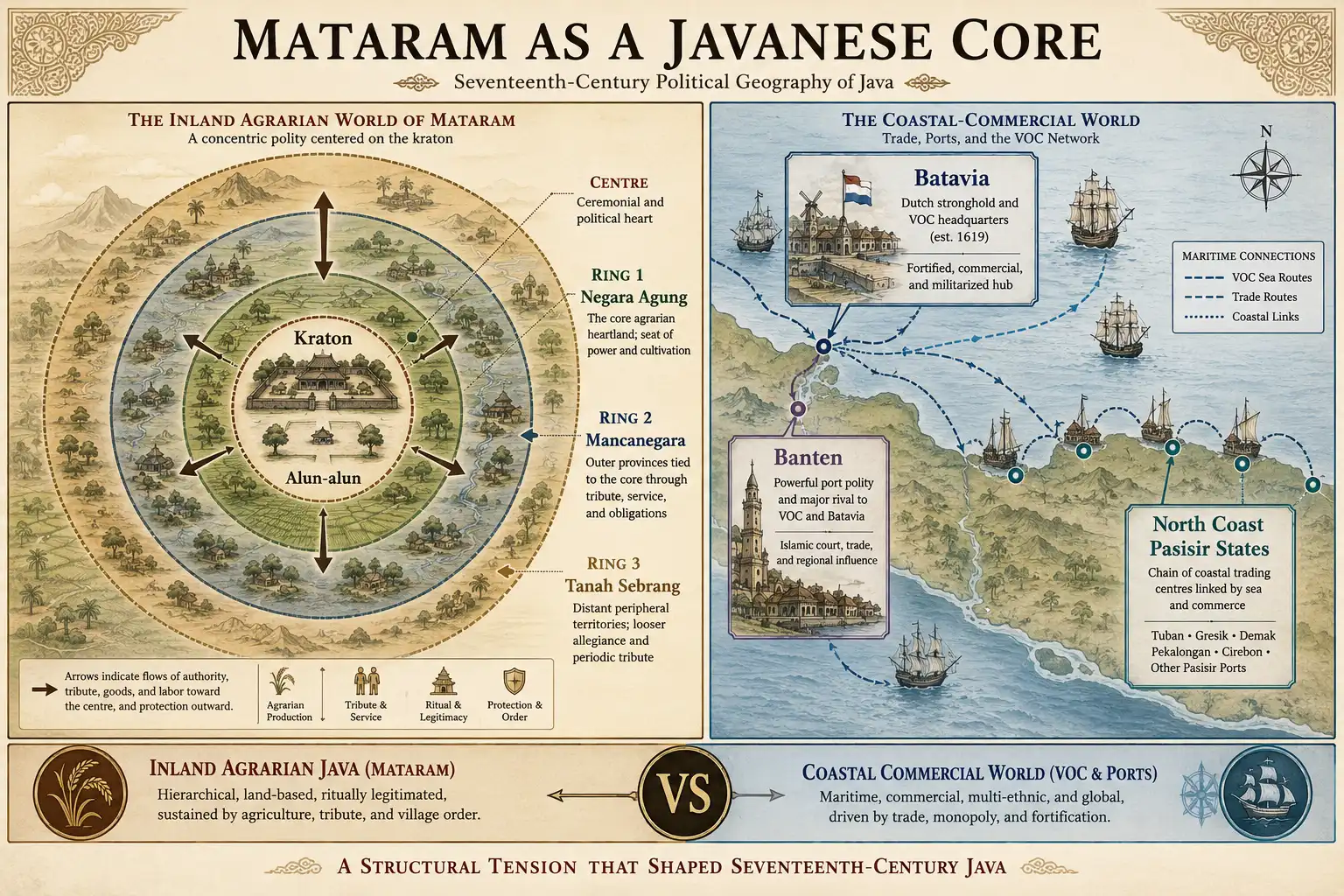
Professor Kumar then turns to the government and administration of Mataram. Javanese writers divided the state into several conceptual areas. At the centre stood the ruler’s capital: the negara or kraton.
The kraton was laid out according to a fixed pattern around a central square, the alun-alun. The ruler’s residence stood on one side, the main mosque on another, with the houses of princes and officials arranged around it. The layout expressed political order, ritual hierarchy and cosmic harmony.
If the kingdom suffered misfortune or defeat, the kraton might be moved because the old site was considered to have lost harmony with the cosmos. In Mataram’s case, the capital was moved three times before the partition of the realm in 1755, being located in the area of present-day Yogyakarta until the 1670s and afterwards in the region of modern Surakarta or Solo.
Negara Agung, Mancanegara and Tanah Sebrang
Around the kraton lay the negara agung, the ruler’s core domain. This was not an urban area in the modern sense, but an area of villages tied closely to the court.
Beyond it lay the mancanegara, the “different regions,” which could be subdivided into eastern, coastal and other regional groupings. Furthest away stood the tanah sebrang, the “lands over the seas,” including tributary places in South Sumatra and South Borneo.
This spatial model is important because it shows that Mataram did not rule a modern bounded state. Power radiated from the centre, became looser with distance, and depended on moral, ritual, military and administrative ties rather than fixed borders.
Central Administration: Patih and Wedana
The central administration of the kraton and negara agung was elaborate. It included numerous officials with their own titles. The most important official was the Patih. Around him stood four chief wedana, arranged in a pattern of symbolic significance.
Professor Kumar stresses that the administrative hierarchy was rigid on paper, but more flexible in practice. A man might inherit an office or title from his predecessor while performing different functions, depending on his ability, influence and relationship to the ruler.
The Problem of the Regions
Regional administration posed greater problems. Rulers had several ways of binding the regions to the centre. They could place them under members of the royal family, though this was not generally favoured because rulers preferred to keep brothers and other potentially dangerous relatives at court.
They could also make marriage alliances with local lords, an expedient favoured by Sultan Agung. Or they could send officials from the kraton to govern the regions. This was the policy of Agung’s successor, Amangkurat I.
These regional governors had various titles, including tumenggung, a military title, because raising and leading armed forces was an important part of their duties. As a class, they came to be known as bupati, or regents.
From Royal Agents to Local Lords
The bupati became one of the central tensions in Mataram’s political system. Their positions tended to become hereditary, and through intermarriage and shared interests they became part of the local aristocracy.
This recreated the problem the ruler had tried to solve: the regions breaking away from the centre. The ruler had limited sanctions. The bupati were not salaried officials whose pay could simply be stopped. They lived by taking a percentage of the yield of their areas. If they ignored a summons to court, it was difficult to send military expeditions against them because local terrain, provisioning and distance favoured the defenders.
Economic Resources: Rice, Labour and Appanages
Mataram’s economic arrangements were simple and based on peasant production. There was little cash in circulation. What tax existed was taken largely in the form of rice, other agricultural produce and labour.
Rice fed the urban and court population and could be exported. Labour was essential for building palaces, public works and royal projects. The ruler’s family held appanages in the negara agung, from which they could draw produce and labour.
The size of these appanages was reckoned in cacah, or households — another indication that manpower was one of the fundamental measures of wealth and power.
What Held Mataram Together?
Professor Kumar is clear about the forces tending towards the break-up of Mataram: regional autonomy, local aristocracies, weak cash administration, difficult communications and the limited coercive reach of the centre.
What held the realm together was not primarily economic or administrative integration. It was cultural and moral. A common Javanese language and, among the governing class, a common priyayi ethic carried more force than modern readers may expect.
This helps explain why the Dutch often recruited soldiers from outside Javanese culture — Makassarese, Balinese, Madurese and others — who did not share the same ethic and were therefore more usable against Javanese opponents.
Sultan Agung and Batavia
The first direct conflict between Mataram and the Dutch was initiated by Sultan Agung. He had demanded tribute from Batavia and had received it, but he had also asked for Dutch help in his Surabaya campaign and had not received it. He therefore decided to attack.
The years 1627 to 1629 were precarious for the Dutch settlement, then under Jan Pieterszoon Coen. On Christmas Eve 1627, a force from Banten even penetrated the Dutch citadel, though it was driven out. In 1628 and again in 1629, Agung’s forces laid siege to Batavia.
Professor Kumar emphasises that Mataram’s military organisation was far from contemptible. The Javanese brought artillery through marshes and jungle terrain the Dutch had thought impassable. During the siege they appeared disciplined and skilled in manoeuvre and siege works.
Why the Sieges Failed
Although Coen died of cholera during the siege, the Dutch were eventually able to beat off Agung’s forces. The decisive factor was not simply fortification, but Dutch command of shipping. Dutch naval superiority enabled them to cut off Javanese food supplies.
The Dutch also benefited from Banten’s fear of Mataram. When Mataram attacked Batavia for the second time, the ruler of Banten made peace with the Dutch, apparently fearing that he would be next on Agung’s list.
This was the first and last direct confrontation between Mataram and the Dutch. Over the next 120 years, the Dutch would displace Mataram as the paramount power on Java — not by direct attack, but by intervention in the internal strife of the Javanese state.
The Pattern of Dutch Intervention
Professor Kumar identifies a repeating pattern. The Dutch would help one claimant to the throne, giving him the edge over rivals. The price of victory would be concessions: territory, debt obligations or trading rights in particular commodities.
There was also a tendency for the weaker claimant to seek Dutch assistance. That meant a less capable ruler might gain the throne because of outside support, weakening the state further and producing new revolts. Professor Kumar describes this as a spiralling effect of an initial technological disparity: one side rises into an ascending spiral, the other falls into a descending one.
Amangkurat I: Cruelty and Centralisation
Sultan Agung was succeeded by his son Amangkurat I, who reigned from 1645 to 1677. He reversed many of his father’s policies, favouring Javanese traditions over newer Islamic elements and dropping the title of Sultan.
His actions have been judged harshly by historians, but Professor Kumar distinguishes moral judgement from political significance. His atrocities formed part of an attempt to destroy regional lordship and create a more centralised bureaucracy. He also attempted to introduce monetary taxation and make foreign trade a state monopoly.
Yet the attempt to form something like a nation-state out of a society based on a goods economy and undeveloped communications was not successful. Amangkurat appears as cruel, but not irrationally so.
Islam, Ulama and Alternative Power
Amangkurat’s policy towards Islam was equally revealing. He abolished Islamic courts and massacred several thousand ulama, apparently seeing them as an alternative focus of power to the monarch.
This moment shows that religion in Mataram was not merely belief or ritual. It was also political authority. The ulama could offer a rival form of legitimacy and organisation, and Amangkurat treated them as a threat to centralised royal power.
Trunajaya and the Dutch Debt
Amangkurat’s unpopularity left him vulnerable when Trunajaya, a prince of Madura claiming descent from Majapahit, rose in revolt. Amangkurat asked for and received Dutch help. Even so, Trunajaya was able to take and sack the capital, while Amangkurat fled and died before the war was concluded.
In 1677, Amangkurat’s son, Mangkurat II, signed a treaty with the Dutch. He agreed to pay the costs of the war, calculated at 20,000 rijksdaalders per month. As guarantee, the Dutch received the port of Semarang and its revenues.
This was the beginning of the state debt of Mataram. Although the Dutch said the debt could be paid in instalments, the ruler had no realistic hope of raising so much cash. Interest accumulated, and the situation worsened steadily. The treaty also gave the Dutch a monopoly in cloth and opium.
Banten, Islam and Dutch Intervention
Around the same time, the Dutch brought about the downfall of Banten’s independence through similar mechanisms: family quarrels and intervention on behalf of a weaker contender.
Sultan Abulfatah of Banten had built up a strong fleet with English and Danish assistance and engaged in the pepper trade. He extended Banten’s control over pepper plantations and ports in South Sumatra. Banten was also a centre of Muslim learning, with religious traffic to and from the wider Islamic world.
His son, Sultan Adji, rebelled and sought Dutch help despite their status as infidels. The Dutch rescued him from imprisonment in his own palace. He became ruler of Banten under strong Dutch control.
Surapati and the Anti-Dutch Party
By the first half of the 1680s, the Dutch had ended Banten’s independence and seriously weakened Mataram. Yet there remained an anti-Dutch party at the Mataram court, led by the Patih.
This anti-Dutch party found support in Surapati and his followers. Surapati’s origins were uncertain, but he was probably an escaped Balinese slave from Dutch Batavia. He had already been involved in the Banten campaigns and now joined the anti-Dutch party at Kartasura.
An expedition was sent against him, and its leader was killed in an engagement with Surapati and his followers. Mangkurat II, who had initially supported him, became afraid of Dutch reprisals. Surapati withdrew to East Java, where he established a semi-independent principality.
This Lecture in the Archive’s Larger Argument
This lecture is one of the archive’s strongest examples of Java as a core. Mataram was not merely a local kingdom reacting to Europeans. It was a powerful inland civilisation with its own political geography, court cosmology, Islamic transformations, administrative hierarchy, aristocratic ethic and regional contradictions.
Its later vulnerability to the VOC came not from simple weakness, but from the structural difficulty of holding regions, regents and rival claimants together. The Dutch did not have to conquer Mataram in a single decisive act. They entered its internal tensions, used debt and military assistance as leverage, and slowly displaced it as the paramount power on Java.
Map / Diagram / Visual Context
Why This Lecture Matters
The Rise of Mataram matters because it gives the archive its central Javanese case study. It explains how an inland agrarian court-state organised authority before Dutch dominance, how Islamic and Javanese traditions interacted, and why regional weakness made later Dutch intervention possible. It is a crucial bridge between Cores and Zones, Indigenous Sovereignty and the Colonial Engine.
Further Reading
- C. C. Berg, writings on Javanese historiography and royal genealogy.
- Clifford Geertz, The Religion of Java.
- H. J. de Graaf, writings on Mataram, Sultan Agung, Amangkurat and Javanese-Dutch relations.
- Further readings on the Babad Tanah Jawi, Sultan Agung, the Trunajaya revolt, Banten and early VOC-Javanese relations should be added when the archive bibliography is finalised.