
Professor Ann Kumar Southeast Asian Civilisation Archive
Changes in the Nature of the VOC “Empire”
Dutch and Indonesians in the Eighteenth Century: Java, extraction and the decline of the VOC.
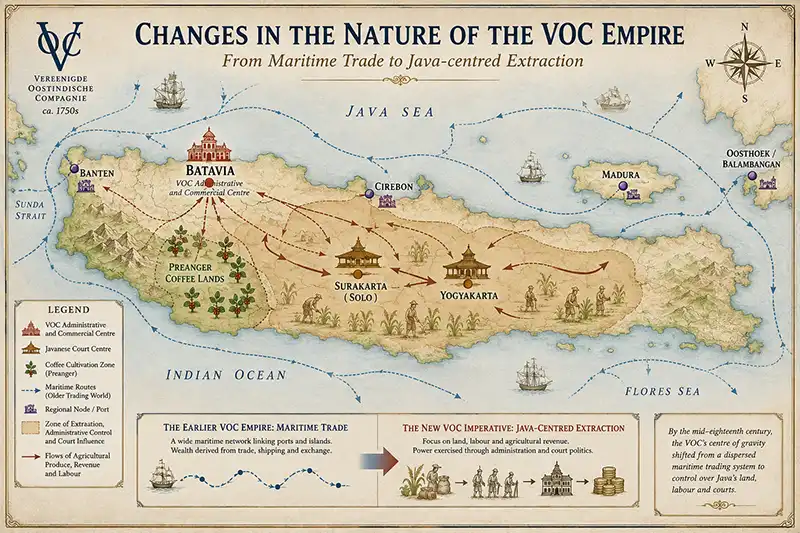
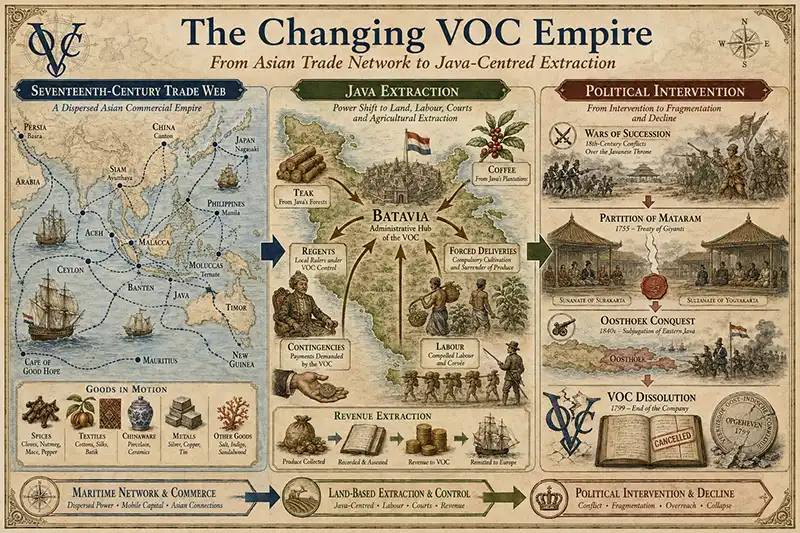
This lecture examines the changing nature of the VOC “empire” in the eighteenth century. Professor Kumar begins by returning to Coen’s dream of a far-flung commercial web catching the trade of Asia in its mesh. By the eighteenth century, that dream had become increasingly unworkable. The VOC turned from dispersed maritime commerce towards Java: its forests, crops, regents, labour systems, courts and wars.
Key Idea
In the eighteenth century, the VOC’s empire changed character. The Company’s far-flung Asian trading network became less viable, and Java became increasingly central. The VOC depended on export produce, regents, forced deliveries, contingencies and military intervention in Javanese politics. The foundations of later colonial administration were laid inside a failing commercial company.
Coen’s Web Begins to Fail
Professor Kumar opens by referring back to Coen’s vision of a far-flung web catching the whole trade of Asia in its mesh. In the seventeenth century, Dutch factories and forts were widely scattered across Southeast Asia and beyond. They were often established and defended by military campaigns, and the VOC’s ambitions took its armies and ships to many different arenas.
But this vision proved unviable in the long run. To exclude rival sea traders, whether European or Asian, the Company had to attack their harbours and land refuges. That meant conquering or subjugating one sultanate or principality after another. The costs were high, and there was a limit to the amount of territory a commercial company could realistically hold.
Unprofitable Posts and Company Corruption
Many VOC posts operated at a loss. Professor Kumar notes Japan as an example. The Company’s own monopoly policy reduced the profits available to Asian inhabitants in its territories, which in turn reduced their ability to buy the European, West Asian or East Asian goods that the VOC wished to sell in pursuit of two-way trade.
Internal malpractice added to the problem. Company servants engaged in forbidden private trading and siphoned off a percentage of Company goods. Professor Kumar explains this without excusing it: salaries were low, there were no pensions, and men did not sail east expecting to return as poor as they had left.
Profit, Loss and the Illusion of Prosperity
The VOC still showed a profit in 1696, but by 1725 the period of losses had begun. Professor Kumar notes that losses reached enormous levels later in the century. Yet the Company continued to pay regular dividends, concealing weakness from the Dutch public and sustaining the appearance of prosperity.
This mattered because the VOC was not merely a company. It was one of the pillars of Dutch prosperity and national prestige. Its financial weakness was therefore politically sensitive. The gap between public confidence and actual performance was filled by borrowing.
The Turn to Java
The failure of international trade pushed the VOC towards a different kind of operation, centred mainly on Java, where its principal base was located. The Company began to depend increasingly on extracting export produce from the island.
Java offered teak forests and export crops introduced or expanded by the VOC. The most important of these was coffee, planted chiefly in the hilly regions of West Java, especially the Preanger. The Company’s commercial survival became tied to Java’s land, trees, peasants and local rulers.
Forced Deliveries and the Regents
Coffee was produced through the agency of native regents, or bupati. Under the system of forced deliveries, the regent’s act of appointment required him to deliver a specified quantity of produce at a specified price. At first, that price might be negotiated, but over time the VOC was in the stronger position and could impose terms unilaterally.
The regent was allowed to raise his own taxes in kind and was expected to pay his own subordinates. This arrangement made the regent both a local ruler and a Company instrument. The VOC did not yet possess the later colonial bureaucracy in full form, but it was already using indigenous authority to organise extraction.
Contingencies and Tribute
In districts outside the main coffee and teak areas, another system operated: contingencies. Here the regent signed a deed of alliance agreeing to deliver part of the produce of his regency to the VOC as tribute, often without payment.
Professor Kumar notes that the distinction between forced deliveries and contingencies was not always clear in practice. Contingencies were sometimes paid for, and forced deliveries were sometimes not. What mattered was the broader pattern: the VOC was using Javanese political structures to convert local production into Company revenue.
Coffee-Sergeants and the Beginnings of Colonial Administration
Professor Kumar identifies the appointment of overseers, or opzieners, as the humble beginnings of later Dutch colonial administration. These men were also known as “coffee-sergeants” because their most important function was organising coffee cultivation.
They were supposed to ensure that cultivators planted the required crops and to keep an eye on the regents. In practice, they could also profit by advancing money to regents at interest, enabling the cultivation process to continue before produce was delivered and paid for. Administration, credit, surveillance and extraction were already beginning to fuse.
The VOC’s Eighteenth-Century Military Ventures
The VOC’s military ventures in the eighteenth century were also concentrated on Java. Banten had become a dependent state, and the Company became intensively involved with Mataram through the Javanese wars of succession.
In 1704, during the First Javanese War of Succession, Mangkurat III was dethroned by the Dutch in favour of Pangeran Puger, later Pakubuwana I, who had asked for their assistance. In 1706–7, the VOC mounted expeditions against Surapati, who had allied with Mangkurat III. In 1719, the Second Javanese War of Succession followed the death of Pakubuwana I, with the Dutch again intervening in the succession.
The Chinese Crisis of 1740
Professor Kumar then turns to the period from 1740 to 1757, which she describes as one of almost continual warfare on Java. The crisis began among the Chinese community in Batavia, a large population whose presence owed much to earlier Dutch encouragement.
Coen had regarded the Chinese as industrious and essential to Batavia’s commercial success. They were active as tradesmen, artisans, small traders, restaurateurs, arak distillers and commercial agriculturalists, especially in sugar. Later Dutch administrators, however, became alarmed by unemployed Chinese itinerant groups and introduced deportation regulations.
Abuses followed. Some officials extorted money from wealthy Chinese under threat of deportation. Rumours spread that the Dutch were throwing deported Chinese overboard at sea. Large numbers fled Batavia and began to organise armed resistance. When this became known, non-Chinese residents of Batavia attacked the remaining Chinese population in a series of massacres.
From Batavia to Mataram
Chinese resistance spread along the north coast and inland. Pakubuwana II of Mataram initially joined forces with the Chinese and killed the Dutch garrison. He later reconsidered and made peace with the Dutch, but Javanese involvement had acquired its own momentum.
Pakubuwana II was dethroned by the anti-Dutch party and later restored with Dutch assistance. In return, he had to cede the whole north coast of Java to the VOC and renounce claims over Madura. After regaining his throne, he shifted the capital to Surakarta, or Solo.
Mangkubumi, Mas Said and the Partition of Mataram
No lasting peace followed. Pakubuwana II’s brother, Mangkubumi, rose in rebellion and was joined by his nephew Mas Said. They gained considerable support, and the war took on the character of a liberation struggle against Dutch control.
Fighting continued until 1755, amid complicated and shifting alliances. The Dutch gradually isolated the rebel leaders. In 1755, through the Treaty of Giyanti, Mataram was partitioned into two main principalities: Surakarta, under Pakubuwana III, and Yogyakarta, ruled by Mangkubumi as Sultan Hamengkubuwana. Both acknowledged VOC sovereignty.
In 1757, a third smaller principality, the Mangkunegaran, was created for Mas Said. The territories were fragmented into scattered tracts, an arrangement designed by the Dutch to prevent dangerous concentrations of power.
The Oosthoek and Balambangan
The last major Dutch campaign on Java was the conquest of the Oosthoek between 1757 and 1777. The political apparatus there centred on Balambangan, the last Hindu kingdom on Java, connected to the Balinese rather than Javanese cultural sphere.
The area became a refuge for anti-Dutch elements: descendants of Surapati, Chinese who had fled after the troubles of 1740, Buginese, Makassarese and Madurese. One striking cultural result of the Dutch conquest was that the Dutch enforced a change in the state religion from Hinduism to Islam, in order to weaken Balambangan’s ties with Bali.
The Fall of the VOC
By 1777, the VOC had extinguished or subjugated all major rivals on Java. Yet it did not long survive to enjoy the profits of its expanded domain. External European politics, maritime competition and internal weakness overtook it.
The American War of Independence damaged Dutch interests because the Dutch took the American side and suffered English attacks in Southeast Asia. English shipping superiority became crucial, as it could prevent the VOC from moving Indonesian products to European markets. The Treaty of Paris in 1784 compelled the Dutch to allow English trade in their territories, breaking the monopoly.
The French Revolution also had repercussions in the Netherlands. In 1795 the Batavian Republic was established, sheltered by French revolutionary armies, while the Dutch ruler fled to England. The British took many Dutch possessions, including the Cape, Ceylon, Dutch posts in India, the west coast of Sumatra and Malacca. The Batavian Republic eventually took over the VOC’s territorial possessions and its enormous debts. The Company was formally dissolved at the end of 1799.
What Were the Dutch Like?
Professor Kumar ends with a methodological warning. Students should not identify too easily with the Dutch simply because they were Europeans. Europeans of the eighteenth century were also very different from modern readers, and in some respects had more in common with Asians of the same period than with us.
She cautions against viewing the Dutch merely as hard-headed businessmen uninterested in religion. They were children of their age, and that age thought instinctively in religious categories. This point prepares the ground for a more complex reading of Batavia, Dutch society and the cultural impact of colonial presence in Java.
This Lecture in the Archive’s Larger Argument
This lecture is crucial because it bridges the seventeenth-century VOC monopoly material and the nineteenth-century colonial state. The VOC remains a company, but its practices increasingly resemble government: supervising crops, disciplining regents, intervening in dynastic politics, partitioning kingdoms and absorbing territory.
Professor Kumar’s larger point is not that Dutch power emerged fully formed. Rather, the mechanisms of colonial rule developed through improvisation, debt, war, monopoly, local alliance and commercial desperation. By the time the VOC collapsed, many of the habits and structures of Dutch colonial rule were already in place.
Map / Diagram / Visual Context
Why This Lecture Matters
Dutch and Indonesians in the Eighteenth Century explains how a commercial Company laid the foundations of colonial government. The VOC’s failure as a far-flung trading network pushed it towards Java-centred extraction. Its dependence on regents, overseers, forced deliveries and military intervention created the administrative and political habits that later Dutch colonial rule would inherit and expand.
Further Reading
- J. S. Furnivall, Netherlands India.
- H. J. de Graaf, writings on Java, Mataram and the VOC.
- Leslie H. Palmier, writings on social status and Javanese nobility.
- W. van Welderen Rengers, The Failure of a Liberal Colonial Policy.
- Further readings on the Chinese massacre of 1740, the Treaty of Giyanti and the VOC’s dissolution should be added when the bibliography page is finalised.