
Professor Ann Kumar Southeast Asian Civilisation Archive
The Growth of Malay National Feeling and the Traditional Aristocracy
How British protection, immigrant labour, Malay rural society, education, aristocratic leadership and post-war crisis shaped the path to Malayan independence.
This lecture examines the growth of Malay national feeling in British Malaya, with particular attention to the traditional aristocracy. Professor Kumar’s central question is why Malay nationalism developed differently from Indonesian nationalism. In Malaya, the British protectorate preserved Malay rulers, reinforced aristocratic authority, encouraged a modern export economy based largely on immigrant labour, and helped keep much of Malay village society outside the full force of urban and industrial change. The result was a slower, more conservative and more aristocratically mediated nationalism than the Indonesian case.
Key Idea
Malay national feeling did not arise first as a mass urban revolutionary movement. It grew within a society deliberately kept partly insulated from the modern export economy, and was mediated by rulers, aristocrats, Islamic institutions, Malay-language teachers, journalists and English-educated officials. The traditional aristocracy, strengthened by British protection, became one of the decisive channels through which Malay communal defence became organised nationalism.
British Protection and Uneven Change
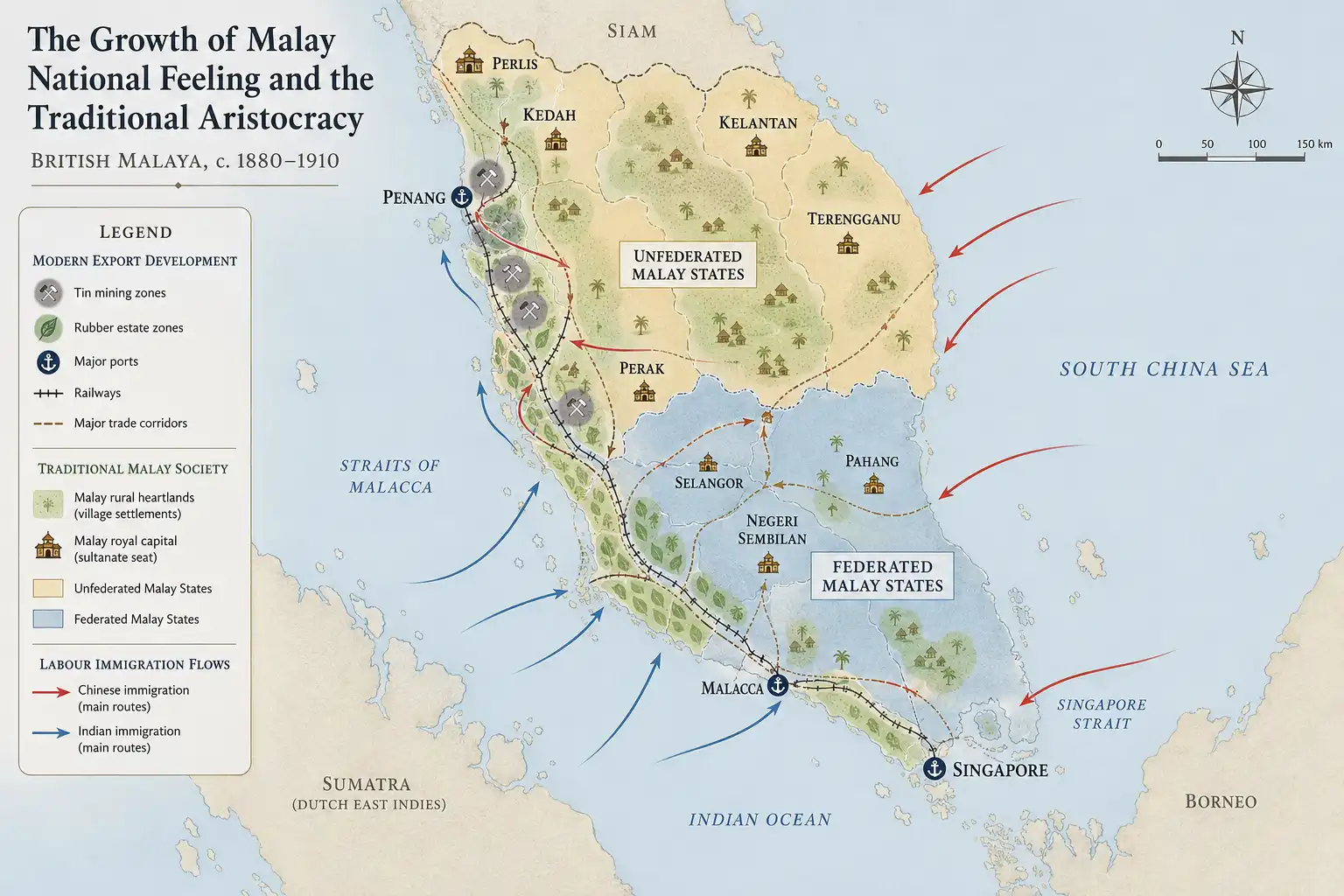
Professor Kumar begins with a paradox. The establishment of British protection over Malaya changed the country dramatically in some ways, while leaving Malay village life curiously unaffected in others. The dramatic changes were demographic and economic. Chinese and, to a lesser extent, Indian immigration transformed the population of the most developed western states, while roads, railways, telegraphs, post offices, ports, plantations and mines reshaped the export economy.
Yet the lives of many Malays remained centred on agriculture, fishing and village society. Before the British presence, Malaya had been comparatively sparsely populated by Malay villagers. They were not under the same population and land pressure as the Javanese, and they were not eager to provide the wage labour required by mines, plantations and other export enterprises.
The British therefore developed Malaya’s modern economy with immigrant labour and skill. Chinese labour and enterprise became central to tin and commerce; Indian labour became vital to plantations and public works. Malay society, by contrast, was partly preserved, partly bypassed, and partly immobilised.
The British Alliance with Malay Rulers
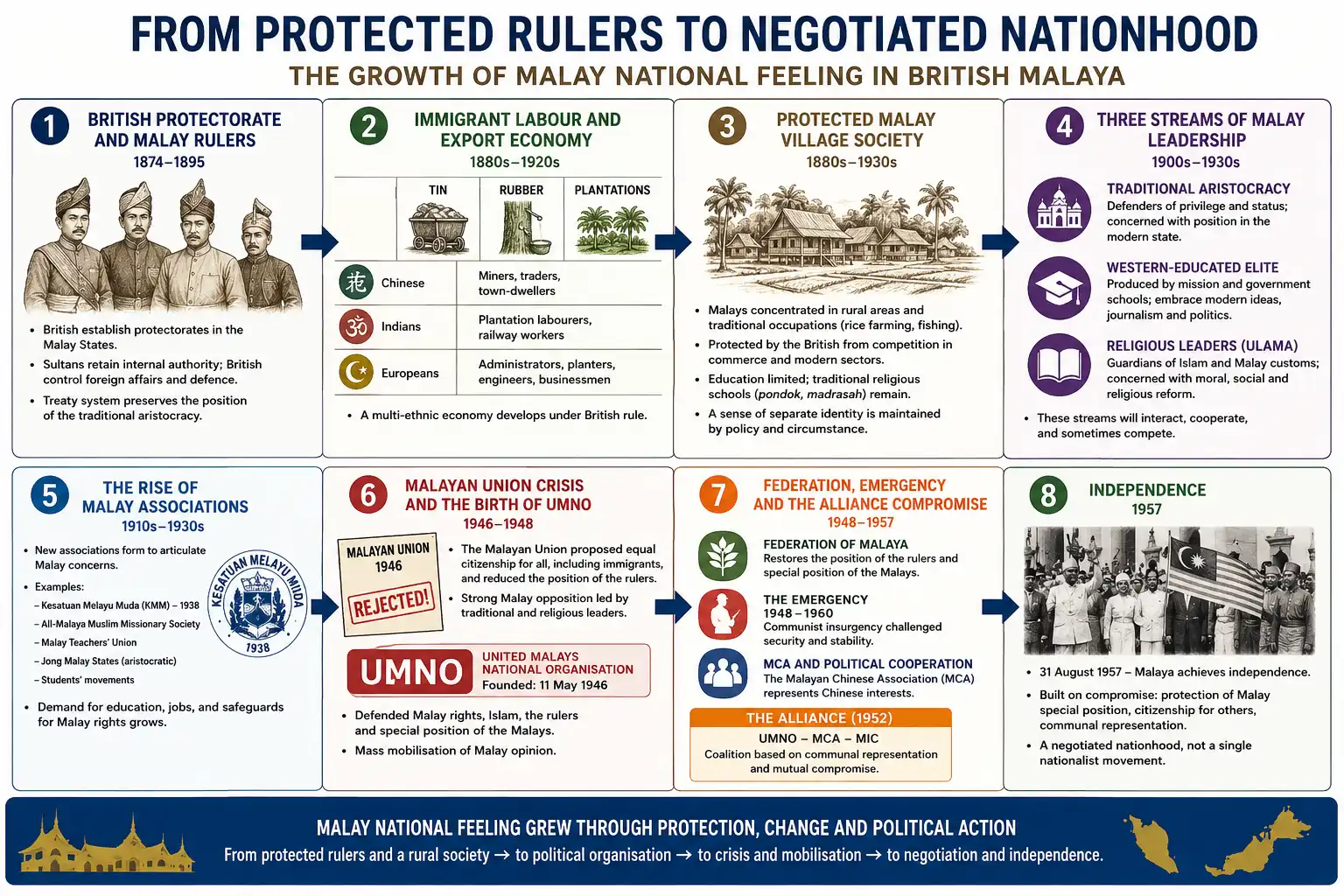
The British made what Professor Kumar describes as a mutually profitable alliance with the Malay ruling class. The British undertook to maintain the position and prestige of Malay rulers, even if their real political power was greatly reduced. In return, Malay rulers allowed the British to build a modern export economy based on immigrant labour.
British policy carefully maintained the fiction that the Malay sultans remained sovereign rulers and that British Residents were merely advisers. In practice, especially in the Federated Malay States, this fiction wore thin. Yet it had real political consequences. The symbolic authority of the sultans was preserved, and within Malay society their position was often strengthened by British backing.
Professor Kumar notes the resemblance to other colonial situations. As Furnivall observed in relation to Javanese Regents, colonial rule could weaken traditional rulers in relation to Europeans while strengthening them in relation to their own people. In Malaya, the sultans and aristocracy could no longer easily be displaced by rivals or revolts because British power stood behind them.
Religion, Custom and the Protected Malay Sphere
Under the Pangkor Engagement, which became the model for later agreements, British Residents were not to advise on matters relating to Malay religion and custom. This limitation gave the Malay ruling class a particular preserve: the sphere of Islam, Malay adat and ceremonial life.
The result was not the disappearance of traditional authority, but its bureaucratic reinforcement. There was an increase in religious pomp and ceremonial order, and in many states councils were created to regulate matters of Islam and Malay custom. These bodies were often known as Councils of Muslim Religion and Malay Custom, and they were largely appointed by Malay rulers.
In this way, the colonial state helped institutionalise a sphere of Malay identity. Islam, custom, ruler and court became politically significant not because they were untouched by colonialism, but because colonialism protected and reorganised them.
The Traditional Aristocracy under Colonial Rule
British policy also confirmed the position of the Malay aristocracy as a whole. Aristocrats held places on state councils, gained access to land and mining opportunities, and increasingly received the forms of education and training that led into government service.
From the beginning of the twentieth century, younger members of the Malay aristocracy were trained for the civil service. This education was largely reserved for them. Although they remained subordinate to Europeans, who held the higher ranks, they occupied a superior position in relation to ordinary Malays and to immigrant communities.
British policy generally kept Chinese and Indians out of the Malay administrative service in rural areas. It was considered politically sensitive for non-Malays to be seen exercising authority over Malays. Malay officers were therefore used in the countryside, where most Malays lived. The effect was to reinforce the authority of Malay aristocrats and officials as intermediaries between colonial administration and Malay society.
West Coast and East Coast Differences
Professor Kumar distinguishes the more developed west-coast states from places such as Kelantan and Trengganu. On the west coast, tin, rubber, immigration and British-backed infrastructure transformed society more rapidly. Johore and Kedah also experienced important demographic change.
In the east-coast states, the kind of economic development taking place on the west coast was far less marked. These states remained more traditional in social form. This difference matters because Malay national feeling did not arise uniformly across the peninsula. It was shaped by state loyalties, different levels of economic change, and differing relationships between ruler, aristocracy, village and British authority.
Keeping the Malays on the Land
Although immigrant labour had originally been brought in because Malays were unwilling or unable to provide the labour and skills required by the export economy, British policy soon went further. It sought to keep Malays as village farmers and, as far as possible, out of the disruptive “hurly-burly” of modern economic life.
There were several reasons. Malay rulers feared that modern ideas and urban competition would disrupt Malay society and weaken their own authority. Many British administrators also held sentimental views about the supposed idyll of Malay village life and wished to preserve it.
Because Malaya had been sparsely populated, Europeans and Chinese could begin plantations and enterprises without immediately dispossessing Malays on the Javanese scale. The British framed land policies intended to keep Malay peasants in possession of inherited land, to encourage rice cultivation, and to maintain food production for a rapidly growing population.
Rubber, Cash and Malay Peasants
Malays did participate in the export economy in one important field: smallholder rubber. Rubber, along with tin, became one of Malaya’s most important exports. After 1910, many Malay peasants turned to rubber smallholding as a way of earning cash income.
This produced some monetisation of the Malay peasant economy. Yet the middlemen involved in preparation, marketing and trade were still largely non-Malay. Later, the British introduced legislation that restricted further rubber planting by Malays. They wanted to maintain food production and reduce competition with plantation interests.
The result was ambiguous. Malay peasants were protected, but also limited. They were not driven into the urban proletariat on a large scale, but neither were they positioned to dominate the modern economy that had grown around them.
Education and Malay Isolation
Education reinforced this separation. The British provided elementary education in Malay, but this schooling tended to isolate Malays from other elements of Malayan society. It was not designed to produce a broad modern intelligentsia on the Indonesian model. It generally prepared Malays for village life or subordinate roles.
The Malay community remained overwhelmingly rural. Malays formed only a small part of the urban population. This helps explain why Malay nationalism did not develop strongly before the 1940s. Nationalism in Southeast Asia often grew in cities, where students, workers and migrants from different regions met one another, argued, organised and discovered shared grievances.
In Malaya, by contrast, Malay loyalties often remained focused on religion or the state — Johore, Kedah, Negeri Sembilan and others — rather than on a fully developed national community.
Three Leadership Groups
Despite this rural base, Malays were becoming increasingly conscious of some wider identity. Professor Kumar identifies three leadership groups, each associated with a different educational background.
The first grew from the Islamic-educated religious reform movement. The second was the largely Malay-educated radical intelligentsia, including teachers, journalists and some young Malays influenced by Cairo and anti-colonial ideas. The third was the English-educated bureaucracy, whose upper ranks were drawn largely from the traditional Malay elite.
Education, as in Indonesia, was a powerful factor in reducing regional differences and giving people a sense that they had something in common. But in Malaya, the three educational streams produced different styles of leadership and different political possibilities.
The Malay-Educated Radical Intelligentsia
The Malay-educated intelligentsia included many teachers and journalists trained at the Sultan Idris Training College for vernacular teachers. This group was strongly influenced by developments in Indonesia.
The college’s first principal, O. T. Dussek, sought to improve the low educational standard of teacher-trainees by concentrating on the study, use and development of Malay language, literature and history. In doing so, he drew heavily on Indonesian publications. Balai Pustaka in the Dutch Indies was producing textbooks, translations, practical manuals, European fiction in translation, original Indonesian fiction and Malay-language periodicals.
This mattered because Indonesian writers had already begun adapting Malay for technical, specialist and modern literary purposes. Early Indonesian novels such as Marah Rusli’s Sitti Nurbaya and Abdul Muis’s Salah Asuhan, together with popular “roman pitjisan” literature and Malay-language periodicals from Indonesia, circulated among this Malay-educated group.
The consequence was that many Malay-educated radicals desired closer association with Indonesia. Some spoke of Greater Malaysia or Greater Indonesia. Because many were of peasant origin and had been trained for village teaching, they were more likely to be influenced by the left wing of Indonesian nationalism than by aristocratic conservatism.
Kesatuan Melayu Muda and the Limits of Radicalism
The Malay-educated radicals criticised British colonialism, the traditional Malay elite and the new English-educated bourgeoisie. Part of their grievance was practical: English education opened opportunities for advancement that were denied to those with only Malay education.
Yet this group did not develop a coherent political programme or a tightly organised mass movement before the war. In 1938, some radicals formed the Kesatuan Melayu Muda, an embryo political organisation that attracted British attention.
The British need not have worried too much at that stage. The radicalism of the Malay-educated intelligentsia was not shared by the majority of Malays. Its influences — Indonesian nationalism, left-wing anti-colonialism, pan-Malay or pan-Indonesian ideas — had reached only a small group. Most Malays remained sheltered in, or fossilised by, village agrarian society, and were still attached to traditional leaders.
The English-Educated Bureaucratic Elite
The third leadership group consisted of English-educated administrators and public servants, mostly drawn from the old Malay ruling class. During the 1930s, competition grew between Malays, Indians and Chinese for government clerical and technical posts.
Government policies brought more Malays into subordinate branches of the service. This caused resentment among Chinese and Indians, especially during the Depression, when the number of government jobs declined. Malay members of Federal and State Councils pressed for more jobs for English-educated Malays and for more Malay Reservations for peasants.
Yet these official Malay representatives were limited by their positions. They could not press too far against the colonial government. From 1938, elements of the English-educated Malay elite began forming explicitly political Malay Associations on a state basis.
The Malay Associations and Conservative Nationalism
The Malay Associations were generally conservative and loyal both to the Malay rulers and to the British. The British were still seen by many aristocratic Malays as a necessary protection against pressure from immigrant communities — an irony, since British economic policy had helped create those communities in the first place.
These associations had more success in attracting mass support than the Malay-educated radicals. Their strength lay in their ties to the traditional aristocracy, to whom most Malays remained loyal. They also expressed Malay grievances in a form that did not require ordinary Malays to abandon rulers, religion, state loyalties or familiar social hierarchy.
In 1939 and 1940, national conferences attempted to construct a unified Malay association. These efforts failed because of state rivalries and an inability to see beyond the traditional Malay political structure. Yet Professor Kumar stresses that the post-war growth of Malay nationalism owed much, both in ideology and structure, to the Malay Association movement and its leadership.
The Japanese Occupation and Communal Division
The Japanese occupation worsened communal divisions in Malaya. The Japanese generally left Malays alone while treating the Chinese with extreme severity. Since the outbreak of war between China and Japan in 1937, Malayan Chinese had contributed to the China Relief Fund, and the Japanese punished those suspected of such support.
Chinese schoolteachers, students, government servants and others thought likely to have pro-British sympathies were targeted. The only major active guerrilla resistance to the Japanese was organised largely by Chinese communists in the Malayan People’s Anti-Japanese Army, known as the “Three Star” army because its emblem claimed to represent the three races, although in practice the movement was essentially Chinese.
Some Indians joined Subhas Chandra Bose’s Indian National Army, while many others were forced into labour, including on the Burma railway. Many Malays obtained positions under the Japanese that they would not have reached under the British. Those who collaborated with the Japanese were later harassed by the MPAJA.
The surrender of Japan brought not unity but a settling of old scores and general dislocation. When the British returned in September 1945, some Malayan people looked forward to an early end to colonial rule, while others feared the violence and communal divisions that such a transition might unleash.
The Malayan Union Crisis
Malaya achieved independence in a very different way from Indonesia. It did not have to mount a full armed struggle against a colonial power determined to hold on. During the war years, the British had already begun thinking about a modern, unified and eventually independent Malayan state.
In January 1946, the British announced the Malayan Union plan. It proposed a unified Malayan state, excluding Singapore, which would remain a separate colony. The plan required the various Malay sultans to cede their separate jurisdictions to the British Crown. It also proposed comparatively liberal citizenship provisions for long-term residents, including many Chinese and Indians.
The Malayan Union became one of the most controversial British acts in Malayan history. To many Malays, it appeared to destroy the sovereignty of their rulers and open the way for Malays to be swamped politically by immigrant communities. To others, especially more liberal observers, the citizenship provisions seemed just and necessary in a multi-ethnic society.
UMNO and the Mobilisation of Malay National Feeling
The Malayan Union came into force on 1 April 1946, but generated such strong Malay opposition that it had to be abandoned after eighteen months. Malay leaders, above all Onn bin Ja‘afar of Johore, quickly brought into being a mass Malay movement: the United Malays National Organisation, or UMNO.
UMNO was created to fight the Union scheme. Within weeks, it had transformed Malay protest into an organised political force. By mid-1946, talks were being held between the British government, the Malay sultans and UMNO.
Opposition to the Union gave Malay nationalism the mass organisation that the earlier Malay Associations had anticipated but failed fully to create. Crucially, this nationalism did not reject the sultans. It defended them. The traditional aristocracy and the new Malay political organisation therefore reinforced one another.
The Federation of Malaya, 1948
The outcome of the talks was a return to a more federal form of government based on the traditional state structure. Citizenship provisions were greatly restricted, and a non-elective legislative council was introduced with an appointed majority that included the nine Malay rulers.
The new Federation of Malaya was inaugurated on 1 February 1948. It represented a partial restoration of the old state-based framework, now reorganised within a path toward eventual independence. The Malay rulers remained central, while UMNO emerged as the main vehicle of Malay political mobilisation.
Left-wing and multi-racial opponents of the retreat from the Union’s citizenship provisions, including the Malayan Democratic Union, Chinese communists and Malay supporters of the pan-Indonesia idea, were unable to exert decisive influence.
The Emergency and the Malayan Chinese Association
The post-war political settlement did not end conflict. After the MPAJA disbanded, the Malayan Communist Party turned to work in trade unions, with particular success among Chinese workers. In 1948, after British measures against industrial unrest, the MCP turned to armed revolt. The resulting Emergency lasted twelve years, although its most serious phase was over by the mid-1950s.
The Malayan Races Liberation Army sought to disrupt tin and rubber production, win mass support and overthrow the colonial government. Yet it did not gain Malay support, partly because many Malays saw the movement as a Chinese attempt to take over the country. Some Chinese supported or feared the communists, especially in squatter communities.
British counter-insurgency policy included the Briggs Plan, under which large numbers of Chinese squatters were resettled in New Villages. This firm action encouraged parts of the Chinese community to resist communist pressure.
One result of the Emergency was that leading Chinese became concerned that their community had no respectable political organisation comparable to UMNO. In February 1949, well-to-do, western-educated Chinese leaders, including Tan Cheng Lock and H. S. Lee, formed the Malayan Chinese Association.
The Alliance and the Road to Independence
The existence of UMNO and the Malayan Chinese Association created the basis for a new political settlement. A British-sponsored liaison committee helped bring representatives of the two communities together. Plans emerged in which Chinese leaders received more liberal citizenship proposals in return for economic assistance to Malays, whose disadvantaged position was recognised.
In 1952, the first democratic elections took place. UMNO and the MCA formed a temporary pact, which proved so successful that it became a permanent alliance. In August 1953, the National Alliance was formed. In October 1954, the Malayan Indian Congress joined, completing the communal spectrum.
The 1955 elections opened the way for independence. The Alliance’s leaders were moderate, often aristocratic Malays and well-to-do Chinese and Indian businessmen. To the British, they offered political stability and reasonable guarantees for British investment.
During the talks that followed, the major issues were citizenship, language and the special position of the Malays. UMNO and the MCA eventually presented joint proposals containing compromises by both sides.
The Constitutional Compromise
The compromise preserved the Malay sultans in each state as constitutional monarchs acting on the advice of ministers drawn from elected state assemblies. Every five years, the sultans would choose one of themselves as paramount ruler, the Yang di-Pertuan Agong, who would act on the advice of ministers responsible to a fully elected national parliament.
Islam would be the state religion, but individual freedom of religion would be maintained. Citizenship would be extended to all born in Malaya in the future, and to increasing numbers of resident Chinese and Indians through naturalisation. Malay would become the sole national language after ten years, with Malay and English continuing jointly during the transition.
The special needs and position of the Malays were recognised through reservations in public service places, scholarships and forms of economic opportunity. The British accepted the compromise, and on 31 August 1957 the independent Federation of Malaya came into being.
This Lecture in the Archive’s Larger Argument
This lecture broadens the archive’s Nationalist Awakening Hub beyond Indonesia. It shows another Southeast Asian path to nationhood: one shaped by British indirect rule, demographic pluralism, immigrant labour, preserved monarchy, protected Malay custom, rural conservatism, Islamic identity, aristocratic leadership and post-war communal negotiation.
It also sharpens comparison with Indonesia. Indonesian nationalism grew through Dutch repression, urban schools, political parties, anti-colonial mass movements and revolutionary struggle. Malay national feeling grew more slowly and more defensively, but it became politically powerful when the Malayan Union appeared to threaten Malay rulers and Malay primacy.
Professor Kumar’s emphasis on the traditional aristocracy is therefore essential. Malay nationalism did not simply replace the old order. It worked through the old order, constitutionalised it, and carried it into independence.
“`Map / Diagram / Visual Context
Why This Lecture Matters
The Growth of Malay National Feeling matters because it shows that nationalism in Southeast Asia did not follow a single pattern. In Malaya, British rule preserved monarchy and aristocracy, encouraged immigrant-led economic development, and kept many Malays tied to rural society. Malay nationalism therefore emerged slowly, defensively and through traditional leadership.
The lecture also shows how ethnicity, class, education and colonial administration shaped political identity. Malay national feeling was not simply anti-British. It was also a response to Chinese and Indian immigration, to economic marginalisation, to the threat posed by the Malayan Union, and to the need to define Malay political primacy in a multi-ethnic society.
Finally, the lecture provides an important comparative counterpart to the Indonesian nationalism material. Where Indonesia moved through mass anti-colonial mobilisation and revolution, Malaya moved through rulers, associations, communal bargaining and constitutional compromise.
Further Reading
- J. S. Furnivall, writings on colonial plural society and the role of indigenous aristocracies under colonial rule.
- R. O. Winstedt, Malaya and Its History.
- Victor Purcell, The Chinese in Southeast Asia, especially on the Malayan Union, citizenship and post-war politics.
- Works on Sultan Idris Training College, O. T. Dussek, Kesatuan Melayu Muda, UMNO, the Malayan Chinese Association and the Alliance should be added when the archive bibliography is finalised.