
Professor Ann Kumar Southeast Asian Civilisation Archive
The Liberal Period and the Rise of Plantation Capitalism
How the end of the Culture System opened Java and the wider Indies to private enterprise, plantation capital and a new phase of Dutch colonial expansion.
This page follows Professor Kumar’s account of the transition from the Culture System to the Liberal Period. The formal language was reform: regular administration, the curbing of forced cultivation, and the opening of the colony to private enterprise. Yet the deeper change was not necessarily liberation for Javanese peasants. It was the transfer of colonial opportunity from the Dutch state to Dutch planters, businessmen and investors.
Key Idea
The Liberal Period did not end colonial extraction; it changed its form. As forced cultivation was slowly dismantled, private Dutch planters and businessmen gained greater access to land, labour and profit. For the Dutch minority, this was a major economic opening. For many Indonesians, especially Javanese peasants and plantation workers, the benefits were far less clear.
From Culture System to Liberal Reform
Professor Kumar begins Lecture II by returning to the appointment of Isaac van der Putte as Minister of Colonies. Van der Putte began reorganising colonial government according to Liberal principles. The Liberals tended to regard the Javanese regent as a survival from an older system of arbitrary oppression.
Van der Putte therefore moved to reorganise the administrative machinery and lay foundations for a regular native civil service. Officials were no longer to be appointed on a quasi-hereditary basis. The regent increasingly became, in Professor Kumar’s phrase, more of an ornament than an instrument of government power.
Abolishing the Least Profitable Forced Cultures
On the economic side, Van der Putte began by abolishing forced cultivation for some products, including spices, tea and tobacco. Professor Kumar notes the ambiguity of this achievement: these were products that were no longer very profitable. Reform began, in other words, where reform cost the state least.
He also removed some abuses, including the so-called percentage system, under which European officials received commissions from the proceeds of forced cultures. This system had given officials a direct personal interest in maximising production and extraction.
The Sugar Law of 1870
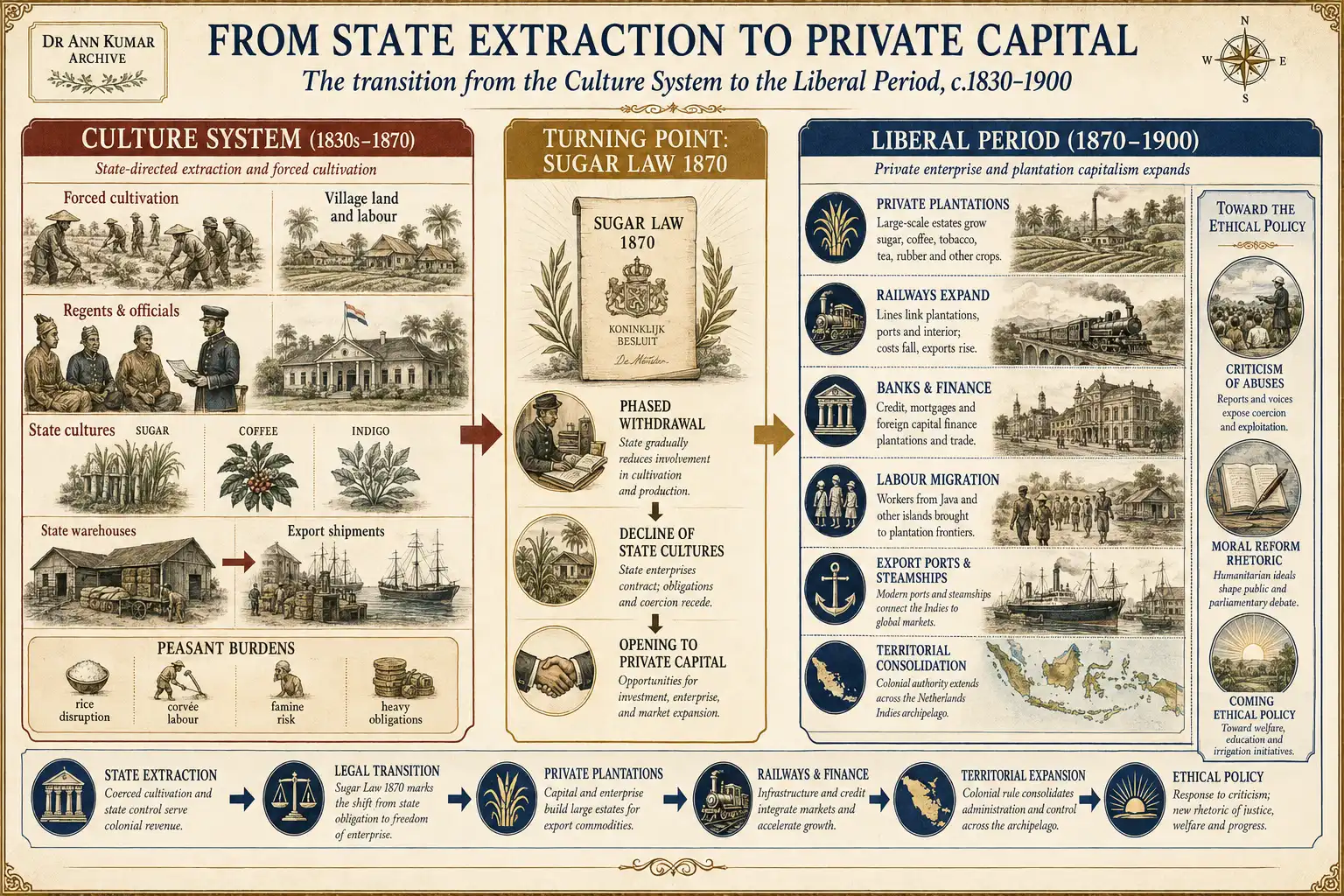
The formal end of the Culture System is generally dated to 1870, when the Sugar Law was passed. This law provided that the government would give up forced cultivation of sugar in twelve yearly stages beginning in 1878. It also permitted the free sale of sugar in Java.
Professor Kumar stresses how slow the transition actually was. Coffee, by far the most profitable product under the system, remained a forced culture until 1917. The “end” of the Culture System was therefore gradual, uneven and shaped by Dutch economic interest.
Who Benefited from Liberalism?
Professor Kumar’s most important interpretive point is that the transition from the Culture System to the Liberal Period was more significant for the Dutch minority than for Javanese peasants. The colony was still treated as a business concern.
The difference was that Dutch planters and businessmen now gained a larger share of the opportunities previously monopolised by the colonial state. Liberalism meant the loosening of government monopoly, but not necessarily the liberation of colonised people from economic exploitation.
Private Enterprise and Plantation Capitalism
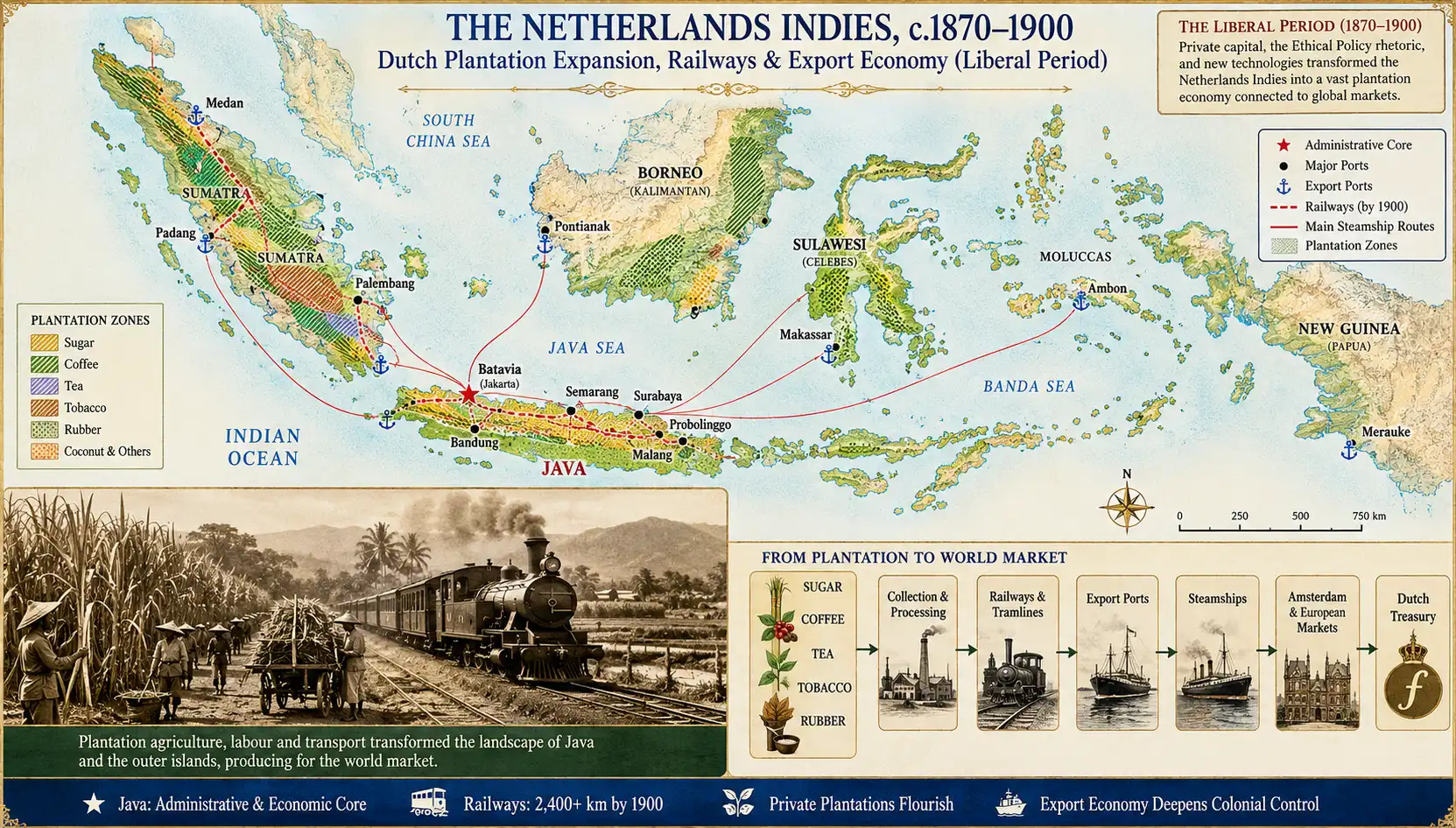
With the progressive abolition of government-controlled forced cultures, private enterprise expanded. Dutch planters, businessmen and investors entered more directly into the colonial economy. Plantations became central to the new phase of colonial development.
Plantation capitalism changed the form of extraction. Under the Culture System, the colonial state had organised land and labour for export crops. Under the Liberal Period, private capital increasingly did the work, supported by colonial law, administrative order, infrastructure and access to land and labour.
The Older Political Geography of the Archipelago
Professor Kumar then widens the frame. Around 1870, the political geography of the archipelago was still unlike the modern system of precisely bounded nation-states. Instead, there were centres of power — Batavia, Manila, Singapore and others — whose influence radiated outwards through vassal and tributary states.
She uses the image of concentric circles: influence fading out gradually from one centre until it met the fading influence of another. This is an important continuation of the archive’s Cores and Zones thinking. Colonial power did not simply cover mapped territory evenly; it radiated, overlapped and had to be consolidated.
Building the Netherlands Indies
From about 1870, the Dutch began building around the old core of Java a 3,000-mile arc of island possessions. This was the territorial formation that would become the Netherlands Indies and, eventually, Indonesia.
At about 1870, the Dutch Governor-General was centred at Batavia, controlling a relatively small Dutch administration and a small but well-trained army. Java was the main base of Dutch power, with a population of around 17 million including Madura. Alongside the Dutch administration stood the Javanese priyayi class, a relatively small group engaged in government and administration.
Outside Java: Administration, Mission and Plantation
Outside Java, Dutch power was uneven. Some areas were under fairly direct administration, including the Moluccas, Bangka and the Minangkabau region of West Sumatra after the defeat of the Padris. Beyond these zones, Batavia exercised broader overlordship over small native states, often requiring expeditions to maintain control.
Professor Kumar illustrates the changing situation with examples from Sumatra. Toba Batak society, north of the Minangkabau, was still largely pagan until the mid-nineteenth century and was later influenced by German Protestant missionaries. Christianity became, in this context, a medium of modernisation, and the Bataks later became more important in Indonesian affairs than their numbers alone might suggest.
Around Medan, European influence appeared differently: through Dutch tobacco plantations from about 1863. The success of these plantations created demand for labour beyond the local population, leading to the importation of Chinese and Malay workers. This influx transformed local society.
Aceh and the Limits of Colonial Control
Further north lay Aceh, the last major indigenous state to put up sustained resistance to absorption by Dutch military action. The Dutch campaign began in 1873, partly stimulated by fear of British influence from the other side of the Straits of Malacca.
The war exposed the limits of formal conquest. It was easy enough to occupy a capital and shackle a ruler; it was much harder to control a countryside. Guerrilla resistance continued for decades, and the Dutch sought advice on the Islamic dimension of Acehnese resistance from Christiaan Snouck Hurgronje.
Short Declarations and the End of Military Expansion
By the end of the first decade of the twentieth century, more than 200 petty rulers had signed the so-called “short declaration,” introduced in 1898. By this declaration, they acknowledged Dutch rule and promised to obey Dutch orders.
Bali was among the regions brought under Dutch control by military expeditions, including the puputans at Badung and Klungkung in 1906 and 1908. These were the last Dutch military expeditions. The Liberal Period therefore coincided not only with plantation capitalism but with the consolidation of colonial sovereignty across the archipelago.
Railways, Telegraphs, Banks and Newspapers
The Liberal Period was also an age of infrastructure and institutional growth. Professor Kumar notes railway construction from 150 miles in 1875 to 1,200 miles in 1900, along with the development of telegraphs, banks, newspapers and other modern institutions.
These developments supported plantation capitalism and administrative expansion. They also changed the practical nature of government. Colonial rule increasingly depended on paperwork, specialist branches such as irrigation, communication systems, finance and transport.
The Decline of the Regents
As government became more specialised, the Javanese regents were left further behind. From 1879, the Dutch government tried to educate the regents for modern times, but Professor Kumar suggests that it was already too late for them to recover their former importance.
Both Dutch officials and regents continued for a time to maintain older status symbols, including retinues and the use of the pajung. Yet this style of life looked increasingly out of place in a bureaucratic state dependent on paperwork, technical specialisation and administrative efficiency.
From Liberal Period to Ethical Policy
Professor Kumar’s lecture then moves towards the next major rethinking in Dutch colonial policy: the Ethical Policy. The transition is important. The Liberal Period had promised reform and private enterprise, but it also intensified Dutch capital, plantation society, labour migration, inequality and the weakening of village structures.
By the turn of the century, moral criticism of colonial exploitation was growing. Writers such as Van Deventer and Brooshooft would argue that the Netherlands had incurred a debt of honour to the Indies and that free enterprise had allowed European planters to seize the best land and profit from impoverished labour. The Ethical Policy emerged from these contradictions.
This Page in the Archive’s Larger Argument
The Liberal Period is a crucial bridge in the archive. It shows that dismantling the Culture System did not end colonial extraction. Instead, extraction was reorganised through private enterprise, plantation capital, infrastructure and an expanding territorial state.
It also prepares the ground for Indonesian nationalism. The modern colonial state built railways, schools, councils, bureaucracies and cities, but also inequalities and contradictions. The Liberal Period created the economic and institutional world to which the Ethical Policy and early nationalist organisations would respond.
Map / Diagram / Visual Context
Why This Lecture Matters
The Liberal Period matters because it shows that colonial “reform” could shift the beneficiaries of exploitation without ending the colonial economy itself. Professor Kumar’s treatment makes clear that the period was transformative for Dutch planters, businessmen and the colonial state, but far less liberating for Indonesian peasants and labourers. It is the essential bridge between the Culture System and the Ethical Policy.
Further Reading
- J. S. Furnivall, Netherlands India.
- J. D. Legge, Indonesia.
- Anthony Reid, The Contest for North Sumatra: Atjeh, the Netherlands and Britain, 1850–1898.
- Christiaan Snouck Hurgronje, writings on Islam, Aceh and Dutch colonial policy.
- Further readings on the Sugar Law, plantation capitalism, Deli tobacco, Aceh, Bali and Dutch colonial infrastructure should be added when the archive bibliography is finalised.