
Professor Ann Kumar Southeast Asian Civilisation Archive
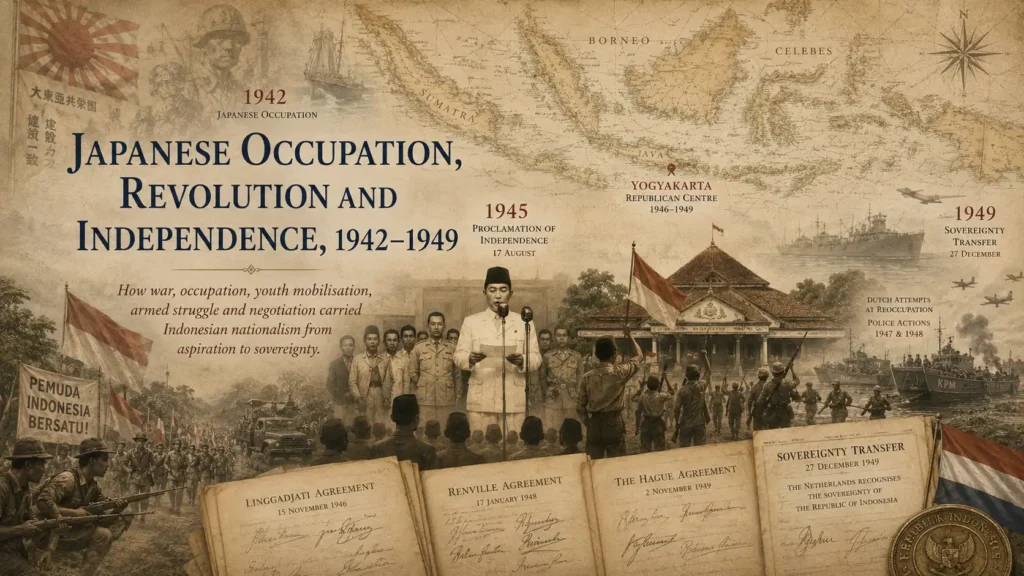
Japanese Occupation, Revolution and Independence, 1942–1949
How war, occupation, youth mobilisation, armed struggle and negotiation carried Indonesian nationalism from aspiration to sovereignty.
This page continues Professor Kumar’s nationalism lecture from the threshold year of 1942. The Japanese occupation destroyed Dutch authority, gave nationalist leaders access to a mass public, reorganised education through Indonesian, created an Indonesian officer cadre through PETA, and produced both severe hardship and new political possibility. The result was not a smooth road to independence, but a turbulent revolutionary period in which youth militancy, Dutch attempts at restoration, military struggle and negotiation all shaped the Republic that emerged in 1949.
Key Idea
The Japanese occupation did not create Indonesian nationalism, but it transformed its conditions. It broke Dutch authority, expanded nationalist reach, militarised youth and created an Indonesian officer cadre. The revolution that followed was therefore both political and social: a struggle against Dutch return, but also a struggle over who would define the new Indonesia.
The Japanese Defeat of the Dutch
At the beginning of 1942, Japanese forces defeated the Dutch and occupied the Netherlands Indies. The collapse of Dutch rule was sudden and decisive. For Indonesian nationalists, it ended the old colonial order that had imprisoned, exiled and restricted their leaders throughout the 1930s.
The Japanese came with the rhetoric of Asian liberation and co-prosperity, but their practical aim was military. Indonesia was to be mobilised for Japan’s war effort. The occupation therefore opened political opportunities while imposing severe hardship.
Sukarno, Hatta and Controlled Mobilisation
The Japanese sought the cooperation of nationalist leaders such as Sukarno and Hatta, and they obtained it. The leaders were kept under tight control, but the Japanese provided them with propaganda organisations through which they could speak to a much wider public than they had reached under the Dutch.
This was one of the occupation’s major consequences. Before 1942, the Dutch had repressed nationalist parties, exiled leaders and tightly limited political speech. Under the Japanese, nationalist leaders were used by the occupying power, but in being used they acquired new visibility and authority.
Language, Education and National Feeling
The Japanese also replaced the older Dutch educational structure, which had been divided between Dutch-language and native schools, with a more unified school system using Indonesian as the vehicle of instruction.
This had a major effect on nationalist sentiment. The Youth Pledge of 1928 had already declared Indonesian to be the language of national unity. Japanese educational policy, for its own wartime reasons, helped make Indonesian a more practical language of public life.
Hardship, Forced Labour and Occupation Disorder
Professor Kumar is careful not to romanticise the occupation. It took place in wartime, and the Japanese were making a grim and desperate effort. Many Indonesian peasants were used as forced labour, and rice was taken for the Japanese armies.
The occupation has been described as both ruthless and inefficient. It was ruthless in its labour and requisition demands; inefficient because the Japanese could not cope with galloping inflation, corruption and the collapse of much of Indonesia’s export economy.
PETA and the Indonesian Officer Cadre
One Japanese policy had especially important consequences for the independence struggle and for post-independence Indonesia: the creation of an Indonesian army, PETA, or Pembela Tanah Air. Professor Kumar describes it as a well-trained force of about 65,000.
The Dutch had made considerable use of Indonesian soldiers before, but PETA was different because it was officered by Indonesians up to battalion level. For the first time, an Indonesian officer cadre was created.
This gave rise to a fourth post-independence power group: the army. Professor Kumar places it alongside the secular nationalists associated with Sukarno and the PNI, the Muslims divided into traditionalist and modernist groups, and the communists who re-emerged as an effective political force in 1945.
The Proclamation of Independence
The Japanese occupation ended in August 1945. Two days after the Japanese surrender, Sukarno and Hatta proclaimed the independence of Indonesia. A committee then drew up the famous Constitution of 1945 and established a cabinet, with Sukarno as President and Hatta as Vice-President.
This proclamation was the beginning of sovereignty as a claim, not yet sovereignty as an uncontested fact. The Dutch did not accept the end of their colonial rule, and the Republic existed at first in conditions of uncertainty, dislocation and revolutionary pressure.
Revolution and Near-Anarchy
Professor Kumar describes the revolutionary period as long, bitter and close to anarchy. The Japanese administration had virtually collapsed overnight. The British were the first Allied forces to land, but they had limited troops and were not primarily concerned with Indonesia.
The Dutch returned under the cover of the British presence. This caused lasting Indonesian bitterness towards the British, because many Indonesians believed the British had helped the Dutch come back after Indonesia had been liberated from the Japanese.
The new Republic existed more on paper than as an effective government. To understand post-independence Indonesia, Professor Kumar suggests, one has to understand the starvation, corruption and dislocation of the Japanese occupation and the near-anarchy of the Revolution.
The Pemuda Movement
Perhaps the most important development out of revolutionary near-anarchy was the pemuda movement. It included young people of many classes and ethnic groups, united by a common commitment to independence.
The pemuda were especially important in 1945–46. They formed local fighting groups, often poorly armed with bamboo spears and improvised weapons. Some pemuda leaders began building a more unified national army, drawing in ex-PETA soldiers after the Japanese disbanded PETA.
Violence, Social Fracture and Minority Communities
Not all violence in the revolutionary period was directed against the Japanese or the Dutch. Some was directed against traditional elites who had been supported by the Dutch, and against minority groups considered insufficiently committed to independence or actively hostile to it.
Chinese, Eurasians and Ambonese could become targets. Professor Kumar describes this as the whole gamut of tensions that Dutch and Japanese power had kept below the level of actual violence now breaking loose.
Politicians and Youth: Two Styles of Revolution
Another division lay inside the independence movement itself. Those who were nominally the government — older nationalists such as Sukarno and Hatta — were urban, elite politicians with little taste for military action. Their strategy centred mainly on negotiation.
The pemuda groups were more committed to fighting for independence without compromise. Professor Kumar identifies this difference in style and commitment between political elites and youth movements as one of the Revolution’s enduring legacies in post-independence Indonesia.
Linggadjati and the Dutch Federal Strategy
Negotiations between the leaders of the Indonesian Republic and the Dutch dragged on until the end of November 1946, when the Linggadjati Agreement was signed, partly under British pressure.
Under this agreement, the Netherlands agreed to recognise the Republic as the de facto authority on Java and Sumatra and to cooperate towards a sovereign federal Indonesia. Professor Kumar follows Kahin in describing Linggadjati as little more than an “agreement to agree.”
Meanwhile, the Dutch retook islands outside Java and Sumatra with relative ease and established the state of East Indonesia in December 1946. This was intended as the first of several regional member states in a federal system the Dutch hoped to influence or control.
The First Police Action and Renville
By July 1947, the Dutch had greatly increased their military strength in Indonesia. They accused the Republic of breaching the Linggadjati Agreement and launched the so-called First Police Action.
Dutch forces took territory in West and East Java and parts of South and East Sumatra. In these conquered areas they created new regional states as part of their federal system, often drawing on old hereditary elites or groups such as Chinese and Eurasians who had suffered during the pemuda violence.
The Republic, in a poor military position, was compelled to accept these conquests through the Renville Agreement in January 1948.
The Second Police Action and the Fall of Yogyakarta
In December 1948, the Dutch launched the Second Police Action. They quickly took all remaining Republican territory, including the capital, Yogyakarta. The siege and fall of Yogyakarta became a central part of the Indonesian story of the independence struggle.
The Dutch also captured most of the Republican leaders, including Sukarno and Hatta, who were exiled to Bangka. Militarily, the Dutch appeared to have succeeded. Politically, that success contained the seeds of defeat.
World Opinion and Guerrilla War
By this stage, world opinion was turning strongly against the Dutch, especially in the United Nations. Australia and India had protested against Dutch actions from the time of the First Police Action.
With the politicians captured, the Indonesian army and much of the population began guerrilla war without being hampered by negotiation. The Dutch found it almost impossible to administer the territories they had conquered because of guerrilla activity.
The Dutch therefore had to accept that Indonesia would have to be given independence and reopened negotiations with the Republican political leaders.
The Hague Agreement and the Federal Republic
A settlement was reached through the Hague Agreement of 2 November 1949. It established the federal Republic of the United States of Indonesia, consisting of fifteen Dutch-created regional states plus the Indonesian Republic, which would hold the dominant position.
The Republican leaders made concessions. The Netherlands retained New Guinea for the time being, with its future status to be settled through later negotiations. Indonesia also agreed to guarantees for Dutch investors and took over a large Netherlands Indies public debt.
These concessions imposed heavy burdens on the new Republic. Japanese paper money, Republican wartime finance, dislocation and the collapse of export industries had already created severe economic problems. The transfer of sovereignty therefore came with unresolved political, territorial and financial costs.
Sukarno’s Later Role
Professor Kumar closes by noting how the revolutionary settlement helps explain Sukarno’s later career. On the one hand, he was enormously popular because he had declared independence and had been imprisoned by the Dutch — a process of martyrisation.
On the other hand, the compromises made in 1949 left many fighters, including pemuda, feeling that the politicians had conceded too much. Sukarno’s later campaigns over West Irian and Malaysia can be partly understood as efforts to prove that he was still fighting colonialism.
27 December 1949
On 27 December 1949, the Dutch flag was hauled down for the last time, and Indonesia became free. Professor Kumar’s ending is deliberately plain. After occupation, anarchy, negotiation, war, federal manoeuvre and international pressure, sovereignty finally passed from the Dutch to Indonesia.
The Republic that emerged was burdened by debt, internal division, unresolved territorial questions, youth militancy, military power and the memory of compromise. Independence was not the end of political struggle. It was the beginning of a new state built out of the pressures of occupation and revolution.
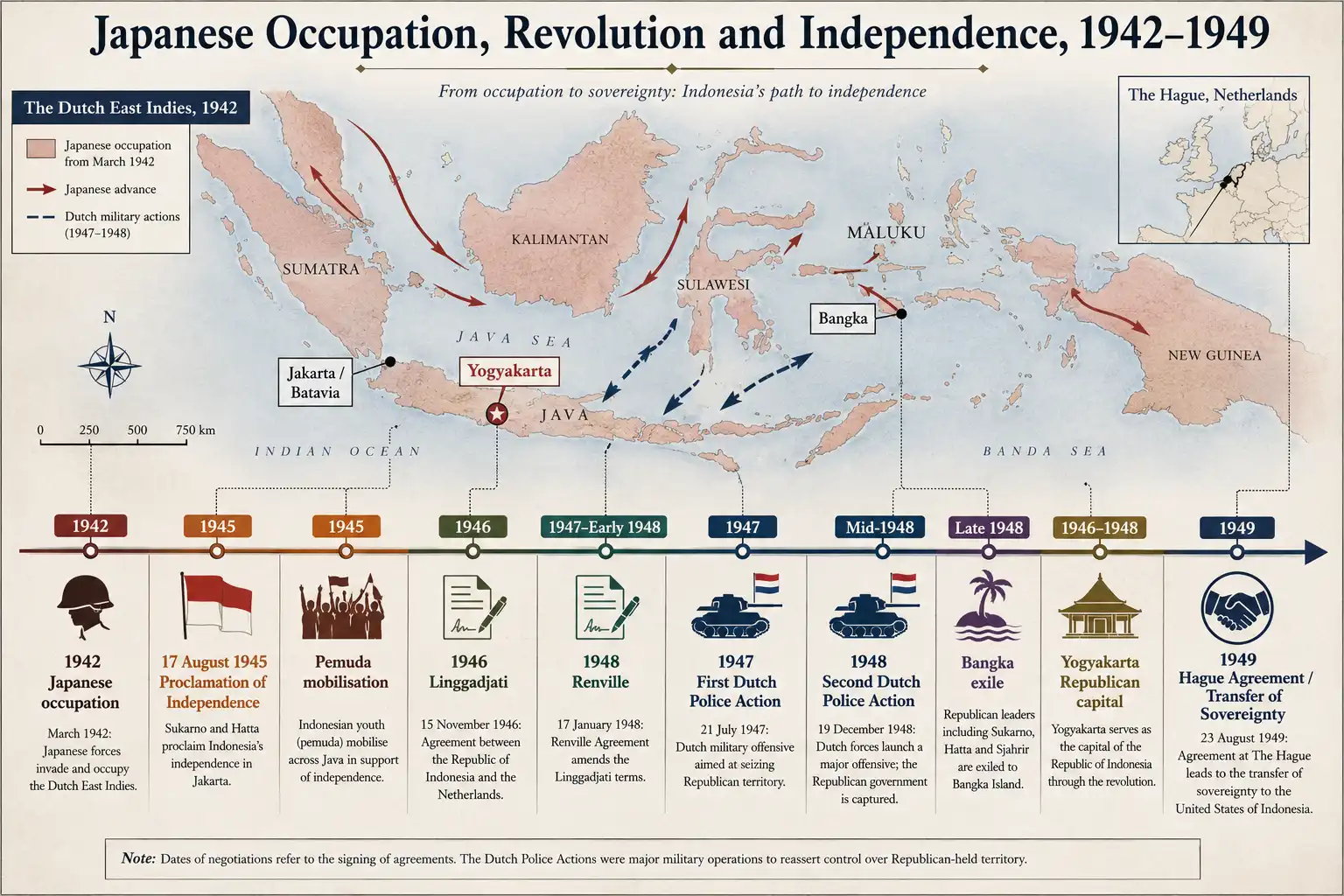
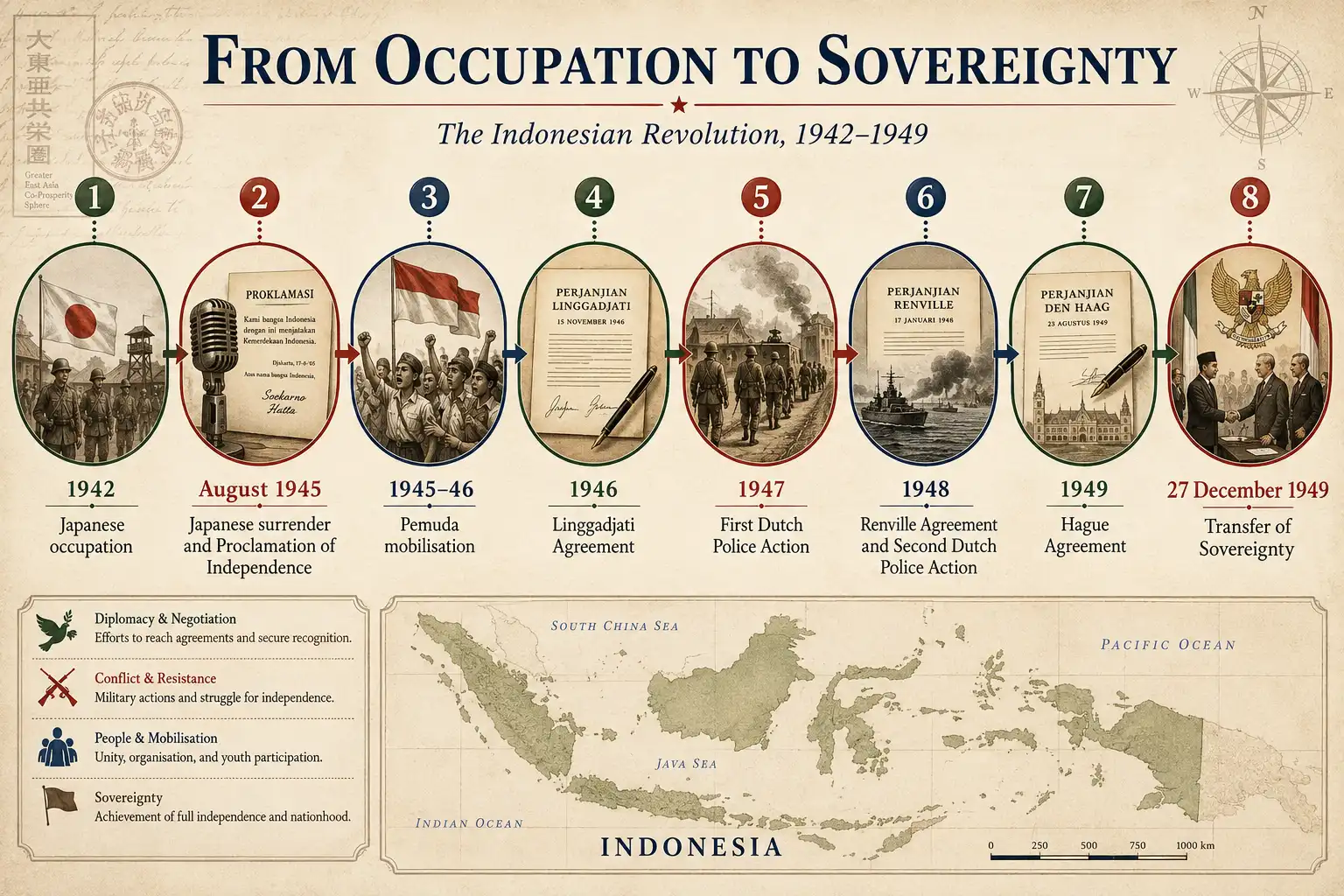
Map / Diagram / Visual Context
Why This Lecture Matters
This lecture section matters because it shows that Indonesian independence was not simply granted after Japanese defeat. It had to be proclaimed, defended, negotiated, internationalised and finally recognised. Professor Kumar’s account keeps all the tensions visible: collaboration and mobilisation, youth militancy and elite negotiation, military success and political failure, sovereignty and compromise.
Further Reading
- George McTurnan Kahin, Nationalism and Revolution in Indonesia.
- Harry J. Benda, The Crescent and the Rising Sun.
- J. D. Legge, Indonesia.
- Sutan Sjahrir, Out of Exile.
- Further readings on PETA, pemuda, Linggadjati, Renville, the Dutch Police Actions and the Hague Agreement should be added when the archive bibliography is finalised.