
Professor Ann Kumar Southeast Asian Civilisation Archive
The Moluccan Spice Monopoly
How a cosmopolitan free port challenged the Dutch spice monopoly — and how its defeat reshaped trade, sovereignty and migration across Southeast Asia.
This lecture follows the shift in anti-Dutch trade from the Moluccas to Makassar. Once the VOC tightened its grip over the spice islands, Makassar emerged as the great loophole in the monopoly system: a maritime entrepôt, a cosmopolitan port, a Muslim court, a military power and a haven for merchants who refused to submit to Dutch commercial control.
Key Idea
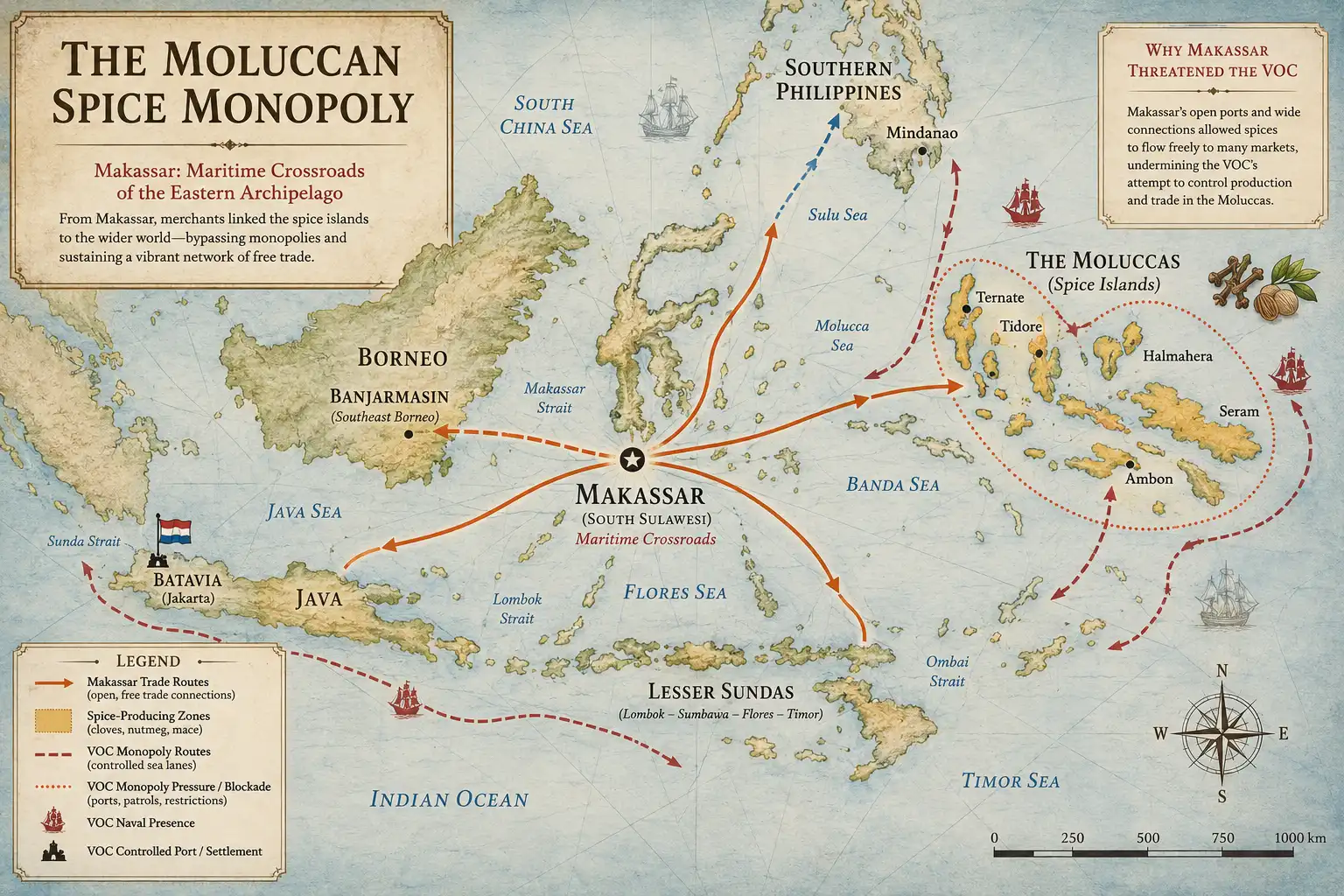
Makassar mattered because it kept the older plural trading world alive. While the VOC tried to narrow commerce into monopoly, Makassar welcomed multiple peoples, faiths, ships and commercial interests. The Treaty of Bongaya was therefore not only the defeat of one port; it was the violent narrowing of a maritime world.
The Shift from the Moluccas to Makassar
Professor Kumar introduces Makassar immediately after her discussion of the Moluccan spice monopoly. Once the VOC had tightened control over the Moluccas, the centre of anti-Dutch trade shifted. Commerce did not simply disappear under pressure; it moved, adapted and found a new harbour.
Makassar was ideally placed for this role. It linked the Moluccas, Java, Banjarmasin, the Lesser Sundas and the southern Philippines. It was not a marginal port but a strategic hub in the maritime geography of eastern Indonesia. For traders wishing to evade Dutch restrictions, Makassar offered access, protection and opportunity.
A Cosmopolitan Free Port
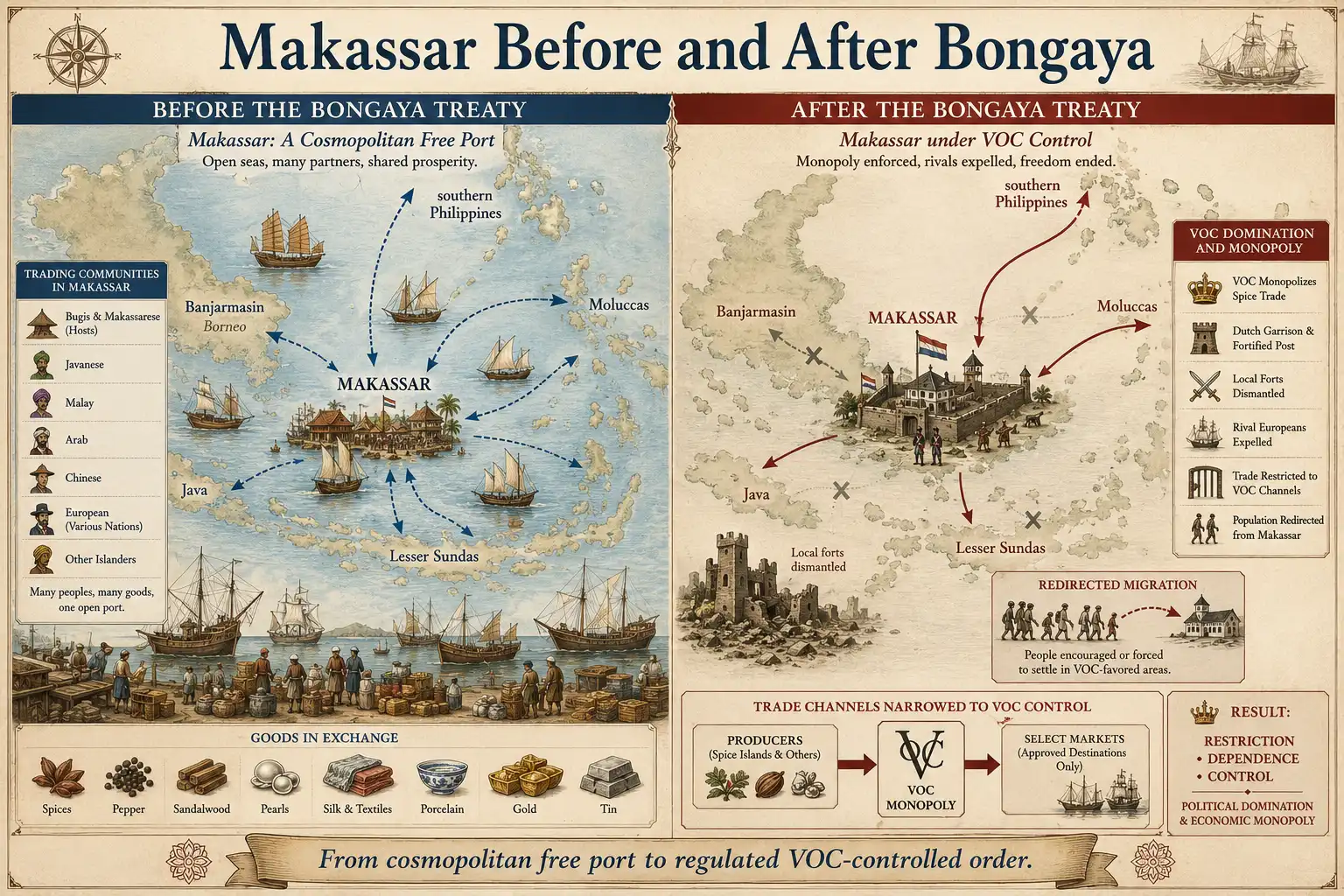
By 1600, Makassar had a large Malay colony. Its rulers encouraged foreign traders and made the port unusually open. Chinese, Indians, Arabs, Javanese, Portuguese, English and Danes all operated there. This diversity was precisely what made Makassar valuable — and precisely what made it intolerable to the VOC.
To the Dutch, Makassar represented the failure of monopoly. As long as merchants could use Makassar as a base, the VOC could not fully control the spice trade. Other Europeans could still buy, sell and ship. Asian merchants could still evade Dutch patrols. Local rulers could still use foreign traders for their own advantage.
Islamisation and Aristocratic Trade
In the early seventeenth century, Professor Kumar identifies two important developments. The first was Islamisation. The second was the increasing involvement of the Makassarese aristocracy in trade. This combination strengthened Makassar’s commercial and political position.
The local aristocracy did not merely supervise trade from a distance. It hired foreign ships, then had its own ships built in Java. Makassarese rulers and nobles also used Portuguese pilots. This was a maritime society actively building capacity: ships, routes, alliances, firearms and fortifications.
Makassar as Regional Power
By the 1630s, Makassar had developed a considerable sphere of influence. Professor Kumar describes its reach across coastal Celebes, parts of the Moluccas and the Lesser Sundas. It was not simply a marketplace. It was an expanding political and military power.
The Makassarese used Portuguese firearms and constructed fortifications along European lines. This detail is important because it unsettles any simple opposition between “European technology” and “Asian tradition.” Makassar was adaptive, maritime, military and outward-looking. Its strength came partly from its ability to incorporate useful external techniques into local power.
Why Conflict with the VOC Was Inevitable
Professor Kumar’s phrase is blunt: because Makassar breached the Dutch trade monopoly, a clash had to come sooner or later. The VOC could not tolerate a strong, independent port that welcomed Dutch rivals and allowed the spice trade to escape Company control.
In 1660, the Dutch sent an expedition to Makassar. A treaty was signed under which the Sultan promised to expel the Portuguese. He did not. From the VOC point of view, the treaty had failed; from Makassar’s point of view, expelling useful commercial and military partners would have weakened the very system that made the port powerful.
Speelman, Arung Palakka and the 1666 Expedition
In 1666, a second Dutch expedition was sent under Cornelis Speelman. The campaign was made far more effective by the support of Buginese troops under Arung Palakka of Bone. Arung Palakka had his own reasons for opposing Makassar, rooted in the political rivalries of South Sulawesi.
This is one of the moments where Professor Kumar’s teaching method is especially strong. She shows that Dutch power worked through local alliances. The VOC did not simply impose itself from outside. It entered existing political fractures, and its victories often depended on Southeast Asian actors pursuing their own objectives.
The Bongaya Contract
After a four-month siege, the Dutch succeeded in imposing the Bongaya Contract. The treaty forced Makassar’s ruler to acknowledge Dutch overlordship and accept the VOC trade monopoly. Makassar’s forts had to be dismantled, except for the main fort, which would be occupied by a Dutch garrison. Non-Dutch Europeans were to be expelled, and a heavy indemnity was imposed.
The treaty’s provisions reveal its purpose. It was not enough for the VOC to defeat Makassar militarily. The Dutch wanted to restructure the port’s commercial ecology. They had to remove rival Europeans, control fortifications, assert monopoly rights and make Makassar governable within the VOC system.
Renewed Fighting and Direct Dutch Administration
The treaty did not immediately settle the matter. Professor Kumar notes renewed conflict in 1668 after treaty evasions. The Sultan eventually had to abdicate. From then on, Makassar came under direct Dutch administration.
Professor Kumar contrasts this with Java, where Dutch domination often reinforced Javanese structures through indirect rule. In Makassar, the result was different. The port’s defeat produced a sharper rupture, and Dutch intervention helped create resentments that would echo in later regional relations, including resentment of Javanese cultural pretensions.
The Buginese and Makassarese Diaspora
One of the most important consequences of Makassar’s defeat was migration. Professor Kumar stresses the “tremendous emigration” that followed. Makassarese and Buginese people moved widely and came to play roles in the histories of Siam, Cambodia, Malaya and other parts of Southeast Asia.
This is a crucial part of the lecture’s wider significance. Dutch victory did not simply silence Makassar. It scattered Makassarese and Buginese energy across the region. The fall of one maritime centre helped produce new patterns of military, commercial and political activity elsewhere.
Makassar in the Archive’s Larger Argument
Makassar is central to the archive because it shows Southeast Asian agency in multiple forms. Its rulers invited foreign traders, adopted external technologies, built ships, used Portuguese pilots, Islamised, fortified, traded and expanded. Its defeat came not because it lacked vitality, but because its vitality directly challenged VOC monopoly.
The Treaty of Bongaya therefore belongs in the Colonial Engine Hub, but it also belongs beside the Indigenous Sovereignty material. It is a story about Dutch coercion, but also about Makassar’s own political imagination and Arung Palakka’s Buginese power. The lecture is strongest when read across both frames.
Map / Diagram / Visual Context
Why This Lecture Matters
Makassar and the Bongaya Treaty show the VOC’s monopoly strategy at its most revealing. The Dutch did not merely want goods; they wanted to close the alternative routes through which goods, people and power moved. Makassar’s defeat was therefore a major moment in the narrowing of Southeast Asia’s open maritime world. Yet Professor Kumar also shows that Dutch victory depended on indigenous alliance and produced regional consequences far beyond Dutch control.
Further Reading
- C. C. Macknight, writings on South Sulawesi and the emergence of civilisation in South Celebes.
- H. J. de Graaf, writings on early modern Indonesian history and Islam in Southeast Asia.
- Leonard Y. Andaya, The Heritage of Arung Palakka.
- Further bibliography on Makassar, the Treaty of Bongaya, South Sulawesi and VOC maritime strategy should be added when the archive bibliography is finalised.