
Professor Ann Kumar Southeast Asian Civilisation Archive
The Buginese Concept of Kingship
How myth, adat, councils and sacred authority shaped a distinctive South Sulawesi model of limited, consultative kingship.
This lecture explores what kingship meant among the Buginese communities of South-west Celebes. Professor Kumar asks a precise question: what sort of position did a king have, both in theory and in practice, among a people who became so important across the Malayo-Indonesian world? Her answer reveals a political system in which divine descent and sacred regalia mattered, but where rulers were also constrained by adat, councils and the practical need to arbitrate between communities.
Key Idea
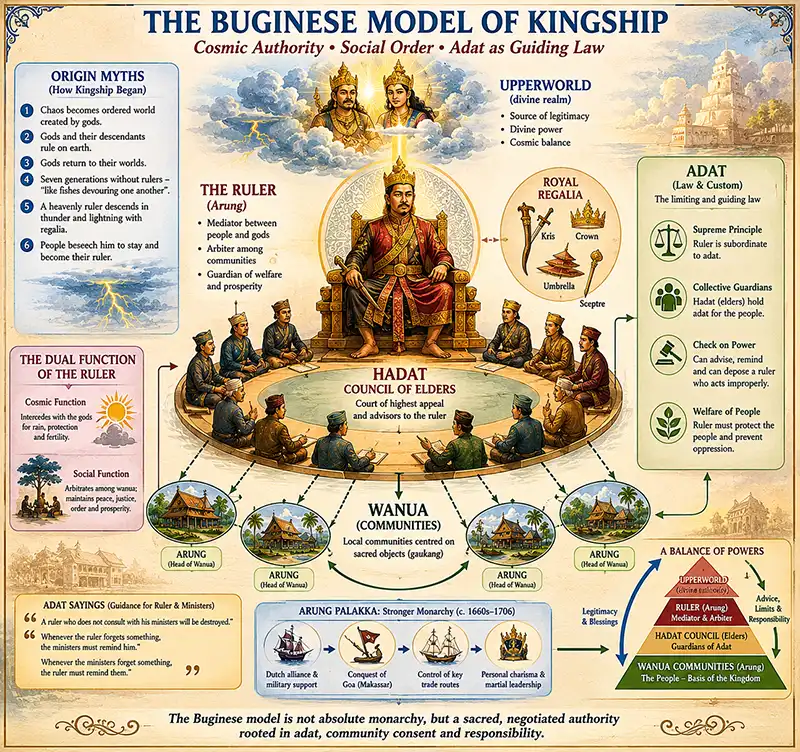
Buginese kingship combined sacred descent with political limitation. The ruler possessed divine aura and ritual power, but he was not absolute. His practical role was to mediate between wanua communities, uphold adat and govern in consultation with the Hadat. In Professor Kumar’s reading, the Buginese king was less a despot than an arbiter, mediator and guardian of balance.
Two Sources of Evidence
Professor Kumar begins by identifying two major sources for understanding Buginese kingship. The first is traditional stories about the origin of kingship, widespread among Buginese communities. The second is Buginese adat: law, custom and traditional sayings about correct behaviour and procedure.
These two sources do not emphasise exactly the same thing. The origin myths highlight divine descent, sacred power and the ruler’s connection to the gods. The adat material, by contrast, stresses procedure, consultation and the ruler’s function as an arbiter among human communities. The lecture’s strength lies in holding both dimensions together.
The Mythic Beginning: Chaos Without Rule
The Buginese origin stories begin with chaos. The gods of the Upperworld and the Underworld decide to make earth habitable. A god from above and a goddess from below are joined, and civilisation begins to spread through their descendants.
For a time, divine rulers govern on earth. Then, for reasons left unexplained, the gods withdraw and leave humankind without rulers. For seven generations, mankind is said to live without order, becoming “like fishes devouring one another.” This vivid image is central to the political imagination of the myth. Kingship arises not as domination, but as an answer to disorder.
The Arrival of the Heavenly Ruler
The chaos ends when each community finds a heavenly ruler. Usually, the ruler is said to descend from heaven amid thunder and lightning, accompanied by a retinue carrying royal regalia. The scene is emphatically sacred, but it is also contractual.
The people approach the heavenly figure and ask him to remain among them. They do not merely submit to conquest. They invite rule because they lack both ruler and Hadat. The origin of kingship is therefore framed as a request for order, pity and institutional foundation.
Regulations, Property and the Hadat
Once the ruler agrees to remain, he begins introducing regulations and institutions for the running of the kingdom. Professor Kumar notes that the regulations specifically mentioned in the myths concern property rights and the transfer of property. This is a revealing detail. Kingship is linked from the beginning to the practical ordering of society.
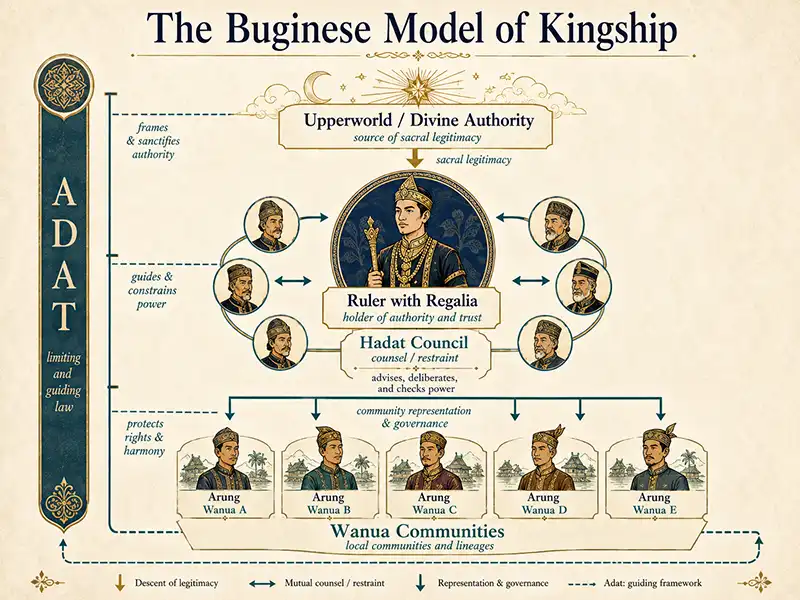
The ruler also forms the Hadat, which serves as the highest court of appeal in adat decisions and as an adviser to the ruler himself. The Hadat is not merely ceremonial. It is an institutional body that gives political order an advisory, legal and collective form.
Sacred Power and Divine Mediation
In the mythic material, the ruler possesses special divine power that can be harnessed for the welfare of the community. Having descended from heaven and agreed to remain on earth, he occupies a unique position between human beings and the gods.
This sacred quality is reinforced by stories in which rulers or their descendants vanish rather than simply die. One queen, Professor Kumar notes, is said to have been spirited away by a flame from heaven. The ruler is therefore not an ordinary political office-holder. He is also a ritual mediator.
From Divine Figure to Human Arbiter
The adat works shift the emphasis. They do not deny the ruler’s divine aspect, but they give greater attention to his human function as an arbiter. To understand that function, Professor Kumar turns to the introduction of kingship in Boné.
Before the ruler appeared, there were many small communities known as wanua. These communities centred around sacred objects called gaukang. They had relationships of kinship, offshoot settlement, alliance and conflict. Some joined together for strength; others quarrelled over land boundaries, fishing rights and other matters.
The problem was not the absence of community. It was the absence of a recognised superior authority able to arbitrate between communities. The mythic image of fishes devouring one another is therefore given a sociological explanation. Without a common arbiter, inter-community disputes could not be resolved.
Kingship as Federation
The ruler and his Hadat were set up as an overarching federated structure. This is one of the most important claims in the lecture. Buginese kingship did not simply crush local communities beneath royal power. The individual wanua retained a strong hold on the new governmental apparatus because each was represented in the Hadat by its head, the arung.
The ruler’s role was to arbitrate when disagreement arose between communities. He was above the wanua in one sense, but dependent on them in another. Kingship created a higher level of order without completely dissolving the local units from which that order emerged.
The King Was Not Absolute
Despite his divine qualities, the Buginese ruler was not absolute. Professor Kumar stresses this point through adat sayings. A ruler who did not consult with his ministers would be destroyed. If the ruler forgot something, the ministers had to remind him; if the ministers forgot something, the ruler had to remind them.
This is a political ethic of mutual correction. The ruler is subordinate to adat and to its guardians. He can be deposed if he does not act properly. He is expected to maintain the welfare of his people, to mix with them, to learn about their daily work and to prevent his relatives from oppressing them.
Two Functions of the Ruler
Professor Kumar concludes that the ruler has a dual function. First, he mediates between the people and the gods. Second, he mediates between individual wanua communities to ensure the smooth functioning and prosperity of society.
The second function seems to have been more important in practice. This is a crucial interpretive move. The sacred dimension gives kingship aura and legitimacy, but the everyday political work of kingship lies in arbitration, welfare and the maintenance of order between communities.
Arung Palakka as the Exception
The lecture’s discussion of Arung Palakka becomes more meaningful when placed against this normal model of Buginese kingship. He was able to establish a stronger form of monarchy than was usual because his position rested on exceptional supports: popular devotion, the loyalty of his Batavian exile followers and Dutch backing.
Subsequent rulers did not enjoy the same special sources of strength, and the Hadat gradually regained its old power. Arung Palakka therefore does not invalidate the Buginese model of limited kingship. He demonstrates its flexibility and the unusual circumstances required for a ruler to override it.
Buginese Kingship in the Archive’s Larger Argument
This lecture is one of the clearest statements of the archive’s Indigenous Sovereignty theme. It shows a Southeast Asian political system with its own categories of legitimacy, authority, law, consultation and sacred order. The Buginese ruler was not a copy of an Indian, Islamic or European monarch. He belonged to a distinct political culture rooted in local community, sacred origin and adat-bound procedure.
Professor Kumar’s treatment also resists the idea that Southeast Asian societies were politically simple before European intervention. The Buginese case reveals a subtle constitutional imagination: kingship invited by the people, surrounded by council, constrained by custom and justified by the practical need to stop communities from devouring one another.
Map / Diagram / Visual Context
Why This Lecture Matters
The Buginese Concept of Kingship is central to the archive because it demonstrates Professor Kumar’s insistence on indigenous political intelligence. Here kingship is not treated as exotic ceremony or imported monarchy, but as a sophisticated system for transforming conflict into order. Sacred descent, property regulation, councils, adat, welfare and consultation all belong to the same political world.
Further Reading
- Leonard Y. Andaya, The Heritage of Arung Palakka: A History of South Sulawesi (Celebes) in the Seventeenth Century.
- C. C. Macknight, writings on South Celebes and indigenous civilisation in island Southeast Asia.
- K. J. Noorduyn, “Origins of South Celebes Historical Writing,” in An Introduction to Indonesian Historiography.
- Further readings on Buginese adat, wanua, gaukang, regalia and South Sulawesi political culture should be added when the archive bibliography is finalised.