Professor Ann Kumar Southeast Asian Civilisation Archive
Nationalist Awakening
Resistance, reform, education, associational life, occupation, revolution and the making of modern political identity.
Hub: Nationalist AwakeningArchive role: Resistance, reform, nationalism and independenceRelated hubs: The Framework · Indigenous Sovereignty · The Colonial Engine
The Nationalist Awakening Hub follows the long movement from early resistance and sacred rebellion to twentieth-century political nationalism. Professor Kumar’s lectures show that nationalism did not arise suddenly. It emerged from older memories of resistance, the pressures of colonial extraction, the limits of reform, the spread of education, urban associational life, Islamic and secular political movements, Japanese occupation, revolution and constitutional settlement. The hub also includes a comparative Malayan case, showing that Southeast Asian nationalism followed more than one path.
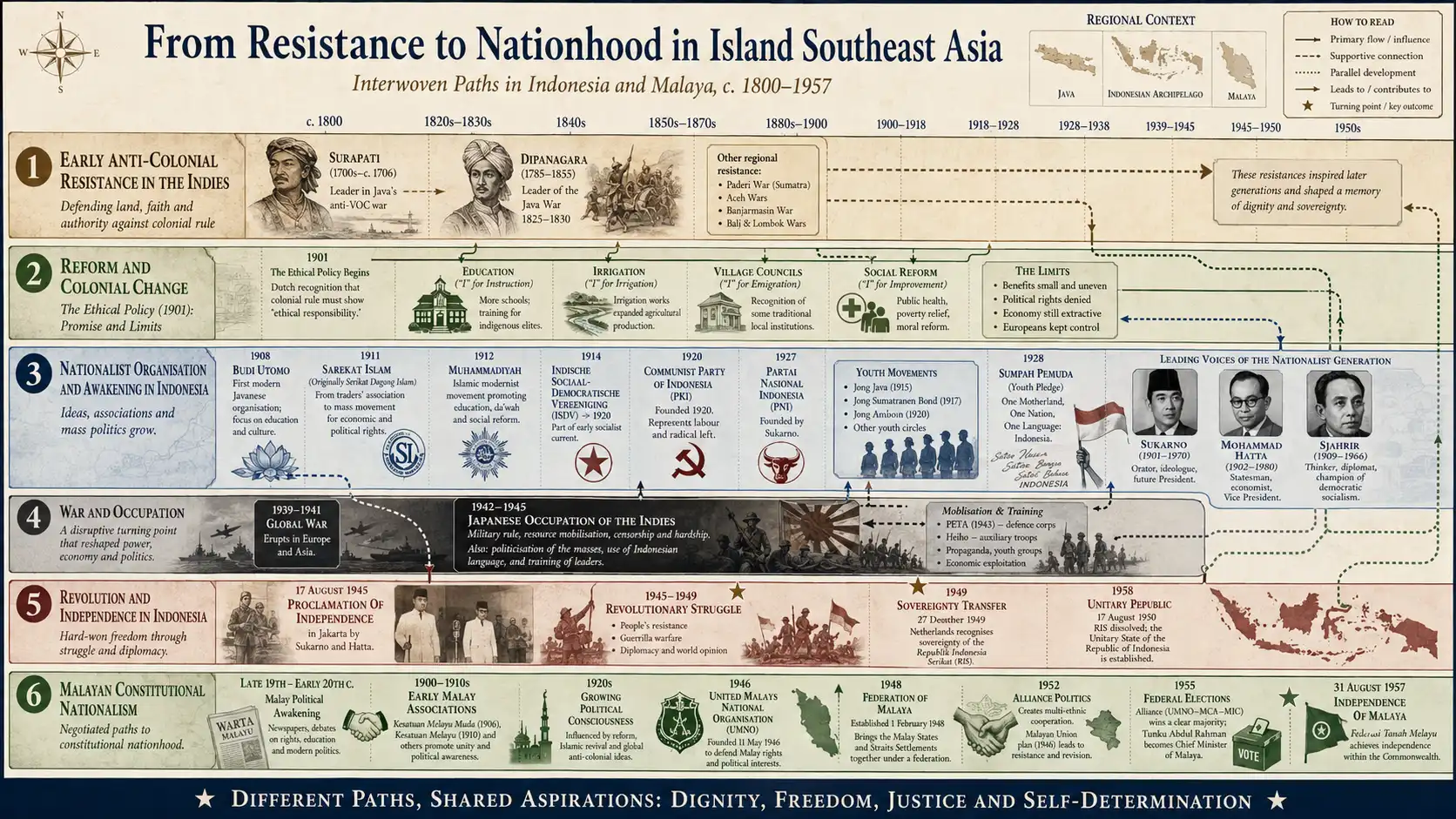
A layered timeline from Surapati and Dipanagara to Ethical Policy schools, nationalist organisations, Japanese occupation, Indonesian independence and Malayan constitutional nationalism.
This hub emphasises that nationalism developed through many channels: memory, education, association, religion, reform, crisis, war and negotiated political change.
Key Idea
Nationalism in Southeast Asia was not a single event or a single ideology. It grew from the encounter between older political worlds and modern colonial systems. Sacred rebellion, peasant grievance, Islamic networks, elite education, urban associations, colonial reform, Japanese occupation and revolutionary struggle all contributed to the making of modern national consciousness.
Lectures in This Hub
These lectures trace the movement from early anti-Dutch resistance and nineteenth-century rebellion to organised nationalism, Japanese occupation, Indonesian independence and the comparative Malayan path.
Surapati’s career links Batavia, Banten, Mataram and East Java, revealing early anti-Dutch networks, court politics and the later making of resistance legend.
The Java War joined sacred geography, Islamic-Javanese prophecy, court politics and colonial expansion in the last great Javanese war before the Culture System.
Dutch reform promised welfare, education and responsibility, but its limits exposed the contradictions of colonial benevolence and helped prepare the ground for nationalism.
Education, cities, associations, Islam, socialism, youth movements and anti-colonial politics converged in the formation of Indonesian national consciousness.
Japanese occupation shattered Dutch authority, opened new political space, armed and mobilised Indonesians, and helped set the conditions for revolution and independence.
A comparative Malayan case showing how British protection, monarchy, aristocracy, communal politics, UMNO and constitutional bargaining shaped national feeling.
The lectures in this hub show nationalism emerging through layered historical processes rather than through a single founding moment.
Memory of Resistance
Figures such as Surapati and Dipanagara belonged to older political worlds, yet later generations could read them as precursors of anti-colonial nationalism.
Colonial Reform and Its Limits
The Ethical Policy promised uplift and responsibility, but it also revealed the narrow boundaries of reform under colonial rule.
Education and Association
Schools, newspapers, student groups, religious associations and political organisations created new spaces in which national identity could be imagined.
Islam and Political Identity
Islamic networks, schools and organisations helped shape modern political consciousness, especially through social mobilisation and communal solidarity.
Occupation and Revolution
Japanese occupation transformed the balance of power, weakened Dutch authority and helped create the military and political conditions for revolution.
Comparative Nationalisms
Indonesia and Malaya followed different paths: one through revolutionary struggle, the other through monarchy, communal bargaining and constitutional compromise.
Why This Hub Matters
The Nationalist Awakening Hub shows how Southeast Asian political modernity emerged from deep historical layers. Professor Kumar’s lectures do not treat nationalism as a simple imitation of Europe. They show how older ideas of justice, Islamic reform, local grievance, colonial contradiction, education, labour, war and elite negotiation were drawn into new forms of collective identity. This hub brings the archive from indigenous polities and colonial systems into the age of mass politics, revolution and independence.
Pathways from This Hub
The Nationalist Awakening lectures gather threads from every other hub: historical frameworks, indigenous political memory and colonial systems of extraction and reform.
Later enrichment pages could include a visual timeline of Indonesian nationalist organisations, a Dipanagara memory page, a comparative Indonesia–Malaya nationalism page, and a resource on the Youth Pledge, Sarekat Islam, Budi Utomo, the PNI and revolutionary-era political formations.