
Professor Ann Kumar Southeast Asian Civilisation Archive
Dipanagara and the Java War, 1825–1830
How sacred kingship, Islamic-Javanese prophecy, colonial roads, court politics and Dutch expansion converged in the last great Javanese war before the Culture System.
This teaching page draws out the Dipanagara and Java War section of Professor Kumar’s lecture on the period from 1800 to the end of the Culture System. The war of 1825–1830 was not simply a dynastic rebellion, nor merely a response to Dutch administrative change. It brought together court politics, sacred geography, Islamic reformist feeling, Javanese prophetic expectation and the growing reach of colonial direct rule.
Key Idea
The Java War was a hinge between old and new forms of resistance. Dipanagara’s revolt drew on Javanese court politics, Islamic discipline, sacred geography and Ratu Adil prophecy, yet its defeat accelerated Dutch direct rule and helped prepare the financial and administrative conditions for the Culture System.
From Reform to Crisis
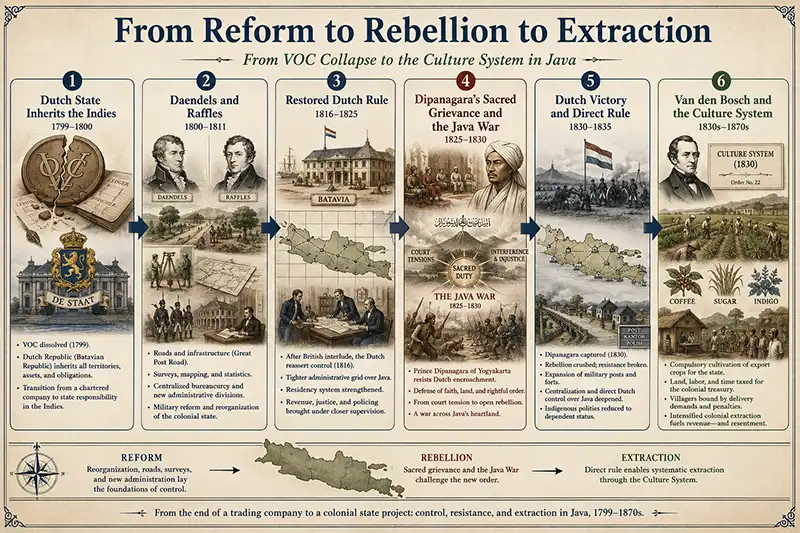
Professor Kumar places the Java War within a wider period of colonial transformation. After the dissolution of the VOC in 1799, the Dutch state inherited responsibility for governing the East Indies. Reformers argued over whether the old tribute and forced-delivery system should continue, or whether a more direct and modern form of administration should replace it.
Daendels and Raffles both moved in the direction of direct rule. Daendels reduced the Javanese regents to the position of civil servants subordinate to Dutch officials, while Raffles went further by trying to deprive them of political and revenue powers. Both men also pursued administrative rationalisation, road-building and military strengthening.
When Java was returned to the Dutch in 1816, the restored regime retained much of the movement toward direct government. The land-rent system continued, regents were denied automatic hereditary succession, and some of Raffles’ reforms were preserved. But these changes placed increasing strain on Javanese court society, rural authority and aristocratic expectation.
The Road to War
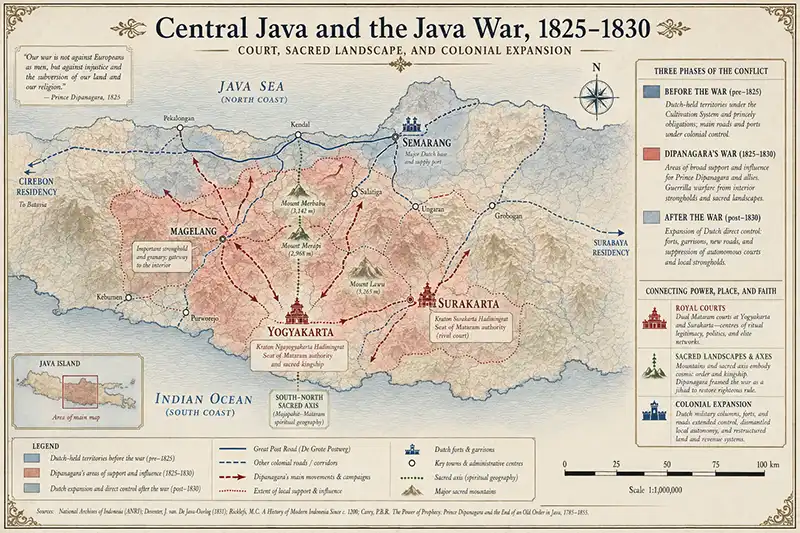
The outbreak of the Java War came after years of mounting tension in the Javanese principalities. The restored Dutch administration had tightened its control over Yogyakarta and Surakarta, reducing the autonomy of court politics and increasing the reach of colonial authority.
By 1830, Dutch direct rule over Java had expanded dramatically. Professor Kumar notes that in 1808 about sixty per cent of Java was under direct Dutch rule, but by 1830 this had risen to ninety-three per cent. The Java War therefore belongs to a period when the colonial government was converting influence into territorial and administrative command.
This was not merely an external Dutch story. It unfolded through Javanese courts, regents, succession disputes, spiritual expectations and local grievances. Dipanagara became the figure through whom these tensions were gathered into war.
Prince Dipanagara of Yogyakarta
The rebel leader was Prince Dipanagara of the Javanese principality of Yogyakarta. His family position was complex. When his father, Hamengkubuwana III, died in 1814, he was succeeded not by Dipanagara but by Dipanagara’s younger brother, whose mother was of higher rank.
Raffles had apparently promised Dipanagara that he would succeed if this younger brother died before him. The younger brother did die first, but by then the Dutch had returned. They placed his two-year-old son on the throne and made Dipanagara one of the guardians of the young ruler.
Professor Kumar is careful not to reduce Dipanagara’s rebellion to disappointed ambition. She notes that the final provocation was not the succession question, but the Dutch decision to build a road across part of Dipanagara’s property where there was a sacred tomb.
Sacred Geography and Political Authority
The sacred tomb episode reveals a central feature of the war. Dutch officials may have understood a road as a practical instrument of administration and military movement. For Dipanagara, the road cut through a sacred landscape and struck at the spiritual order in which political authority was embedded.
This is why the Java War cannot be understood only through modern categories of administration, taxation or territorial control. Javanese politics was still deeply entangled with sacred places, ancestral power, court legitimacy and signs of cosmic disorder.
Dipanagara’s rebellion therefore drew force from a world in which spiritual insult, political exclusion and colonial expansion could become the same event.
Pesantren, Asceticism and Islamic-Javanese Syncretism
Dipanagara’s autobiography gives important insight into his motivation. Professor Kumar stresses that the syncretism of Islamic orthodoxy and Javanese tradition was one of the most important forces behind his actions.
In his youth, Dipanagara moved from one pesantren to another and frequently withdrew to the mountains to practise asceticism in lonely caves. This religious discipline linked him to Islamic learning and piety, but also to older Javanese traditions of ascetic kingship and spiritual preparation.
Dipanagara’s world was therefore not neatly divided between Islam and Javanese tradition. His authority came from their fusion: pesantren learning, wali memory, ascetic practice, prophecy and royal descent.
Visions, Wali and the Ratu Adil
Dipanagara’s autobiography describes many visions. One of the most important was a vision of Sunan Kalijaga, the sixteenth-century wali traditionally associated with the Islamisation of Java. Such a vision linked Dipanagara’s cause to the sacred history of Javanese Islam.
On another occasion, while meditating, Dipanagara saw a figure who summoned him before the Ratu Adil. C. C. Berg associated the Ratu Adil with Javanese Buddhism, identifying him with the bodhisattva Maitreya. But in Dipanagara’s own account, the Ratu Adil appears as an Islamic figure, dressed like an Arab.
The Ratu Adil told Dipanagara that he would lead his warriors on Java and that his mandate would be the warrant. The vision was accompanied by striking signs: bats and owls screeching, the sea burning, thunderous noise, and a face too bright for a man to look upon.
The War Itself
The Java War lasted five years, from 1825 to 1830. Professor Kumar describes it as a holocaust that ravaged Java. Yet she also notes that there were no pitched battles in the conventional sense. Dipanagara and his allies were skilled in guerrilla tactics, and it took the Dutch a long time to gain the upper hand.
This style of warfare is significant. It shows that Dipanagara’s resistance was not a court army meeting the Dutch on European terms. It was dispersed, mobile, locally rooted and spiritually charged. Its strength lay in support networks, terrain, moral legitimacy and the difficulty Dutch forces faced in bringing it to decisive battle.
The Dutch eventually prevailed through military adaptation, attrition and the gradual weakening of Dipanagara’s alliances. In 1829, his two chief allies surrendered.
Betrayal, Exile and Autobiography
In 1830, Dipanagara agreed to negotiate with the Dutch. At the meeting, he was treacherously arrested by the Dutch general. He was then banished to Celebes, where he died in 1855.
His exile has lasting historical importance because he wrote his autobiography there. For Professor Kumar, this autobiography gives unusually direct access to Dipanagara’s own world of meaning: his religious discipline, visions, sense of mandate and understanding of sacred authority.
The Dutch captured the rebel leader, but the memory of Dipanagara did not disappear. His story entered the longer history of Javanese resistance, Islamic legitimacy and later Indonesian national memory.
The War and the Dutch Colonial State
The Java War did not improve the financial situation of the Dutch colonial government. It deepened the fiscal crisis of the colony and created the immediate background to Van den Bosch’s appointment as Governor-General in 1830.
Van den Bosch arrived with a reputation for making colonies profitable. He had previously been sent to restore prosperity to the Dutch West Indies, where he had succeeded in producing an annual profit for the Netherlands.
In Java, he responded to the fiscal crisis by introducing the Culture System, or cultuurstelsel. In Professor Kumar’s lecture, the Java War therefore forms the bridge between the reforming experiments of Daendels and Raffles and the return to a tribute-based colonial machine under Van den Bosch.
From Prophetic War to Forced Cultivation
The defeat of Dipanagara cleared the way for a more comprehensive colonial order. Van den Bosch restored the position of the Javanese regents, recognised hereditary succession in the regencies, and returned to a system in which the government of Java became a machine for collecting export produce for Europe.
This sequence is crucial. A war fought under the signs of prophecy, sacred geography and Islamic-Javanese authority was followed by a system of bureaucratic extraction. The Dutch did not simply defeat a prince. They reorganised Java financially, administratively and agriculturally in the aftermath of the conflict.
In the archive’s larger structure, Dipanagara therefore belongs between Indigenous Sovereignty and the Colonial Engine. His revolt was rooted in Javanese political and spiritual traditions, but its defeat accelerated the modern colonial state.
This Lecture in the Archive’s Larger Argument
Dipanagara’s rebellion is one of the clearest examples of why Southeast Asian history cannot be reduced to European action. The war emerged from Javanese court politics, Islamic piety, sacred geography, prophecy, local grievance and colonial intrusion.
At the same time, the war shows how colonial power adapted. The Dutch state learned from crisis, tightened its grip, expanded direct rule and turned to forced cultivation to restore solvency.
The Java War therefore belongs to the Nationalist Awakening Hub not because it was modern nationalism in the twentieth-century sense, but because it became a memory of resistance and a precursor to later anti-colonial narratives. Dipanagara stands between older Javanese sacred kingship and the modern Indonesian national story.
Map / Diagram / Visual Context
Why This Lecture Matters
Dipanagara and the Java War matters because it is the great nineteenth-century hinge in Professor Kumar’s Indonesian sequence. It connects the older Javanese world of sacred authority, court politics, Islamic piety and prophetic expectation with the modern colonial state that emerged after 1830.
The war also complicates any simple account of resistance. Dipanagara was not a modern nationalist in the later twentieth-century sense, but his revolt became part of the longer genealogy of Indonesian anti-colonial memory. He fought through an idiom of sacred kingship, Islamic-Javanese authority and local grievance, yet later generations could read him as a national hero.
Finally, the lecture explains why the Culture System followed so quickly after the war. The Dutch colonial government emerged from the conflict financially strained and administratively more ambitious. The result was one of the most important systems of colonial extraction in nineteenth-century Southeast Asia.
Further Reading
- H. J. de Graaf, writings on Javanese history and the nineteenth-century principalities.
- C. C. Berg, writings on Javanese prophecy and the Ratu Adil tradition.
- D. G. E. Hall, A History of South-East Asia, especially on the Java War and the transition to the Culture System.
- Works on Dipanagara’s autobiography, Javanese Islam, the Java War and Van den Bosch should be added when the archive bibliography is finalised.