
Professor Ann Kumar Southeast Asian Civilisation Archive
Makassar and the Bongaya Treaty
How the fall of Makassar broke a major free port of Southeast Asia and strengthened Dutch monopoly power in the archipelago.
This lecture examines Makassar as one of the great open maritime centres of seventeenth-century Southeast Asia. Professor Kumar presents its defeat not simply as a Dutch military success, but as the destruction of an alternative commercial order: a free port system that challenged the VOC’s monopoly ambitions.
The Bongaya Treaty of 1667 marked a decisive moment in the transformation of eastern Indonesia. It translated military defeat into political subordination, commercial restriction and Dutch strategic advantage.
Central Argument
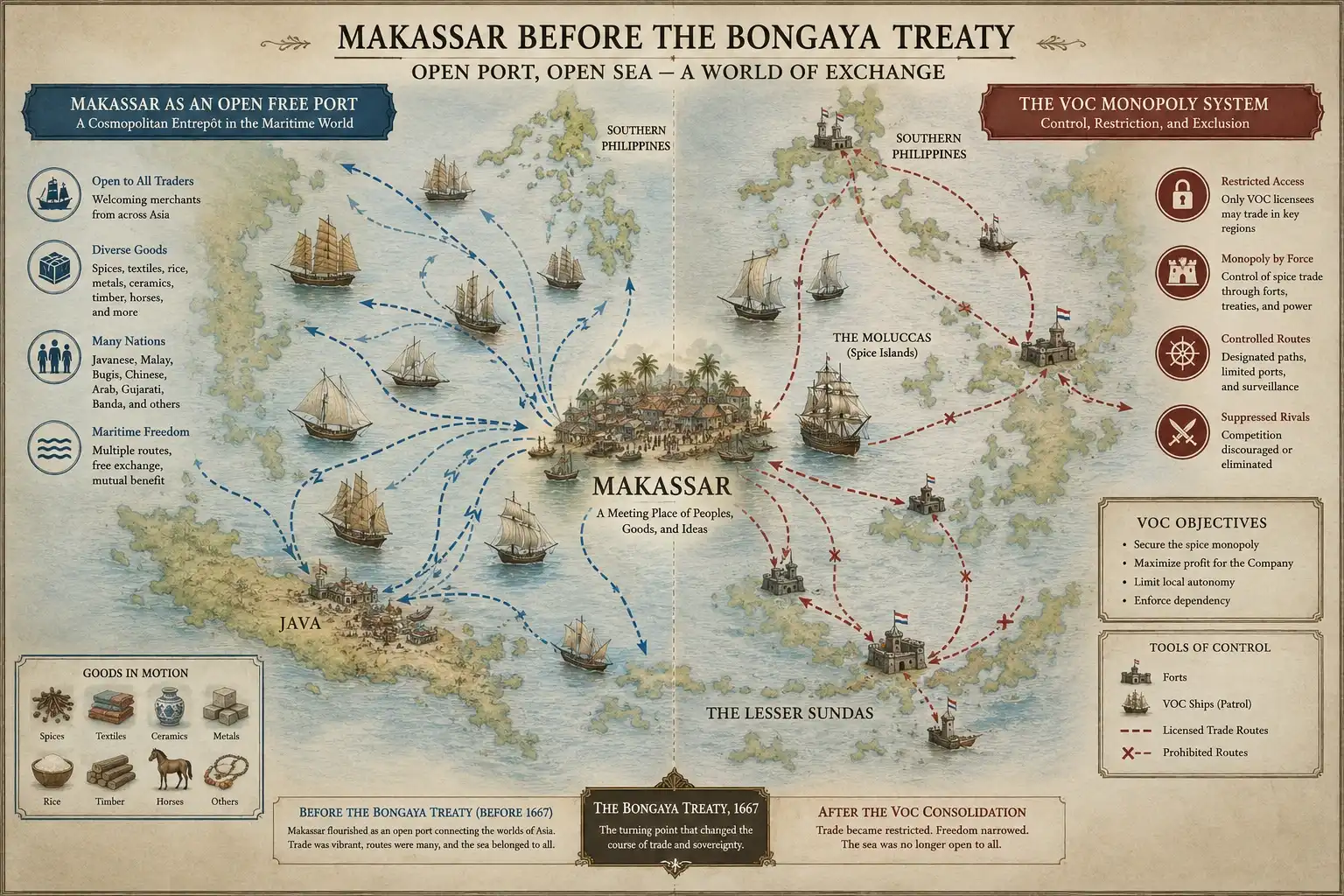
Makassar mattered because it stood for a different commercial principle from the VOC. The Dutch sought control, monopoly and restricted channels of exchange. Makassar represented openness, mobility and a plural trading world. Its fall was therefore not merely a local defeat, but a major restructuring of eastern Indonesian commerce and politics.
Makassar as a Free Port
Makassar occupied one of the most important positions in the seventeenth-century Indonesian world. It was not simply a kingdom among others. It was a great free port, a meeting place of routes, peoples and commodities. Professor Kumar treats it as one of the clearest examples of a Southeast Asian polity whose vitality lay in openness: openness to trade, to migration and to political opportunity.
This openness made Makassar formidable. Situated in South Celebes, the kingdom of Goa-Tallo stood at a strategic junction. From Makassar, traders could move west toward Java and Malacca, east toward the Moluccas, south toward the Lesser Sundas, and north toward the Philippines.
Goods from across the archipelago converged there. So too did people: Malays, Buginese, Chinese, Portuguese, Indians, Arabs, Javanese and others. Makassar became a commercial clearing-house of remarkable scale.
Technical Vitality: Free Port
A free port is a trading centre open to merchants of many origins and affiliations. In Professor Kumar’s treatment, Makassar’s openness made it both commercially successful and politically dangerous to the VOC’s monopoly strategy.
Why Makassar Threatened the VOC
It was precisely Makassar’s openness that made it intolerable to the Dutch. The VOC’s commercial ambitions depended on control. It wanted privileged routes, limited competition and, ideally, monopoly in the spice trade.
Makassar represented the opposite principle. It welcomed merchants excluded elsewhere. It offered an alternative to Dutch-controlled circuits. It allowed spices and other goods to circulate beyond the Company’s reach. So long as Makassar remained independent and commercially open, Dutch monopoly could never be secure.
Professor Kumar’s treatment of Makassar is especially valuable because she does not reduce the kingdom to a passive victim of Dutch expansion. Makassar was dynamic, assertive and ambitious in its own right.
Its rulers strengthened their state through warfare, trade and diplomacy. Islamisation gave the kingdom deeper links to the wider Muslim world, while its political leadership became increasingly involved in maritime commerce itself. The aristocracy did not merely tax trade; it participated in it. Makassar was therefore both a political centre and a commercial actor.
Conflict Becomes Inevitable
This made conflict with the VOC increasingly likely. There had already been tensions before the great war of the 1660s. The Dutch objected to Makassar’s refusal to accept monopoly conditions. Makassar, for its part, had no reason to subordinate its prosperity to Dutch commercial doctrine.
Treaties were made and broken. Neither side trusted the other. Dutch strategy increasingly turned toward force.
Yet force alone was not enough. Here Professor Kumar returns to one of the central truths of the archive as a whole: colonial advance worked through local political fractures.
Dutch success against Makassar depended crucially upon alliance with those who had their own reasons to oppose Makassarese dominance. Foremost among them was Arung Palakka, the Buginese leader whose struggle against Goa had already driven him into exile and into partnership with the Dutch.
In the Lecture Room
Professor Kumar’s account of the campaign is careful to show that the Dutch did not act alone. VOC power advanced through alliance, local conflict and regional political ambition. Arung Palakka was not merely an instrument of the Dutch; he pursued his own Buginese political goals.
Arung Palakka and the Dutch Alliance
The alliance with Arung Palakka changed the political balance. The campaign launched in 1666 under Cornelis Speelman was not simply a Dutch invasion. It was a combined assault in which VOC military organisation and local anti-Makassar forces operated together.
That fact matters. It reminds us that the destruction of Makassar’s independence was achieved not by Europeans acting alone, but by Europeans entering and exploiting an already divided political field.
Professor Kumar’s account is careful on this point. Arung Palakka was not merely a Dutch instrument. He pursued his own political goals: the weakening of Goa, the restoration of Buginese standing, and the consolidation of his own authority. His alliance with the VOC was strategic, contingent and historically transformative.
The Bongaya Treaty
The conflict culminated in the Bongaya Treaty of 1667. The treaty was a decisive blow to Makassar. Its provisions were designed not merely to end a war but to dismantle the kingdom’s capacity to function as a rival centre of power.
Makassar was required to recognise Dutch privilege, accept monopoly arrangements, destroy many of its fortifications, expel competing Europeans and submit to a sharply reduced political position.
Primary Text Fragment: Treaty as Conquest
The Bongaya Treaty shows how treaties could operate as instruments of colonial restructuring. A military victory was converted into political obedience, commercial monopoly and the weakening of a rival maritime state.
But the treaty did not immediately end resistance. Conflict continued. The Dutch tightened enforcement. Makassar’s defeat became not a single event but a process of reduction and subordination. Eventually the kingdom came under much closer Dutch control, and the old free port order was broken.
A Turning Point in the Archipelago
This was one of the great turning points in the history of the archipelago. With Makassar subdued, the Dutch no longer faced the same kind of open maritime rival in eastern Indonesia. A major alternative commercial system had been crippled. The fall of Makassar therefore strengthened VOC power far beyond South Celebes itself. It helped secure the wider architecture of monopoly.
Yet the consequences were not only Dutch. Professor Kumar stresses that Makassar’s fall triggered movement, dispersal and reconfiguration across the region.
Makassarese and Buginese peoples migrated widely. Warriors, traders, sailors and political exiles moved into other parts of island Southeast Asia. Their influence did not vanish with defeat. It travelled. South Sulawesi’s political energies were not extinguished; they were redistributed.
Open Trade Versus Monopoly
This is one reason Makassar matters so much historically. The city and kingdom stood for a different commercial principle from that embodied by the VOC. Dutch rule favoured restriction, surveillance and controlled channels of exchange. Makassar had stood for openness, multiplicity and competition.
The fall of the free port was therefore not simply a military event. It was the defeat of one commercial order by another.
Professor Kumar’s treatment of the Bongaya Treaty reveals how treaties themselves functioned in the colonial world. They were not neutral diplomatic settlements between equals. They were instruments through which military victory was translated into durable political and economic advantage.
A treaty could do the work of conquest more subtly than permanent siege, but no less effectively.
Why This Lecture Matters
Makassar occupies an important place in the archive because it links several strands of the course. It connects the history of indigenous sovereignty in South Celebes with the growth of Dutch power. It links Arung Palakka’s career with the larger structure of VOC expansion. It helps explain how a trading company could move from maritime strategy toward political overlordship.
It also shows, in especially vivid form, how colonial transformation often depended on the destruction or capture of nodal centres in existing regional systems.
Seen this way, Makassar was much more than a local capital. It was a hinge between worlds: between open trade and monopoly, between regional power and colonial intervention, between indigenous political contest and Company rule. Its fall helped reshape the balance of the Indonesian world.
That is why the Bongaya Treaty matters. It marks the moment at which the Dutch did not merely participate in the politics of South Celebes, but decisively reordered them.
“`Key Terms
Makassar
Major free port and political centre in South Celebes, strategically placed within eastern Indonesian trade.
Goa-Tallo / Gowa-Tallo
The Makassarese kingdom that dominated the region and became the central target of Dutch and Buginese opposition.
Bongaya Treaty
The 1667 treaty imposed after Dutch victory over Makassar, sharply reducing Makassar’s autonomy and commercial freedom.
Cornelis Speelman
VOC commander of the 1666 expedition against Makassar.
Arung Palakka
Buginese leader whose alliance with the Dutch helped defeat Goa and transform South Celebes politics.
VOC Monopoly
The Dutch East India Company’s effort to restrict competitors and control spice circulation through treaty, fortification and force.
Archival Note
This page is based on a breakout from Professor Kumar’s lecture notes on Dutch strategy in the seventeenth century. The Makassar material is closely connected to the wider VOC lecture, the Arung Palakka lecture, and the South Celebes material on Buginese political organisation.